

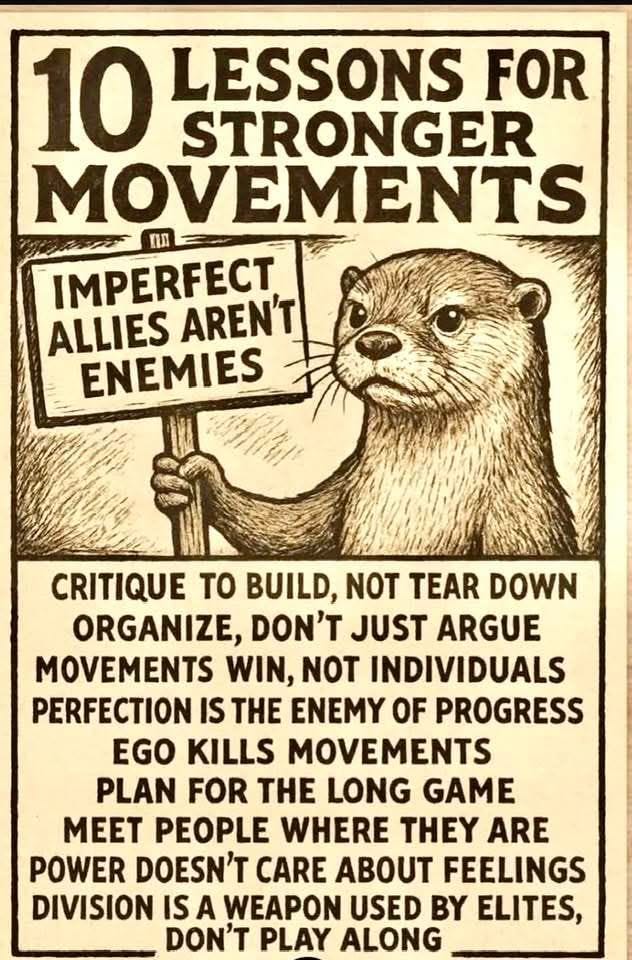
A poster is circulating in Your Party Facebook groups. You’ve probably seen it: clean design, an otter, ten lessons for stronger movements, the headline “IMPERFECT ALLIES AREN’T ENEMIES.” It’s making the rounds for an obvious reason. The CEC elections have been bruising. The factionalism that erupted in Liverpool hasn’t disappeared; it’s metabolised into something quieter and more corrosive, the kind that makes people dread the 9pm agenda item and count the ceiling tiles instead of arguing. Members want to reduce the heat. That’s understandable.
So let’s take the poster seriously. Most of what it says is right. But it leaves out the hardest lesson, the one the Comintern learned in blood: you cannot act on the principle that imperfect allies aren’t enemies unless you can actually tell the difference between an ally and an enemy. Without that, “imperfect allies aren’t enemies” becomes a prohibition on political clarity. It becomes a way of silencing the person who notices that some people in the room don’t share your long-term interests at all.
With that caveat lodged upfront, let’s work through the ten lessons properly.
1. Critique to Build, Not Tear Down
The principle is sound. Lenin’s insistence, against the Comintern’s later bureaucratic degeneration, was that disagreements be corrected through study and experience rather than treated as occasions for purging. Pat Jordan put it plainly in his notes on the Leninist party: the goal is “a healthy and positive form of clarifying political questions and differences.” What the Comintern became under Stalin, where critique was a pretext for expulsion and internal democracy was suppressed in the name of unity, stands as the permanent counter-example.
The application to Your Party is direct. Critique of the bureaucratic clique around the leadership is not factionalism; it is how a political party functions. Critique of the Imperiali quota used in the CEC elections was not an attack on party unity; it was democratic accountability. The lesson cuts both ways, though: critique deployed not to clarify but to humiliate, not to build but to mark territory, is something else. It is the critique of people who mistake noise for power.
2. Organize, Don’t Just Argue
Mandel’s formulation in “The Leninist Theory of Organisation” remains the clearest: theoretical understanding without organisational capacity echoes in the void. Your Party has produced an extraordinary number of arguments. It has produced fewer branches capable of running a paper sale, organising a tenants’ meeting, or getting a candidate through a ward. The balance needs correcting. The May 2026 council elections in England, Holyrood and the Senedd are the immediate test. Organising for those elections is not a distraction from the argument about what Your Party should be; it is the argument, conducted through practice.
3. Movements Win, Not Individuals
True, with a qualification the poster doesn’t make. The history of the Comintern is also a history of what happens when movements become dependent on a single leader’s charisma, prestige and moral authority. The young delegate at the Your Party Scotland conference was right to invoke Zack Polanski as an example of what a single effective communicator can achieve for the English Greens. But the Scottish Socialist Party also had a charismatic single leader, and when Tommy Sheridan’s personal crisis became the party’s crisis, it destroyed the organisation. The lesson from Pierre Frank’s history of the Communist International is that the conscious minority must organise into a solid collective party, not into a court around an individual. Mass movements need figures; they need institutions more.
4. Perfection Is the Enemy of Progress
The Comintern’s most important tactical innovation, the united front, rested on exactly this insight. Revolutionaries who insisted on working only with the ideologically pure isolated themselves from the actual working class, which was mostly in organisations led by reformists, social democrats and trade union bureaucrats. The sectarian left’s permanent condition is waiting for the working class to become worthy of its vanguard. Your Party is not a perfect vehicle. It has labourist habits baked in from the top, it has MPs who are not accountable to the membership, it has a leadership that expelled SWP members on the eve of the founding conference. None of this makes it the wrong terrain.
But here is where the poster’s caveat becomes unavoidable. Abandoning the demand for perfection is not the same as abandoning politics. The Comintern learned, at catastrophic cost in China in 1927, what happens when “flexibility” means liquidating independent class organisation into an alliance with forces that have opposed interests. Chiang Kai-shek was an imperfect ally. He was also an enemy. The two categories are not mutually exclusive.
5. Ego Kills Movements
The bureaucratisation of the Soviet Union and the Comintern did not come from abstract ego. It came from specific social processes: the exhaustion of the revolutionary generation, the material privileges of the apparatus, the substitution of administrative control for political leadership. The “ego” that kills movements is structural as much as personal. In Your Party’s terms, this means the problem is not individual bad actors but the institutional reproduction of labourist habits: MPs who treat the party as their vehicle, central structures that treat members as their audience, a leadership culture that mistakes internal factional manoeuvring for political work. Naming it as “ego” is accurate but insufficient.
6. Plan for the Long Game
After the defeat of the German revolution and the failure of the revolutionary wave, the Comintern under Zinoviev’s guidance shifted to preparing for the conquest of power through patient mass work rather than immediate offensive. The lesson holds. Your Party exists in a political conjuncture where Labour under Starmer has delivered the fastest political disillusionment in living memory, where Reform has successfully positioned itself as the opposition, and where the space for a left alternative is real but not automatically redeemable. Building for the May 2026 elections matters. Building the branches that will still exist in 2030 matters more.
7. Meet People Where They Are
Mandel’s discussion of transitional demands crystallises this. You start from where people actually are, their immediate grievances, the rent, the job, the hospital appointment they couldn’t get, and you find the connection between those immediate realities and the structural questions. Lenin’s example of starting with demands for a tea service is less absurd than it sounds when you understand what he meant: the specific, concrete demand that connects to the person standing in front of you, not the abstract programme that tells them what they should want.
For Your Party members exhausted by CEC election arguments, this also means something specific: the poster circulating in their Facebook groups meets them where they are. People do not want to be told their impulse toward unity is politically naive. They want to feel that the impulse is taken seriously, which is exactly what this article is trying to do.
8. Power Doesn’t Care About Feelings
The state apparatus in Germany in 1933 was in the hands of forces sympathetic to fascism. The workers’ movement was divided. The united front strategy failed, partly because it was applied too late, and partly because the Communist Party, following Comintern instructions, characterised the Social Democrats as “social fascists” until almost the moment the Nazi regime made the distinction academic. “Power doesn’t care about feelings” is true of the bourgeois state. It is also true of factional leadership cliques inside left parties. Emotional sincerity is not a substitute for organisational analysis.
9. Division Is a Weapon Used by Elites: Don’t Play Along
The rationale for the united front was always this: the ruling class benefits from division within the workers’ movement, therefore unity in action against the common enemy is a strategic imperative, not a sentimental preference. This holds for Your Party’s internal politics. The factional heat generated by the Liverpool conference and the CEC elections is not primarily serving the interests of Your Party members. It is serving the interests of those who would prefer a manageable, electoralist organisation over a living political party capable of threatening them.
It also points toward the external allies Your Party needs and mostly hasn’t yet built: Plaid Cymru, the Scottish Greens, the Green Party of England and Wales. These are not the same as Your Party. They have different traditions, different social bases, different long-term trajectories. But on the immediate terrain of contesting Labour’s betrayals, confronting Reform’s advance, and keeping alive the possibility of a left alternative, they are imperfect allies; not enemies.
10. Imperfect Allies Aren’t Enemies
The united front tactic directly embodies this. You engage with forces who are not fully aligned, you unite around specific common action, you maintain your own political independence and the right to public critique. This is how the revolutionary left has always related to reformist organisations: not by pretending the political differences don’t exist, but by insisting they don’t preclude joint action.
The lesson is necessary. It is not sufficient. The Second Chinese Revolution and the Popular Front experience both illustrate what happens when “imperfect allies aren’t enemies” becomes a prohibition on saying out loud that the allies in question have opposed class interests. The Kuomintang was an imperfect ally. The French Radical Party in the Popular Front was an imperfect ally. Neither was an enemy in the simplistic sense. Both were organisations whose long-term interests were irreconcilable with those of the working class.
Not all allies in Your Party’s orbit have the same long-term interest in a genuinely socialist, democratic, mass party capable of challenging capitalism. Some want a pressure group. Some want a vehicle for particular careers. Some have already shown, in Liverpool and in the CEC elections, that when the choice is between democratic accountability and institutional control, they choose control. The lesson that imperfect allies aren’t enemies is important. So is the lesson that comes after it: learn to distinguish between imperfect allies and opponents who happen to be standing in the same room.
The poster is right. It just needs a page two.
This May 2025 article was updated in February 2026, to better connect to discussions in Your Party using this image.
Red Mole is a publication of revolutionary intelligence for activists. Subscribe for three pieces a week connecting the Fourth International’s analytical tradition to the strategic challenges facing movements today.