

Data centre expansion right now is wasteful even on capitalist terms, not just by ecosocialist ones: the UK and Wales already have more computing capacity than any credible forecast says is needed, and specific proposals (Brick Lane, Livingston-Dunfermline, most of the Welsh AIGZ sites) serve financial speculation or political boosterism rather than any social need.The programme: public ownership of hyperscale compute, community and worker control over siting, a public register of water and energy draw, no new fossil generation built to serve data centres, worker veto and shorter hours over AI-driven job losses, and above all a moratorium on new construction until social need is demonstrated, burden of proof on the developer, not the objector. That last demand is deliberately not the same as the SWP’s ‘shut down AI data centres’: it is fully as confrontational for nearly every data centre actually being proposed, but it doesn’t call for closing the ones that clear the bar, like ECMWF’s AI weather model, which is roughly 1,000 times more energy-efficient than the supercomputing it supplements.The argument is grounded in the socialist movement’s own history (Kidron’s 1950s casebook on automation, never anti-technology, always about who controls it) and in live cases: Cymru’n Codi’s Welsh campaign, the Pontyclun planning fight, and Daniel Tanuro’s 2026 ecosocialist theses, which concede that ownership alone doesn’t resolve AI’s ecological footprint.A parallel warning: opposition to this industry is not politically uniform. The Pro-Human AI Declaration unites Steve Bannon with a teachers’ union under a slogan vague enough for both; ‘shut it down’ risks the same thing from the other direction. What a movement is for has to be argued, not assumed from what it’s against.Monday’s final plenary at the summer school of ACR (Anti-Capitalist Resistance, the England and Wales organisation of the Fourth International) in Darsham closed on data centres, and I said there what needs saying here. Nobody at the tech conference I was at a few months ago, not the institutional investors, not the forecasters, can explain the data centre boom. It is, to use the phrase I reached for on the day, ‘this bizarre tulip economy about building data centres.’ The reference is to tulip mania, the Dutch bulb-trading bubble of the 1630s, when a single rare tulip bulb could trade for more than a skilled craftsman earned in a decade before the market collapsed within weeks. Run the industry’s own ten and twenty year forecasts out to their most extreme demand scenario and the world already has as much computing capacity as it needs.
Pete had asked the obvious question a few minutes earlier: some comrades at another summer school this year took the view that the right response to a data centre is to burn it down, so what did the panel think of that. My answer wasn’t a defence of the hardware. It was that the waste is real and the argument still has to end up somewhere programmatic, because a demand that stops at ‘no data centres’ can’t be built on easily, and a demand built on ‘why do we need this one’ can.
Another comrade added something sharper than either slogan on the table: the government does not know what the country’s biggest data centres are being used for. A freedom of information request to the Department for Science, Innovation and Technology, asking who was using the largest sites and for what, got the answer that the department did not hold the information, reported shortly before the department itself was dissolved. Their point mattered because ‘data centres’ has already become political shorthand specifically for the current generative-AI hyperscale buildout, and the sharper question moves past who should own this to whether it is needed at all, a question of evidence that an ownership slogan alone lets the state duck.
Which is where the NPA-Anticapitalistes gets it right: a moratorium until social need is demonstrated. The target is the burden of proof, currently resting on the community objecting, reversed onto the developer proposing. A data centre training weather models or coordinating a public health system would clear that bar without difficulty. Most of what is actually being built would have to earn its permission instead of receiving one by default, which is the whole difference. NPA-Anticapitalistes’ own branch in Isère has already put a version of this into practice, co-signing a petition for a moratorium on a 200MW AI supercalculator under construction in Eybens, alongside Extinction Rebellion, Greenpeace and half a dozen other Grenoble-area groups. ‘NO NEW DATA CENTRES UNTIL THE NEED IS PROVEN’ will never fit easily on a sticker. ‘Moratorium now’ does, and it is already the position of comrades in Isère, even if only for one project so far.
The clearest illustration I gave on Monday wasn’t Wales, it was Brick Lane. A data centre proposed for one of the hottest, most water-stressed sites in London, which I called on the day ‘the most insane place in the world to put a data centre,’ makes no sense as a computing decision and total sense as a financial one: it sits close enough to the City, London’s financial district, that ‘milliseconds are worth millions’ to the high-frequency trading firms it serves. Livingston and Dunfermline are the same story without even that excuse. Scotland already has more computing capacity than it needs, and the data centre being built between the two towns is, in my own phrase from the plenary, ‘a plank of public sector love for business’ rather than a response to any social requirement at all.
Four days later, Cymru’n Codi (Welsh for roughly ‘Wales rising’), a Welsh political organising group, published a comment on their Substack that could have been drafted from the same argument without ever having heard it: megawatts, acreages, the difference between a moratorium and a review, closing with a list of conditions no data centre developer in Cymru is currently required to meet.
Wales now has Artificial Intelligence Growth Zones, AIGZs, UK Government-designated areas where planning and grid connection are fast-tracked for AI infrastructure investment, across the north and south of the country, and since May a Plaid Cymru-led government has backed them as hard as Westminster does. Adam Price MS, Cabinet Minister for Enterprise, Connectivity and Energy since 13 May, told the CBI in his first public remarks in the job that Wales wants to be one of the easiest places in Britain to invest, planning and grid connection cleared by government rather than contested by communities. A party that spent a generation arguing devolution meant Wales deciding its own future is now the government clearing the path for capital to decide what gets built on it.
Cymru’n Codi’s own figures put a number on the same waste I described from Brick Lane and Scotland, and the topline ones check out. Wales had 154MW of data centre capacity in 2024, the highest outside London, against London’s 1,048MW, both figures from DSIT, the UK Government’s Department for Science, Innovation and Technology, confirmed in the Senedd’s own research briefing of 31 July. The Senedd, Wales’s parliament, calculates the UK Government’s own projection for the South Wales AIGZ alone, over 1GW by the early 2030s, at thirteen per cent of Wales’s entire 2024 electricity capacity, none of it answering a computing need that the industry’s own forecasters, on Monday’s evidence, don’t believe exists either.
The site-by-site figures turn out sturdier than an earlier pass through this piece gave them credit for, once traced to the Senedd’s own PDF rather than the news summary of it. Cardiff’s two developments are the planned Cardiff East campus at around 150MW, and Vantage’s Newport CWL1, oddly counted under ‘Cardiff’ in one of the briefing’s own summary lines despite operating from Newport, at 148MW. Newport separately gets a planned Microsoft site at around 200MW. Bridgend’s figure was never a stated megawattage at all: Vantage’s planned CWL4 campus there is described only as ‘approximately four times the capacity and size’ of its Newport campus, which is where the widely repeated ‘around 600MW’ comes from, a multiplication, not a measurement. Anglesey’s 349MW appears in the same Senedd document without clarifying whether it refers to the data centre’s IT load or the battery storage system on the same site, which the planning documents for Prosperity Parc specify as BESS capacity rather than compute.
‘Land and expand’ is a phrase used by Democracy for Sale, a British investigative newsletter, to describe how the tech firm Palantir won a £1 NHS contract in 2020 and turned it into a seven-year, £330 million one: get an initial foothold through, then make the next phase nearly impossible to refuse. Cymru’n Codi borrowed the same phrase for the fight in front of them. The applicant behind the proposed data centre at Mwyndy Cross, near Pontyclun, is Maska Group, a developer and asset manager with London and Manchester offices which trade press confirms has not previously built a data centre. Local reporting also names Talbot Green Developments in connection with the site, a company based in Aylesbury and ultimately owned in New Zealand, which is why one objection to the scheme wasn’t really about data centres at all: the profits, whatever they turn out to be, were never going to stay in Wales. That is not a detail. That is the entire economics of speculative infrastructure, stated plainly.
Red Mole’s own casebook on automation, drawn from seventy years of the press of the Fourth International, the international Trotskyist movement founded in 1938, and collected this year as Red Mole Guide 16, supplies the argument’s other half. Four times since 1954, the movement forecast what a new machine would do to work, from Lyn Marcus on the servomechanism to Winfried Wolf on the West German robots that could feel warm from cold, and every forecast was serious, well-researched, and wrong about the outcome in one direction or the other. What decided the outcome was never in the forecast. It was whether the workers affected were organised to take the machine’s saved time as time.
Wolf’s 1984 report from Volkswagen is the clearest case. West German metalworkers, organised in IG Metall, the engineering and metalworking union, struck for seven weeks that year against robots that could replace between four and ten workers each. Under capitalism, he wrote, the gain from that machine arrives “as massive unemployment instead of a shorter workweek for all.” IG Metall’s strike didn’t stop the robots. It won a phased reduction in the working week instead, the one outcome across four forecasts that the Fourth International’s own record shows organisation actually secured.
The fourth forecast is being made now, and the casebook closes with the ecosocialist theses on AI of Daniel Tanuro, a Belgian agronomist and long-standing writer for the Fourth International’s press, published in International Viewpoint, the Fourth International’s English-language magazine, this February. Thesis 27 lands where every other document in the casebook lands: trade union veto over the introduction of AI at work, workers’ control over the workload, “reduction of working hours without loss of salary” against layoffs. That is the demand this piece has been building toward, and it belongs alongside the workers’ and community inquiry I argued for on Monday: not a survey after the planning decision, but a standing right to ask what a given piece of land is actually needed for before anyone builds on it, garden, housing, industry, whatever it turns out to be.
The obvious response is that public ownership settles the rest of it: expropriate the hyperscalers and the ecological question becomes a planning question, decided democratically instead of by a share price. But that isn’t quite right either. Thesis 32 refuses exactly that comfort. “Replacing capitalist property with collective ownership,” Tanuro writes, “in and of itself, would not be enough” to bring AI’s material footprint within what the planet can sustain. Public ownership answers who profits from the data centre. It does not answer how much throughput a plan is entitled to authorise once profit stops being the constraint, and Red Mole has not settled that question either.
The same evasion happens in the opposite direction too, and reading Eko’s own campaign page rather than the coverage of it makes the gap sharper, not softer. ‘Billionaires like Elon Musk and Sam Altman are racing to see who can conquer AI first,’ the pitch runs, promising to stop AI being used ‘just to make the rich even more filthy rich.’ Eko’s own tagline is ‘people and planet over profit.’ The demands that follow ask for safety standards, liability for AI companies, a ban on training AI on children, and a verifiable off-switch: matters of regulation and liability. Who owns the compute and who captures the profit, the target of three paragraphs of billionaire-baiting in the pitch itself, stays outside the list of six.
A sentence loose enough for Steve Bannon, Donald Trump’s former chief strategist and a signatory, to sign alongside a teachers’ union cannot by construction contain a class analysis, because naming one would cost half the signatories. One comrade at the same Monday plenary, unnamed in the transcript, warned that the venture capitalists Peter Thiel and Marc Andreessen, and Curtis Yarvin, the blogger who argues democracy should be replaced by a form of corporate rule under a national CEO, are using AI to advance an anti-democratic political project that treats democracy itself as the obstacle. The Pro-Human AI Declaration is close to the mirror image: opposition to AI mobilised behind an answer decided before a single worker signed it, the anger real, the demand regulatory. It stood at 679,663 signatures when this was drafted, seventy thousand short of the round number the campaign is chasing, a serious figure for a petition and a modest one for a movement. Even inside the AI-safety milieu this isn’t landing as serious either. PauseAI, a campaign group pushing for a halt to frontier AI development, said the declaration ‘goes the way of crypto regulation, slow, reactive, captured by incumbents,’ a pattern no petition reverses.
Being against billionaires settles nothing on its own. The German socialist August Bebel called antisemitism ‘the socialism of fools’ for exactly this reason: a hatred of finance and ‘rapacious’ wealth that never touches capital as a social relation, only personalises it into a villain. Hitler’s National Socialism built an entire economic doctrine on the same move, splitting capital into schaffendes (productive, coded German) and raffendes (rapacious, coded Jewish) forms, and left German capital’s actual power completely intact while doing it. What replaces the billionaire, the market’s own discipline, the nation, or the working class, was always the only question that mattered, and it is the one question the declaration never asks.
Cymru’n Codi’s own conditions for the Senedd do something a national slogan can’t: they price the externality before construction starts rather than after, developer-funded rather than bill-funded, audited annually rather than taken on trust. The one thing missing from the list as published is enforcement with teeth: statutory inspection instead of self-certification, and a community’s right to walk the site with the inspector instead of reading the report afterwards. That, to be fair to Cymru’n Codi, is exactly the demand they end on.
None of this, Welsh, Scottish or English, touches the harder problem thesis 32 leaves standing. A planned economy still has to decide how much compute the world actually needs, not only who owns the servers that supply it, and nobody in this argument, Tanuro included, has said how a democratic plan sets that number rather than backing into it from whatever capacity already happens to exist. I said at Darsham that the AI question is at one level a totalising, existential one, closer to shouting at clouds than to leafleting outside a Tube station, and that the task is finding the agitational form underneath it. The workers’ and community inquiry is that form for the land, and a moratorium until need is proven is that form for the industry as a whole. Nobody at the plenary, least of all me, had an answer for the form it takes for the compute itself.
Postscript: Shut the data centres?
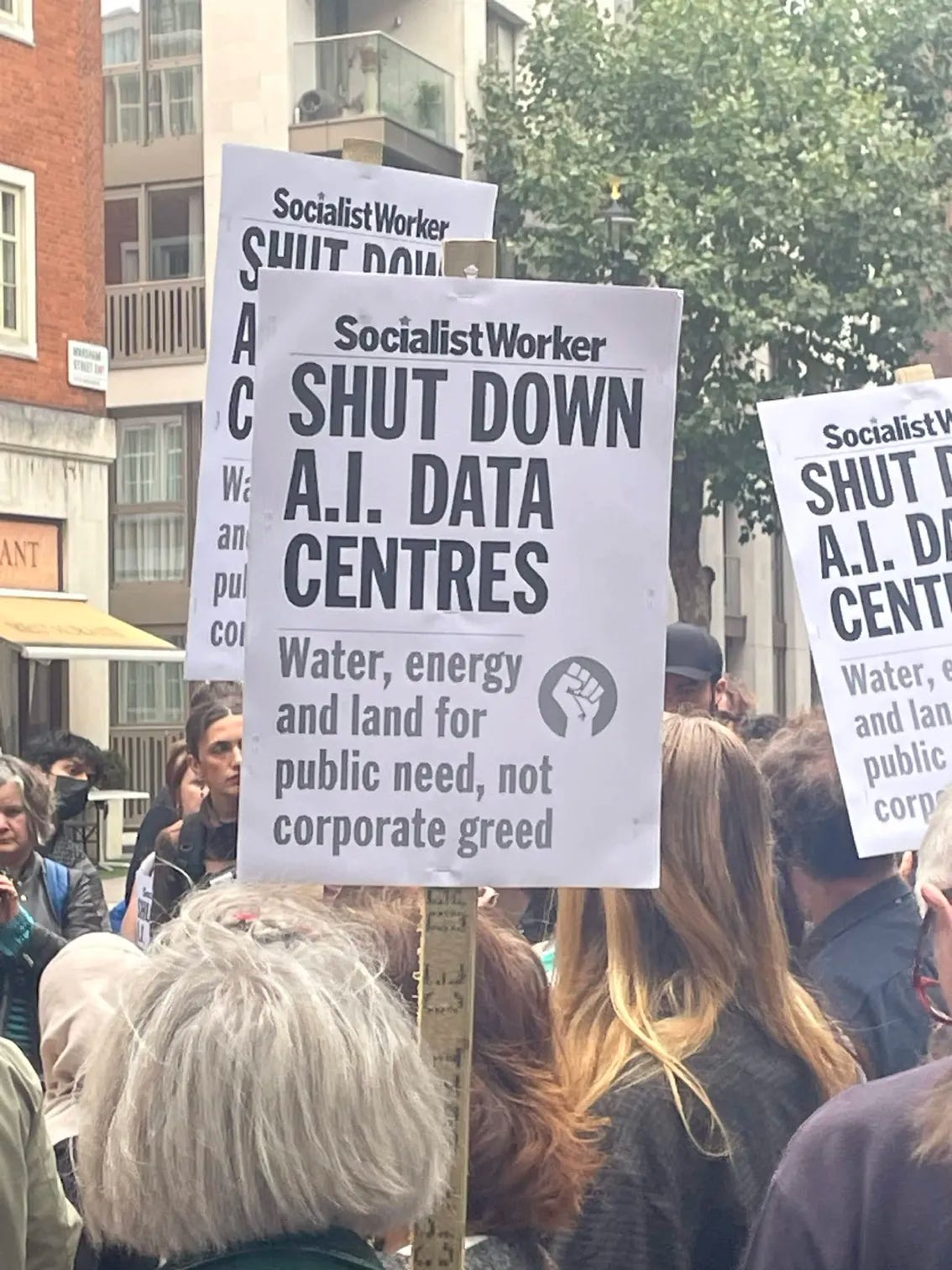
Necessary context first. The Socialist Worker placard in question carries two demands, not one, in two different registers. The headline is sweeping: ‘Shut down AI data centres,’ no qualification, no exceptions. Underneath it sits something closer to a hope than a demand: ‘Water, energy and land for public need, not corporate greed,’ which names an outcome without specifying who delivers it, through what mechanism, or against what resistance.
The letter below was sent in response to the headline, on the view that the subline doesn’t answer the question the headline raises. ‘Your slogan,’ it argued, ‘mistakes the machine for the master.’ The problem is ownership and control, not computation itself, and the socialist answer is democratic control of AI, public ownership of its infrastructure, shorter hours without loss of pay and protection against redundancy, not a call to shut down technology that could, under workers’ control, be socially useful.
Dear Socialist Worker,
Your slogan, “Shut down A.I. data centres”, mistakes the machine for the master.
The issue is not that computers can process information, or that automation can reduce necessary work. The issue is who owns these systems, who controls the data, and who gains while workers and communities carry the costs in jobs, energy, water and land.
A socialist response should demand democratic control of AI, public ownership of its infrastructure, shorter working hours without loss of pay, and protection against redundancies—not a blanket call to shut down a technology that could, under workers’ control, be socially useful.
We should fight corporate AI, not retreat from technical progress.
Duncan
The strongest case for the SWP’s approach doesn’t need borrowing from anyone in this argument to make. Four points, at minimum, deserve to be taken on their own terms rather than answered before they’re stated.
Urgency outruns precision. The industry is building faster than any movement can develop a fully worked-out ownership programme, and a demand that waits for the theory to catch up arrives after the concrete is poured. ‘Shut it down’ is legible and actionable this week; a moratorium pending proof of social need requires an adjudicating body that doesn’t yet exist and a definition of proof that doesn’t yet exist either.
A blunt demand recruits where a qualified one doesn’t. Most people encountering data centre politics for the first time will not be won by a sentence with a subordinate clause in it. ‘Shut it down’ asks nothing of the newly angry beyond agreement, and that is precisely what a slogan, as opposed to a programme, exists to do.
It concedes nothing to capital’s framing. A moratorium implicitly grants that some future data centre, once need is proven, would be legitimate, which hands the industry exactly the opening its public relations departments are built to exploit: prove the need, and the objection disappears. ‘Shut it down’ makes no such concession, and there is a real argument that none should be made to an industry this dishonest about its own resource use.
The ecological crisis changes our programme. Nothing in the automation debates of the 1950s had to reckon with a planetary limit; the argument over who owns the machine was the whole argument. An industry burning water in drought-stressed regions to train models nobody asked for is not obviously the same problem as a car plant automating its assembly line, and a slogan that treats it with more alarm than an older generation’s automation debates did may simply be right to.
Whether these four points settle the question is separate from whether they deserve to be raised, and the ecological point in particular runs into a specific cost the slogan doesn’t name. The European Centre for Medium-Range Weather Forecasting currently takes six hours on a supercomputer to produce the world’s most accurate forecast. Google DeepMind’s AI model, GraphCast, trained over four weeks on 32 machines, now produces a comparable ten-day forecast in under a minute on a single desktop, a figure ECMWF’s own machine-learning lead, Matthew Chantry, has described as roughly a ‘thousand-fold saving’ in energy, in Financial Times reporting picked up by the German press. That is close to the strongest possible case for keeping some AI data centres running: less resource use than the method it supplements, for a public good with no capitalist mechanism attached at all. Traditional numerical forecasting still outperforms it on the rarest, most extreme events, so it supplements the supercomputer runs rather than replacing them, but ‘shut down AI data centres’ draws no line between the two. Radiology diagnosis support makes the same shape of argument without the same weight of published numbers behind it yet, which is an honest gap, not a settled one. Simply shutting the technology down would not even be true to the Luddites, who were skilled trade unionists breaking the particular machines used to break them, not machinery as such.
The opposition to this industry is not one thing either, and this piece has already made that argument about a different slogan. The Pro-Human AI Declaration united Steve Bannon with a teachers’ union under a sentence vague enough for both to sign. The same test applies here in reverse: a slogan that names no exceptions can be carried by a NIMBY objection to a specific planning application exactly as easily as by an ecosocialist one, and ‘shut it down’ does not by itself distinguish a resident worried about house prices from a comrade worried about the grid. The distinguishing test matters here, the one that separates those two, and a moratorium tied to proven need supplies it in a way a bare shutdown doesn’t.
None of that is answered by pointing out that the small print exists. What actually needs saying runs the other way from how slogans are usually defended: they deserve more time spent on them, not less, because compression is a form of selection, and what gets selected is a political choice with consequences a five-thousand-word article doesn’t have to carry. A slogan that only says what it is against costs nothing to agree with and commits to nothing once the shutdown, if it ever happened, is won. What a movement is for has always mattered more than what it is against, and a first slogan is exactly where that gets decided, not the last place it gets addressed.