

Note: As part of our five-party response to the AWL’s open letter to Ernest Mandel, we have published two background notes to outline some of Ernest Mandel’s views on the topics addressed by the AWL: Ernest Mandel's Evolving Perspectives on 20th Century Socialism and Capitalism and Ernest Mandel: Some of his Contributions to Marxist Theory and Revolutionary Practice. The whole series of articles is available here.
Introduction
Ernest Mandel (1923-1995) remains a pivotal figure in 20th-century Marxist thought, recognized for his extensive scholarly output, profound economic critiques, and steadfast dedication to global revolutionary movements. As a distinguished Belgian economist and a leading theoretician of the Fourth International, Mandel consistently applied and innovated classical Marxist frameworks to dissect the intricate dynamics of global capitalism and the formidable challenges inherent in socialist construction. His intellectual approach was characterized by a rigorous, non-dogmatic stance, a sharp critique of bureaucratic distortions within post-capitalist societies, and an unwavering advocacy for authentic workers' democracy. This report meticulously examines four critical facets of Mandel's intellectual and political contributions: his pivotal personal exchanges, his in-depth country-specific analyses of revolutionary endeavors, the refinements and self-critical assessments within his later theoretical work, and his perspectives on fundamental institutional and organizational questions pertinent to socialist transformation.
I. Personal Exchanges and Their Political Significance
Ernest Mandel's intellectual and political trajectory was not merely an academic pursuit; it was profoundly shaped by his direct interactions and leadership roles within the international revolutionary movement. These engagements frequently served as crucial arenas for the development of his theoretical positions and the formulation of practical strategies.
I.1. Interactions with Che Guevara and Shared Economic Views
Ernest Mandel's intellectual influence extended directly into the heart of revolutionary governments, exemplified by his invitation to Cuba in the spring of 1964 by Che Guevara, then Minister of Industry. Guevara held Mandel's Marxist Economic Theory in high regard, leading to an extensive seven-week visit during which Mandel engaged in numerous discussions with Che and other Cuban leaders.
Their exchanges revealed a significant alignment on fundamental economic principles. Both Mandel and Guevara maintained that products exchanged between nationalized enterprises were not commodities, and therefore, the law of value should not govern production within the state or public sector. They advocated for the financing of enterprises primarily through the State budget, aligning with a centralized planning model, and explicitly opposed self-financing systems. A core tenet of their shared economic outlook was the conviction that industrialization in underdeveloped nations necessitated a deliberate "violation of the law of value." This approach prioritized long-term economic and social development over immediate profitability, as they believed that reliance on market mechanisms would inevitably perpetuate underdevelopment. Mandel also cautioned against the perils of excessive autonomy for enterprises in underdeveloped contexts, arguing that such autonomy could lead to local or sectoral interests superseding national development objectives, thereby impeding overall industrialization.
During these substantive discussions, Mandel actively sought to impress upon Guevara the critical importance of establishing a robust socialist democracy. He emphasized that genuine workers' management at the enterprise level and comprehensive workers' democracy at the state level, including the formation of a national congress of workers' committees, were indispensable safeguards against bureaucratic deformation. This direct engagement with Che Guevara in Cuba represents a compelling instance where abstract Marxist economic theory was brought into immediate dialogue with the practical challenges of constructing socialism in a post-revolutionary, underdeveloped nation. The shared understanding between Mandel and Che regarding central planning and the conscious "violation of the law of value" underscored a mutual conviction that revolutionary economic transformation required a deliberate departure from capitalist logic. This interaction highlights Mandel's role as a militant scholar, demonstrating that his Marxism was not merely an academic exercise but a dynamic framework designed to inform and guide real-world revolutionary processes. It underscored the practical application and intellectual influence of his work within the global revolutionary movement.
Mandel maintained close ties with Cuba after his visits and penned a poignant tribute to Che Guevara following his assassination in October 1967, mourning him as a "dear comrade".
I.2. Role in the Fourth International's Internal Debates and Reunification Efforts
Ernest Mandel's revolutionary convictions were deeply ingrained, stemming from a family background steeped in anti-Stalinist radicalism, and his own active role in building Trotskyism concurrently with the Resistance during World War II. His involvement in the internal dynamics of the Fourth International (FI) was both central and at times contentious.
Mandel played a significant, albeit controversial, role in the 1953 split within the FI. He aligned with Michel Pablo, supporting the "entryism" tactic—where Trotskyists would join larger, established mass workers' parties—and the theoretical concept of "centuries of deformed workers' states". This stance drew considerable criticism from orthodox Trotskyists, notably James P. Cannon, who viewed these positions as fundamental revisions of Trotskyist principles. Critics also pointed to Mandel's defense of Pablo's bureaucratic methods and his belief that the Stalinist bureaucracy could undergo a process of "self-reform" under mass pressure, potentially leading to a "real liquidation of the Stalinist regime" through internal bureaucratic struggles rather than a mass political revolution.
Despite these profound ideological and organizational divisions, a partial reunification of the Fourth International was achieved in 1963, notably after a "friendly meeting" between Mandel and James P. Cannon. This reunification saw Mandel co-authoring a programmatic statement that established common ground on the dynamics of world revolution. A significant theoretical contribution by Mandel at the 1963 reunification congress was his thesis on the "three sectors of the world revolution": the proletarian revolution in advanced capitalist countries, the colonial revolution, and the political revolution in the bureaucratized "workers' states" of the East. This framework represented a crucial theoretical advancement and a departure from Pablo's more exclusive focus on "Third Worldism". Following Pablo's departure from the now-renamed United Secretariat of the Fourth International (USec/USFI) in 1965, Mandel became the organization's principal spokesman.
In 1977, Mandel vehemently denounced Gerry Healy's "frame-up campaign" against the Fourth International, accusing Healy of reducing the complexities of class struggle to mere "police infiltration and operations of agents". Mandel passionately defended the FI's integrity and its deep connections within the international working class, asserting that such slanders would ultimately "boomerang against himself". Mandel's complex involvement in the internal struggles of the Fourth International, particularly the 1953 split and the 1963 reunification, demonstrates his strategic flexibility and persistent commitment to international revolutionary organization amidst profound ideological differences. His initial support for Pablo's controversial theories and his later participation in the reunification with Cannon's faction, along with his presentation of the "three sectors" thesis, illustrate an evolution in his strategic thinking, perhaps reflecting a recognition of the limitations of earlier positions or the imperative of broader unity. His willingness to engage with former adversaries and his subsequent role as a leading spokesman for the reunified FI underscore a pragmatic commitment to consolidating the international movement. His forceful condemnation of Healy's sectarianism further highlights his dedication to protecting the organizational integrity and public standing of the Fourth International, viewing such attacks as detrimental to the broader class struggle. For Mandel, theoretical clarity and organizational unity were inextricably linked to effective revolutionary practice.
I.3. Engagement with Student Movements and Activists
Beginning in 1968, Ernest Mandel gained widespread public recognition as a prominent Marxist politician. He embarked on extensive speaking tours across student campuses in Europe and America, delivering lectures on a range of topics including socialism, imperialism, and revolution.
He actively engaged with influential student leaders of the era, such as Rudi Dutschke and Alain Krivine, during the summers and winters of 1967. Their discussions centered on critical strategic questions and the vital task of establishing a vanguard organization within the Students for a Democratic Society (SDS). Mandel held "highest expectations" for the burgeoning movements in Germany and played a central role as a key speaker at the Vietnam congress held in Berlin in February 1968. At this event, he advocated for decisive actions by a revolutionary vanguard comprising young individuals, estimated at 15,000 to 20,000 students and young workers.
Mandel's analytical approach to student movements extended beyond viewing them as isolated revolts against immediate academic conditions. He interpreted them as manifestations of deeper societal contradictions, particularly in underdeveloped countries where various forces impelled youth to rise up. Mandel's direct and sustained engagement with student movements, especially during the politically charged late 1960s, underscores his strategic understanding of the pivotal role of youth in revolutionary processes. His discussions on "vanguard organization" and "effective actions" demonstrated his commitment to translating theoretical insights into practical organizational forms for a new generation of activists. By interpreting student revolts as symptoms of broader "social contradictions," Mandel provided a Marxist framework for comprehending these movements, aiming to integrate them into a larger revolutionary strategy. This active participation highlights Mandel's belief in the necessity of a conscious, organized "subjective factor"—a revolutionary party or cadre—to guide spontaneous mass discontent towards socialist transformation, thereby preventing its dissipation or co-optation.
II. Detailed Analysis of Specific Countries and Revolutionary Movements
Ernest Mandel consistently applied his theoretical framework to concrete historical developments, offering nuanced and often critical analyses of various "socialist" experiments and liberation movements across the globe. His analytical focus consistently centered on discerning the underlying class dynamics and the extent to which these societies genuinely progressed towards, or deviated from, a classless, democratic socialist future.
II.1. Yugoslavia: Critique of Self-Management, Market Mechanisms, and Bureaucratic Control
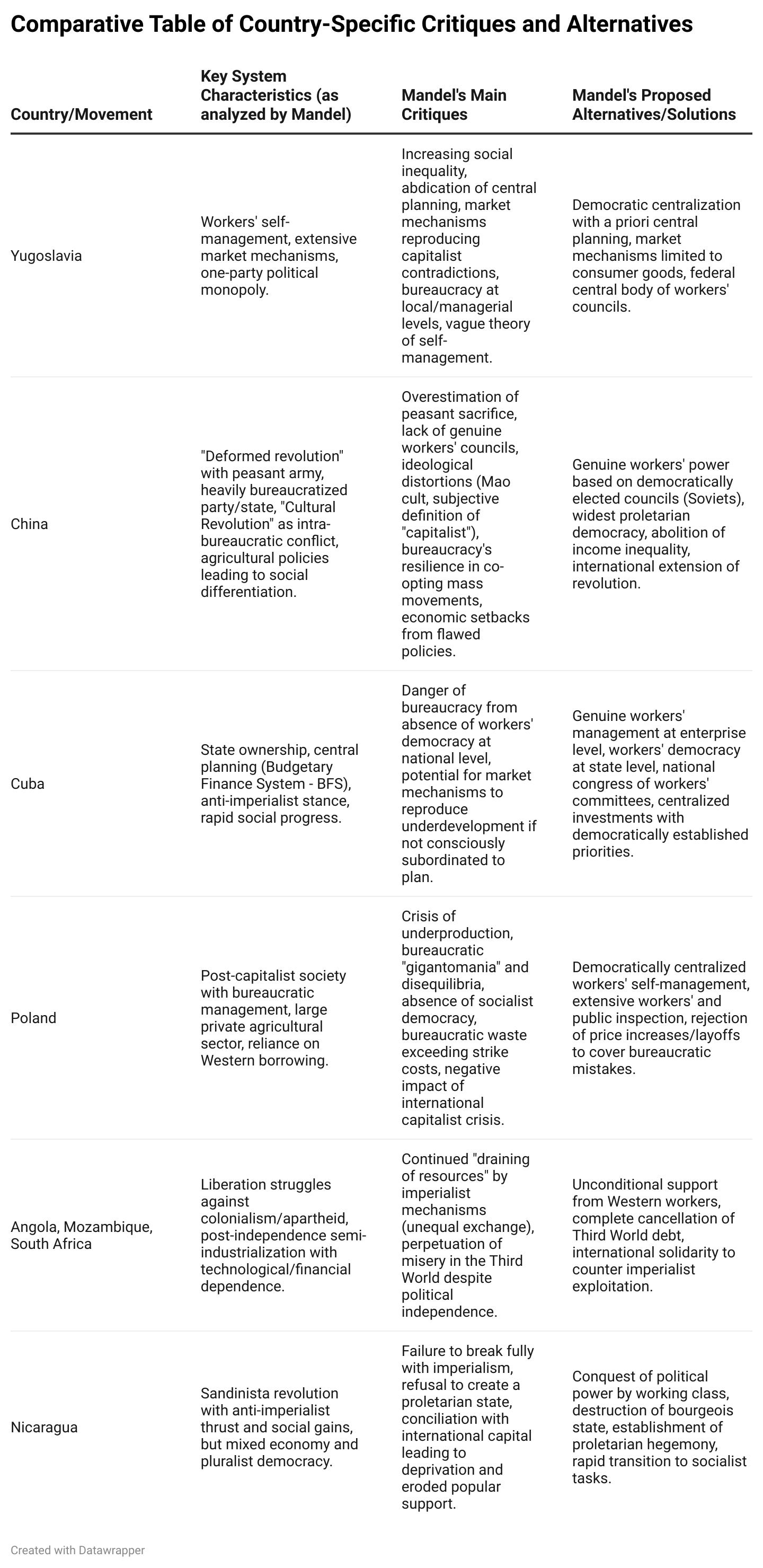
Ernest Mandel characterized the Yugoslav Workers' Self-Management (YWSM) as a "unique combination" of workers' self-management, extensive market mechanisms, and the Communist League of Yugoslavia's tight political monopoly of power. While acknowledging positive aspects such as "greater workers' initiative" and a "larger span of ideological freedom," he heavily emphasized the negative consequences, including "increasing social inequality" and an "increasing abdication of central planning".
Mandel criticized the "vague theory of self-management" in Yugoslavia, asserting that the model shared fundamental weaknesses with Stalinist systems, particularly concerning the inherent contradictions introduced by market mechanisms. He specifically critiqued Branko Horvat's theoretical justifications for the Yugoslav model, arguing that Horvat's approach was more aligned with the Cambridge school of welfare economics than with Marxism. Mandel found Horvat's definition of bureaucracy "ludicrous," equating it merely with "habits of those accustomed to lead from behind an office desk". From a traditional Marxist perspective, Mandel posited a fundamental incompatibility between socialism—defined as a classless society with high social equality and economic efficiency—and commodity production. He argued that commodity production inevitably generates social inequality and reproduces primitive capital accumulation. He contended that the Yugoslav Communists were the first to attempt to reverse this classical Marxist antithesis by intending the market economy to persist even after the construction of socialism, viewing this as a pragmatic and apologetic justification of their country's reality rather than a theoretically sound development.
Mandel defined bureaucracy from a Marxist perspective as "the sum total of all materially privileged elements and layers which are not private owners of the means of production." He argued that decentralization and market mechanisms, far from eliminating bureaucracy, led to its growth at the plant and commune level, alongside increased inequality between different economic units, industrial branches, regions, and between workers and managerial personnel. Mandel's critique of Yugoslavia extends beyond a superficial assessment of its "self-management" claims, delving into the systemic contradictions arising from its unique economic model. He challenged the fundamental Yugoslav premise that a market economy could persist into socialism without reproducing capitalist contradictions, asserting that commodity production inherently generates inequality and waste. He demonstrated that the increased use of market mechanisms, coupled with a lack of genuine democratic control from below, led to increased social inequality and the growth of bureaucracy at decentralized levels, rather than its elimination. This analysis indicated that merely decentralizing economic decision-making without fundamentally altering power relations could lead to new forms of exploitation and privilege. This highlights Mandel's consistent argument that true socialist transformation requires not just nationalization or formal self-management, but a conscious, democratically planned economy that subordinates market logic to social priorities, backed by genuine workers' power. His proposed "democratic centralization" was a direct response to the observed failures, emphasizing that planning is not inherently bureaucratic but becomes so in the absence of democratic accountability.
As an alternative, Mandel proposed a model of "democratic centralization" for Yugoslavia. This model would achieve demand and supply equalization a priori through a central plan, with market mechanisms used only to adjust consumer goods prices within these centrally determined limits. He envisioned a federal central body of workers' councils with supreme authority, operating under strict conditions to prevent bureaucratization, thereby strengthening and unifying the working class.
II.2. China: Critiques of Agricultural Policies, Cultural Revolution, Bureaucratic Methods, and Sino-Soviet Split
Ernest Mandel regarded the "Cultural Revolution" as "the most complex phenomenon faced by revolutionary Marxists in recent decades," emphasizing the need for painstaking analysis rather than simplistic interpretations. He interpreted its "objective meaning" as Mao's deliberate appeal to the masses, bypassing party and state cadres, when facing internal opposition.
Mandel critiqued Mao's agricultural policies, arguing that an overestimation of the peasantry's capacity for sacrifice resulted in "serious setbacks" between 1959-61 and fostered "substantial social differentiation" in Chinese villages, evident in income disparities across "working teams" and regions. He observed that the Red Guard movement, initially focused on student youth, rapidly "escaped control" and prompted broader critiques of the bureaucracy. This compelled the Maoist faction to extend mobilization to industrial plants, giving rise to the "revolutionary rebels" movement. Ultimately, Mandel viewed the Cultural Revolution as a "conflict within the bureaucracy where contending factions appealed to the masses." Its aim, he contended, was a partial change in leadership and political orientation, an attempt to reform the bureaucracy, not to abolish it.
Mandel criticized the systematic organization of the "Mao cult" as serving inter-bureaucratic power struggles rather than genuine democracy, contrasting it with Stalin's ascent, which was facilitated by mass political passivity. He noted the general absence of genuine workers' councils or soviet-type organs in Chinese industrial plants. He further argued that Mao abandoned Marxist sociology by attributing the danger of degeneration to ideological factors rather than the material infrastructure of society, leading to "enormities" such as defining a capitalist based on disagreement with "Mao Tse-tung's thought". Mandel considered the Chinese revolution "deformed" from its inception, with the proletariat playing only a contributory role and a peasant army substituting for independent mass action, resulting in a state and party that were more bureaucratized from the outset than the USSR in 1927.
He primarily attributed the Sino-Soviet split to the Soviet bureaucracy's refusal to provide nuclear weapons or economic aid to China, which severely complicated China's economic and social development. While acknowledging Maoist leaders' "ultra-opportunistic policies" in Indonesia and sectarianism regarding a united front in defense of Vietnam, he emphasized the Soviet bureaucracy's primary responsibility for the Chinese crisis. In his later analyses (1982), Mandel examined China's persistent economic crisis, noting declining economic growth, rampant inflation, recurring budget deficits, and the relaxation of the "right to work" rule, which resulted in significant urban unemployment and worker protests. He also observed a substantial expansion of the private sector and escalating political repression. Mandel's analysis of the Cultural Revolution as an intra-bureaucratic conflict, rather than a genuine political revolution, provided a critical lens for understanding the dynamics of post-capitalist states. He observed that while the Cultural Revolution, initiated by Mao, aimed to mobilize masses against party cadres, the mass movement, once unleashed, exceeded Mao's initial intentions and began to question the entire bureaucracy, leading to repression and military intervention. The absence of genuine workers' councils and the ideological distortions, such as the subjective definition of "capitalist," allowed the bureaucracy to maintain control, even as its monolithic unity was shattered. This demonstrated that even when a bureaucracy is weakened, it can reassert control if independent, self-organized workers' power is not firmly established. This highlights Mandel's consistent argument that revolutionary change cannot be successfully imposed from above, even by a "revolutionary" leader. Genuine socialist transformation requires the active, self-organized participation of the masses and the institutionalization of their power, which a bureaucracy, by its very nature, will resist. The later economic crises and repression further illustrated the long-term instability caused by unresolved bureaucratic contradictions.
II.3. Cuba: Nuanced Views on the Revolution, Economic Policies, and Bureaucratic Deformation
Ernest Mandel expressed profound admiration for the Cuban Revolution, describing it as "the most advanced bastion of the emancipation of man." He lauded its transformative societal impact, including the conversion of military barracks into schools, the redistribution of luxurious mansions to scholarship students, extensive mass literacy campaigns, the radical suppression of racial inequality, and the elimination of unemployment.
Mandel strongly supported Che Guevara's economic policies, particularly the Budgetary Finance System (BFS), which advocated for financing enterprises through the State budget and aligned with central planning, in contrast to self-financing models. He critiqued Stalin's stance on the law of value, arguing that while the law of value might objectively operate in a socialist economy, it "should not directly regulate production," especially in underdeveloped countries striving for industrialization. He differentiated between violating and merely disregarding the law of value, emphasizing the necessity of strict cost calculation while consciously prioritizing long-term social development over immediate profitability. Mandel consistently warned against the adoption of pro-market reforms, believing they would lead to social injustices, speculation, and a distortion of the central plan, thereby recreating an economic logic more akin to capitalism.
Mandel contended that the primary threat of bureaucracy did not reside in centralization itself, but rather in the "absence of workers' democracy at the national political level." Citing Trotsky, he stressed that "only the co-ordination of three elements, state planning, the market and Soviet democracy, can assure correct guidance of the economy of the epoch of transition". He advocated for genuine workers' management at the enterprise level and robust workers' democracy at the state level as essential safeguards against bureaucratization. He believed that democratically established priorities for centralized investments, guided by a national congress of workers' councils, would effectively suppress sources of bureaucracy. Mandel's analysis of Cuba revealed a critical balance between celebrating revolutionary achievements and identifying potential pitfalls, particularly concerning economic management and democratic control. His high praise for Cuba's social and economic transformations, viewing them as a beacon of human emancipation, was coupled with his support for Che Guevara's economic model, which consciously sought to "violate the law of value." This demonstrated his conviction that overcoming underdevelopment required a deliberate, planned approach that transcended capitalist profit logic, rather than simply replicating market mechanisms. Mandel's warnings against market reforms and excessive enterprise autonomy illustrated his understanding that without democratic control, these elements could lead to new forms of inequality and bureaucratic power, thereby undermining the very goals of the revolution. This underscored Mandel's core argument that nationalization of the means of production is a necessary, but not sufficient, condition for socialism. The success of a post-capitalist society, especially in overcoming underdevelopment, critically hinges on the democratic nature of planning and the active participation of the working class at all levels, from the enterprise to the national state. This was his proposed defense against the "logic that was to lead to a faithful, if not servile, imitation of Stalinist theory".
II.4. Poland: Analysis of the Economic Crisis and the Role of Solidarity
Ernest Mandel meticulously analyzed the severe economic crisis that afflicted Poland from 1979 to 1981, characterized by significant declines in production. He distinguished this crisis as one of "underproduction of use values" (scarcity) rather than a capitalist crisis of overproduction, which is marked by an accumulation of unsold commodities and uninvested capital. He also observed similar, though less severe, crises emerging in other post-capitalist societies like Romania, Hungary, Czechoslovakia, and the USSR.
Mandel attributed the immediate cause of the crisis to the "new course" adopted by Edward Gierek's leadership in 1970–71. This program, backed by the Kremlin, aimed for accelerated modernization financed by massive Western borrowing, with the promise of maintaining the living standards of the working people. However, Mandel argued that Gierek's plan dangerously amplified existing disequilibria within the nationalized Polish economy, such as imbalances between economic and social investments, heavy and light industry, and production and distribution. He criticized the absence of socialist democracy and social control over economic life, which allowed bureaucratic cliques to pursue self-interest, engage in corruption through easy access to foreign credits, and foster "gigantomania" in industrial projects. This led to a partial breakdown of planning and distorted productive investments.
Mandel asserted that the summer 1980 strikes, which precipitated the rise of Solidarity, were a "spontaneous response of workers trying to stop this course toward disaster," rather than the cause of the crisis itself. He vehemently refuted the blame placed on workers by the Soviet bureaucracy and its allies, arguing that bureaucratic waste and shortsightedness incurred far greater costs to the Polish economy than the strikes. The international capitalist economic crisis further exacerbated the catastrophic consequences of the Gierek program, which had been predicated on the flawed assumption of sustained capitalist growth. This led to a deterioration of Poland's balance of trade, a surge in foreign debt, and undermined the balance of payments. A long-term structural vulnerability was the persistence of a large private agricultural sector (80% of land) combined with underinvestment and price freezes, leading to stagnation in agricultural production and urban supply crises.
Mandel identified the ultimate cause of the crisis in the "witch's brew of overcentralization and overdecentralization" inherent in the bureaucratic system of management, advocating for "democratically centralized workers self-management" as the only viable solution. He cautioned against imposing the costs of bureaucratic mistakes onto consumers through price increases and layoffs, arguing for extensive workers' and public inspection to expose abuses and privileges. The December 13, 1981, crackdown, in Mandel's view, was a move to implement drastic price increases that would have been impossible with an independent union movement like Solidarity. Mandel actively supported Solidarity, viewing it as a crucial independent workers' movement fighting against bureaucratic dictatorship. He also participated in initiatives supporting the cancellation of Third World debt, linking it to the misery caused by imperialist mechanisms. Mandel's in-depth analysis of the Polish crisis demonstrated his capacity to dissect the internal contradictions of "bureaucratized workers' states" and pinpoint the systemic flaws that lead to economic and social instability. He established a clear cause-and-effect relationship between bureaucratic control and economic dysfunction, linking the crisis directly to the "new course" of bureaucratic management and its inherent "disequilibria" and "gigantomania," exacerbated by the absence of socialist democracy. His assertion that the Solidarity strikes were a response to the crisis, rather than its cause, and that bureaucratic waste was far more damaging, highlighted the agency of the working class in challenging an unsustainable system. This reinforced Mandel's core argument that genuine socialist development requires "democratically centralized workers self-management." The Polish crisis, for Mandel, was a powerful empirical confirmation that bureaucratic rule, even in a non-capitalist context, is inherently unstable and cannot deliver on its promises without the active, democratic participation and control of the working masses. It underscored the necessity of independent workers' organizations to fight for genuine socialist transformation.
II.5. Angola, Mozambique, South Africa: Analysis of Liberation Movements and Post-Independence Trajectories
Ernest Mandel considered the liberation struggles in Mozambique, Angola, and Guinea-Bissau as a "decisive factor" in the fall of fascism in Lisbon. He argued that for two decades, the "center of gravity of the world revolution" had shifted from Western countries to Africa, Asia, and Latin America. During this period, when imperialism was relatively stable in Europe and North America, these struggles played a crucial role in "crystallizing a new revolutionary vanguard" in advanced capitalist countries, thereby enabling the resumption of the struggle for socialist revolution in the West.
Mandel emphasized the "unavoidable duty" for workers and revolutionary youth in Western Europe to "unconditionally support" these struggles until they achieved "unconditional, immediate, and full independence". He specifically called for the release of political prisoners and the immediate withdrawal of Portuguese troops from Africa. While acknowledging the weakening of imperialist forces in most territories due to the successes of freedom movements, he recognized the "formidable difficulties" faced in South Africa, predicting a "long, complicated, hard, and bitter" struggle that would necessitate "maximum unity" and "skillful planning" within the national movement. Mandel's writings referred to the Popular Movement for the Liberation of Angola (MPLA) and its geopolitical context, including its "proximity to the anti-communist South Africa".
He analyzed the phenomenon of "uneven and combined development" in semi-industrialized countries such as South Africa, India, Brazil, and Mexico. He contended that technological and financial dependence in these nations led to a continuous "draining of resources towards the imperialist metropolises" through unequal exchange, which "obviously hampers long-term economic development". Mandel highlighted the "appalling increase in the misery of the Third World," directly linking it to the deterioration of terms of trade and escalating foreign debt. He actively advocated for the "complete cancellation of the Third World debt" as a crucial act of international solidarity. Mandel's analysis of African liberation movements demonstrated his consistent internationalist perspective, viewing regional struggles as integral components of a broader global revolutionary process. He explicitly linked the success of African liberation movements to the fall of fascism in Europe and the emergence of a new revolutionary vanguard in the West. This implied a reciprocal relationship: anti-colonial struggles weakened imperialism globally, which in turn created more favorable conditions for socialist movements in advanced capitalist countries. His analysis of "uneven and combined development" in countries like South Africa revealed that even after formal independence, imperialist mechanisms, such as technological and financial dependence and unequal exchange, continued to "drain resources," thereby perpetuating underdevelopment. This suggested that political liberation alone was insufficient without a fundamental economic break from imperialist exploitation. His call for unconditional support and debt cancellation was a direct political implication of this analysis, emphasizing that international solidarity was not merely a moral imperative but a strategic necessity for the global working class.
II.6. Nicaragua: Class Character and Limitations of the Sandinista Revolution
Ernest Mandel's theory of permanent revolution posits that in less developed countries, the full realization of national-democratic tasks—such as national unification, independence from imperialism, and agrarian revolution—is impossible without the conquest of political power by the working class, leading to the destruction of the bourgeois state. He argued against the possibility of "intermediate" state powers existing between the bourgeoisie and the proletariat. Mandel contended that the peasantry, while a vital revolutionary force, is historically compelled to align with either the bourgeoisie or the proletariat, and a victorious revolution necessitates the "hegemony of the proletariat".
Despite the Sandinista revolution's anti-imperialist thrust and notable social gains, Mandel's analysis suggested that Nicaragua largely remained a "capitalist state" where bourgeois property relations continued to prevail. He observed that the FSLN, even after eight years, "still refuses to break with imperialism". The FSLN's "failure to mobilize workers and poor peasants for the creation of a proletarian state," which stemmed from a desire to "co-exist with and conciliate international capital," led to "harsh deprivation" for the masses and consequently "eroded support" for the revolution. Mandel's framework implied that revolutions that did not culminate in a "full break with the old ruling classes and with international capital" would not be considered "genuine" in the comprehensive sense, as key national-democratic tasks would remain unfulfilled. He identified the "mixed" economy and "pluralist" democracy in Nicaragua as "contradictory characteristics," reflecting the inherent instability of a regime balancing "antagonistic poles of a capitalist economy vs. the anti-capitalist thrust of the revolution". While supporting the FSLN's democratic character and its resistance to imperialist aggression, Mandel also highlighted the limitations imposed by this aggression and the imperative to expand elements of direct democracy, enabling the broad masses to determine essential economic and social policies. Mandel's assessment of the Sandinista revolution in Nicaragua served as a concrete application of his theory of permanent revolution, illustrating the consequences of an incomplete social transformation. He observed that the Sandinista revolution, despite its anti-imperialist and social gains, was characterized by a "mixed economy" and "pluralist democracy." He argued that Nicaragua remained a "capitalist state" because the FSLN had not made a "full break with imperialism" and had failed to mobilize the masses to create a proletarian state. This indicated that Mandel moved beyond superficial political labels to analyze the underlying class character of the state. This "failure to mobilize" and "conciliate international capital" directly led to "harsh deprivation" and "eroded support" among the masses. This established a clear causal link: an incomplete social revolution, by failing to fundamentally transform economic relations, undermined its own popular base and rendered it vulnerable. The Nicaraguan case, for Mandel, confirmed that revolutions in underdeveloped countries must rapidly transition beyond national-democratic tasks to socialist ones, or they risk stagnation, internal contradictions, and ultimately, defeat or reversal. It underscored the "all or nothing" logic of permanent revolution in the imperialist epoch, where a "half-way" revolution is inherently unstable.
III. Late-Career Theoretical Refinements and Self-Criticisms
Ernest Mandel's intellectual journey was marked by a continuous process of theoretical development and critical self-reflection, particularly evident in his later career as he grappled with evolving global capitalism and the transformations within post-capitalist states.
III.1. Evolution of Long Wave Theory and Economic Predictions
Mandel significantly contributed to Marxist economic theory through his development of the concepts of "neo-capitalism" and later, "late capitalism," which described the post-World War II epoch of capitalist growth, technological innovation, and increased state intervention. Central to this framework was his revival and elaboration of "long waves" of capitalist expansion and contraction, a concept initially identified by Nikolai Kondratiev. These waves typically involved approximately 25-30 years of economic expansion, driven by investment in new technology and increased capital accumulation, followed by a similar period of downswing characterized by slumping profits and slower economic growth.
A notable aspect of Mandel's intellectual rigor was his capacity for self-criticism. He acknowledged that he had initially "mistakenly clung to the idea, not borne out by the facts, of an irreversible stagnation of the economy shortly after the Second World War". This error compelled him to recognize the necessity of studying a "third type of rhythm"—beyond the short-term industrial cycle and the system's overall life cycle—to fully grasp capitalism's dynamics, leading to his refined long wave theory.
Mandel's approach to predicting capitalist breakdown was nuanced, distinguishing him from those who mechanistically forecast capitalism's immediate collapse. Instead, he aimed to identify the complex interplay of contemporary economic and class forces in real time. For instance, in his 1977 work The Second Slump, he presciently identified a new instability in global banking that would have profound consequences decades later, as seen in the 2008 financial crisis. He observed that large corporations were increasingly able to borrow from banks while obscuring their accounts, and that a decline in the competence of bank officials, coupled with intensified competition, led banks to undertake greater risks. He also noted a trend towards central banks underwriting this reckless lending, which opened the prospect of increasingly dangerous financial crises.
Mandel's method involved applying Marxist economic categories to current problems, illuminated by contemporary data, rather than relying solely on textual citations from Das Kapital. He broke with the mechanical determinism that had influenced some interpretations of Marx, reaffirming Marx's original insight that the capitalist system is determined by a dialectical interplay of real forces. Consequently, Mandel, like Marx, eschewed mono-causal explanations for capitalist instability and breakdown. He maintained that the capitalist economic system is inherently entropic and susceptible to existential disruption due to its internal inconsistencies. He theorized that crisis is structurally embedded in the system, where excessive global capital accumulation eventually reduces the average rate of profit to a point where the extra productivity from new technical investments becomes insufficient to cover their cost. This illustrates a commitment to empirical validation and a non-deterministic understanding of capitalist development.
III.2. Reassessment of Stalinism and the Collapse of the Soviet Union
Ernest Mandel consistently rejected the theory of "state capitalism" as applied to the Soviet Union and other post-capitalist states. For him, the defining characteristic of capitalism was the generalization of commodity production and competition between individual capitals. He argued that the Soviet economy, with its state ownership of major means of production, centralized planning, and absence of a market for capital or labor-power, was fundamentally non-capitalist. Instead, he defined Soviet society as a "transitional society" between capitalism and socialism, albeit one severely deformed by a privileged bureaucracy.
Mandel's analysis of the Soviet bureaucracy was crucial. He defined it as "the sum total of all materially privileged elements and layers which are not private owners of the means of production". He argued that while the bureaucracy's material self-interest was the primary instrument for plan realization, there was no economic mechanism to ensure this self-interest aligned with the optimization of economic growth, especially after a certain threshold of industrialization. This inherent conflict led to enormous distortions and waste in the planning process, such as hiding reserves, transmitting false information, and producing low-quality outputs. He stressed that the bureaucracy's power stemmed from the decline of independent mass activity and that its blows against bourgeois forces often occurred after it had already weakened the Soviet Union and its proletariat, resulting in unnecessary losses and hindering progress towards a classless society.
Despite his long-standing critique of the Soviet bureaucracy, Mandel initially expressed skepticism about the possibility of a short-term capitalist restoration in the USSR and other bureaucratized workers' states after 1989. In October 1989, he believed the primary conflict was between the bureaucracy and the toiling masses, and that the convergence of forces would be insufficient to impose capitalist restoration in the short or medium term. In February 1990, he further elaborated, describing events in East Germany and Czechoslovakia as the "beginning of a revolutionary movement" developing under "exceptionally favourable international conditions," asserting that "a short-term restoration of capitalism is completely impossible – even the capitalists do not want it".
However, the subsequent collapse of these states and the widespread reintroduction of capitalism necessitated a reassessment. While some critics claimed Mandel's theory of the inconceivability of capitalist restoration proved wrong, his broader framework provided tools to understand the unfolding events. Mandel later argued that the collapse was possible because "power was usurped by a bureaucracy whose political base disintegrated". He explained that the growing and conflictual decomposition of the bureaucracy itself accelerated the disintegration of Soviet society. Mandel's analysis of the bureaucracy's inherent instability was confirmed by the collapse, but the speed and extent of capitalist restoration challenged his short-term predictions. This demonstrated that while the bureaucracy was not a ruling class in the traditional Marxist sense, its internal contradictions and inability to effectively manage the economy could indeed pave the way for a return to capitalism under specific historical conditions. He warned that if the Soviet economy were privatized, the USSR would likely become a "Third World country," not a developed capitalist one, leading to mass resistance and repression.
III.3. Creative Marxism vs. Dogmatism
Ernest Mandel's intellectual approach was fundamentally rooted in a commitment to creative Marxism, actively resisting dogmatism within socialist thought. This was evident in his engagement with various theoretical debates, such as his critique of Althusserianism, where he argued against the notion of an "epistemological break" in Marx's thought, emphasizing instead a continuous "evolution". His co-authored book Offener Marxismus. Ein Gespräch über Dogmen, Orthodoxie und die Häresie der Realität (Open Marxism: A Discussion about Doctrines, Orthodoxy and the Heresy of Reality) explicitly positioned him against the "dogmatism of Marxism-Leninism," advocating for an "openness to praxis and history".
Mandel consistently championed unlimited political democracy and freedom of the press as indispensable for the development of socialist society. He argued that any restriction on press freedom, even for reasons of "objectivity" or "responsibility," inherently undermines it, as such criteria are subjective and can lead to censorship. He aligned with Marx's polemics against censorship, viewing "irresponsible," "subjective" reporting, and "disinformation" as lesser evils than censorship itself.
For Mandel, building socialism was a process of "successive, often contradictory experiments," where mistakes were inevitable. The key, he believed, was the ability to limit and quickly correct these errors, which necessitated the "fullest expression of minority counterproposals" and unlimited political democracy. He rejected the idea of infallibility, asserting that truth is "never final" and can only be discovered through the "fullest possible debate and freedom of opinion". He famously articulated the "right of error for majorities," emphasizing the need and capacity for self-education among the toilers through trial-and-error and the confrontation of opposing ideas. Mandel's advocacy for intellectual freedom was central to preventing Marxism from becoming a sterile dogma. His insistence that truth is discovered through open debate, and that even "wrong ideas" must be expressed to allow for self-correction, directly challenged the authoritarian tendencies seen in Stalinist and Maoist regimes. This approach underscored his belief that a vibrant, evolving Marxist theory requires constant engagement with new facts and scientific considerations, rather than rigid adherence to preconceived schemas.
IV. Institutional and Organizational Questions for Socialist Transformation
Ernest Mandel's theoretical contributions extended deeply into the practical questions of building a socialist society, particularly concerning its institutional and organizational foundations. He consistently emphasized that genuine socialist transformation required specific democratic structures to prevent bureaucratic degeneration and ensure authentic workers' power.
IV.1. Socialist Democracy, Multi-Party Systems, and Press Freedom
Mandel was a staunch advocate for unlimited political democracy during the transition from capitalism to communism, asserting that collective social power and individual rights are complementary and essential for a communist society. He unequivocally supported multi-party, multi-platform democracy, which he believed could not be realized without unlimited freedom of the press.
His detailed program for press freedom included guaranteeing every civilian group access to printing presses and media, strictly proportional to the support they could mobilize, verified by signatures, sales, or audience metrics. He proposed quantitative examples, such as 20,000 people gaining the right to publish a daily paper, or lesser numbers for weeklies or monthlies. The only constraint on this freedom, he argued, should be material resources, allocated by a nationwide body like a congress of workers' and popular councils. However, media producers could not be forced to exceed a democratically decided workload. Mandel explicitly stated that this material limitation did not restrict the freedom of individuals to express their ideas, rejecting any restriction based on "objectivity," "fairness," or "responsibility" as potential censorship.
Mandel fundamentally believed that limiting press freedom hindered the construction of socialism because there are no definitive "rules" or "laws" about its nature; society during this period is a "huge laboratory of successive, often contradictory experiments," making mistakes inevitable. The capacity to limit and quickly correct these mistakes necessitated the fullest expression of minority counterproposals, which in turn required unlimited political democracy and press freedom. He rejected the notion of infallibility, aligning with Engels's view that "socialist science" cannot develop without the "fullest freedom of movement". He referenced Rosa Luxemburg's prophecy that restricting political freedoms to a single-party system would lead to the disappearance of political life from the Soviets, leaving only bureaucracy as an active factor. Mandel's view of robust democratic freedoms as indispensable for genuine socialist construction and a safeguard against bureaucracy was a cornerstone of his theoretical framework. He argued that democracy was not a luxury to be granted after socialism was achieved, but a necessary condition for its very realization. This perspective directly challenged the authoritarian practices of existing "socialist" states and underscored his commitment to a truly emancipatory political system.
IV.2. Workers' Councils, Self-Management, and Economic Freedom
Mandel asserted that the extension of human rights and freedom to the economic sphere was entirely complementary with unlimited press freedom. He argued that economic freedom for producers to control their lives and working conditions depended on suppressing private ownership of large means of production and exchange, and emancipation from market laws, profit motives, and capital accumulation. It also hinged on their right and power to escape "either state despotism or market despotism" and to freely, collectively, and consciously decide what to produce, how to produce, and how to distribute a significant part of the output.
Recognizing that producer/consumers are not homogeneous in their interests or understanding, Mandel acknowledged that differences of opinion about priorities would be unavoidable. He contended that if multi-party, multi-platform democracy and press freedom were restricted, sectors of the working class would be restricted in their economic freedom. Economic freedom at macro-economic and macro-social levels, he argued, required the possibility for workers to choose among alternative proposals for economic development and coherent development plans, which could not be realized without the fullest freedom of discussion and press.
Mandel's vision of democratically centralized self-management was not merely theoretical; it was a practical blueprint for organizing a post-capitalist society. He envisioned dozens, if not hundreds, of democratically elected and functioning self-administration bodies, with nearly everyone participating in several. A material precondition for generalized self-management and self-administration, he noted, was a radical reduction of the workday and workweek for all. Mandel's vision linked political freedoms with economic self-determination for the working class. He understood that without genuine control over the means and processes of production, political liberties could remain superficial. This emphasis on economic freedom, manifested through self-management and collective decision-making, was designed to prevent the emergence of new forms of exploitation, whether by a state bureaucracy or residual market forces.
IV.3. The Role of the Revolutionary Party and Democratic Centralism
Mandel viewed the revolutionary party as an indispensable "subjective factor" for guiding mass movements towards socialist transformation. He argued that radical change was possible only during "waves of unrest" when capitalism's contradictions generated mass anger and protest. During such periods, a revolutionary party should aim to draw ever larger groups into political action and propose anti-capitalist demands, understanding revolution as a process of interaction between organized action and spontaneous movement.
His perspective on internal party democracy was robust. He emphasized the necessity of a party where members enjoyed the "actual right to define the direction of the party policy," including "freedom of criticism and intellectual struggle." He explicitly rejected the notion that Bolshevism did not tolerate factions, stating that the "history of Bolshevism is a history of the struggle of factions". He also advocated for the non-prohibition of factions, even if they were considered "bad," arguing that their banning was "a cure worse than the illness".
Mandel consistently rejected the idea of a single-party monopoly as a necessary precondition or feature of workers' power, stating that no theoretical or programmatic document of Marx, Engels, Lenin, or Trotsky ever proposed such a system. He argued that classes are heterogeneous and arrive at solutions through an inner struggle of tendencies, groups, and parties. He believed that the artificial administrative suppression of parties, even those reflecting currents among the masses, increased dangers rather than reducing them, and that reformist influence would persist and should be combatted through ideological struggle rather than repression.
A guiding principle for Mandel from his earliest days in the European Trotskyist movement was the necessity of "mergers and fusions" of political tendencies within the working-class movement to build a mass international. This strategy was rooted in the history of the Russian Revolution and the Bolshevik party prior to Stalinism, and the Trotskyist Left Opposition's struggle against Stalinism. Mandel's approach sought to reconcile the need for organized leadership with the imperative of mass democratic participation. He understood that while spontaneous mass movements were crucial, they required a conscious, programmatic vanguard to achieve lasting revolutionary change. His strong advocacy for internal party democracy and the right to factions demonstrated his conviction that the revolutionary party itself must embody the democratic principles it seeks to implement in society, thereby serving as a safeguard against its own bureaucratization.
IV.4. International Coordination vs. National Autonomy in the Fourth International
Mandel, as a leading figure of the Fourth International, consistently emphasized the imperative of international organization for the proletariat. He argued that "without the international organisation of the proletariat, the co-ordination and indeed the understanding of the international process of class struggle, the revolution will be more difficult, the defeats more heavy". This perspective underscored the belief that the global nature of capitalism necessitated a globally coordinated revolutionary response.
The Fourth International, under Mandel's influence, aimed to tackle the political problems of worldwide class struggle collectively, thinking about and solving problems encountered in individual countries together. This vision implied a degree of international coordination that would guide national sections, ensuring a unified strategy against global capitalism and bureaucratic forces.
However, the practical implementation of international coordination also brought forth questions of national autonomy. While the ideal was a "world party" that could define and plan internationally coordinated campaigns, the reality often involved national organizational fragmentation. Mandel acknowledged that the Fourth International had, at times, underestimated the importance of nationalism and its influence within the working class. He believed that the effect of this national organizational fragmentation could undermine the ability to construct genuine international perspectives. The imperative of internationalism, for Mandel, was not merely an abstract principle but a practical necessity for overcoming capitalist and bureaucratic challenges. He recognized that the "periodically explosive nature of the contradictions between the productive forces and the capitalist relations of production" manifested through "outbreaks of working class struggles which paralyse the functioning of the capitalist system," and that these required an international response. This understanding highlighted the continuous tension and dialectical relationship between the global nature of class struggle and the national specificities of revolutionary movements, demanding flexible yet principled international coordination.
Conclusion
Ernest Mandel's intellectual and political contributions represent a profound and enduring legacy within Marxist thought. His work consistently demonstrated a commitment to applying and creatively developing historical materialism to understand the complexities of the 20th century.
His personal engagements, particularly with figures like Che Guevara, underscored his belief in the vital interplay between theoretical rigor and revolutionary practice. These interactions revealed his conviction that economic transformation, especially in underdeveloped nations, must be consciously planned and democratically controlled to avoid the pitfalls of market logic and bureaucratic deformation.
Mandel's detailed country-specific analyses, from Yugoslavia's market socialism to China's Cultural Revolution, Poland's economic crisis, and liberation movements in Africa and Latin America, consistently highlighted the systemic contradictions of "bureaucratized workers' states" and the inherent instability of incomplete revolutions. He meticulously demonstrated how the absence of genuine workers' democracy and the persistence of bureaucratic interests led to economic inefficiencies, social inequalities, and ultimately, vulnerability to internal and external pressures. His analyses consistently pointed to the necessity of a "full break" with old ruling classes and international capital, arguing that partial transformations inevitably lead to stagnation or reversal.
In his late-career theoretical refinements, Mandel exhibited a remarkable capacity for self-criticism, as seen in his evolution of the long wave theory. His nuanced understanding of capitalist dynamics, which eschewed mechanistic collapse predictions in favor of a dialectical analysis of structural contradictions, reflected a commitment to empirical grounding and intellectual honesty. His persistent critique of Stalinism, defining Soviet society as a bureaucratically deformed transitional state rather than "state capitalist," provided a framework for understanding its eventual collapse, even if the speed of capitalist restoration challenged his short-term predictions. His advocacy for "Open Marxism" and unlimited democratic freedoms underscored his belief that Marxism must remain a living, evolving science, constantly refined through open debate and the "right to be wrong."
Finally, Mandel's perspectives on institutional and organizational questions for socialist transformation were rooted in a deep commitment to genuine workers' democracy. He championed multi-party systems, unrestricted press freedom, and robust workers' councils as indispensable safeguards against bureaucracy and essential for the self-emancipation of the working class. He sought to balance the necessity of a revolutionary vanguard party with the imperative of mass self-activity and internal party democracy, recognizing that the international nature of capitalism demanded a coordinated global revolutionary movement.
In sum, Ernest Mandel's analytical framework remains highly relevant for understanding global capitalism, the challenges of post-capitalist societies, and the ongoing struggle for a genuinely democratic and international socialist future. His work serves as a testament to the power of a non-dogmatic, critically engaged Marxist perspective in navigating complex historical processes and informing revolutionary practice.
This is a lengthy statement. However I seem to remember that in the 1980s a few people in the USFI were advancing the position that Nicaragua was a workers' state. Also, I note that on section heading mentions Democratic Centralism, but there is nothing about it in the section itself.