When Leading Marxists Disagree on the USSR, What Does It Mean for Building Movements Today?
TL;DR: A debate between the Alliance for Workers’ Liberty and Socialismo o Barbarie at an AWL Ideas for Freedom event on 21 November 2025 was polite for a revealing reason: both sides were on the same side of the question they were arguing about. Neither organisation defends the Stalinist states. Both nonetheless used long-dead theorists, Ernest Mandel, Michel Pablo and Nahuel Moreno, as straw dolls, without fully accounting for what those theorists argued. Socialismo o Barbarie is an international current from the Morenoist tradition in Latin American Trotskyism, not to be confused with the francophone Socialisme ou Barbarie. The Workers Liberty position, put by Elaine Jones with a floor contribution from Liam Conway, is that nationalised property alone cannot make a state progressive, that the post-Stalin bureaucracy was a genuine ruling class reproducing itself across generations, and that these were therefore a new form of class society. Underneath the theory sits the practical question, because the two organisations reach opposite conclusions on Ukraine, and the piece argues that is what the argument is really about.
A polite debate between the Alliance for Workers' Liberty (AWL) and Socialismo o Barbarie at an AWL “Ideas for Freedom” event on November 21, 2025, exposed a fundamental fracture in contemporary Trotskyism.
Note: Socialismo o Barbarie (SoB) is an international current from the Morenoist tradition in Latin American Trotskyism. It should not be confused with the francophone current Socialisme ou Barbarie, a distinct historical and contemporary tendency.
On the surface, the debate asked if the Stalinist states were progressive. Beneath this theoretical question lay something far more consequential: how revolutionaries should analyze imperialism, support national self-determination, and orient themselves toward conflicts in the Global South.
The debate was polite precisely because both speakers were on the same side of the question. Neither organization actually defends the Stalinist states. Instead, both groups oppose Stalinism yet used long-dead theorists, Ernest Mandel, Michel Pablo and Nahuel Moreno, as straw dolls to make their case, without fully accounting for what those theorists actually argued. The real argument concerns what the Soviet collapse in 1989 revealed about Marxist theory itself, and more practically, what it means for how revolutionaries orient to contemporary wars and national liberation struggles.
More urgently, this theoretical dispute has immediate political consequences. The two organizations reached opposite conclusions on Ukraine, with profound implications for how international socialists should respond to imperialism and self-determination conflicts today.
The Theoretical Fault Line: What Defines a “Workers’ State”?
The Workers Liberty position, articulated primarily by Elaine Jones and a floor contribution from Liam Conway, argues that nationalised property alone cannot define a state as progressive or workers-based. The bureaucracy that controlled the Soviet Union after Stalin’s consolidation of power was a genuine ruling class, reproducing itself across generations, maintaining privileged positions, and controlling the means of production. Because the working class never actually held power, and because Stalinist regimes systematically destroyed independent working-class organization, these states represented a new form of class society—neither progressive toward socialism nor defensible on Marxist grounds.
This flawed position at least carries moral clarity: it refuses to excuse dictatorship by pointing to economic gains. But it faces a historical problem. When the USSR collapsed in 1989-1991, workers didn’t need to re-nationalize factories or overthrow a capitalist class—they needed to defend nationalized property against restoration. The fact that restoration happened so easily, that the atomised working class largely failed to resist it, suggests something about the Soviet structure was fundamentally different from capitalism. If it truly were a “new class society” like AWL argues, the ruling class should have been able to defend its position.
Socialismo o Barbarie, represented by Daniela L., acknowledges serious problems with applying the “degenerated workers’ state” category rigidly across different cases and different historical periods. They break with orthodox Morenoism by admitting the category became “petrified” and dogmatic. Yet they resist the AWL conclusion. Their key argument concerns the nature of the bureaucracy itself.
A ruling class, properly understood, maintains power through control of property relations it can pass on and develop. The Soviet bureaucracy, by contrast, could only rule through state control of nationalized property. If that property form were restored to capitalism—which is exactly what happened in 1989-1991—the bureaucracy’s entire basis of rule disappeared. This made it fundamentally different from the capitalist class, which owns private property directly and can reproduce itself through market mechanisms even under changing political systems. The bureaucracy was therefore a “political caste” dependent on the continued existence of state property, not an independent ruling class in the classical sense.
This distinction has real organizational consequences. For SoB, it means Russian expansion into Eastern Europe and Finland was imperialist in character, even if structurally different from Western capitalism. It also means—critically for contemporary politics—that nationalized property, despite bureaucratic mismanagement, represented a real advance that workers should defend against capitalist restoration.
The Ukraine Test Case: Theory Meets Contemporary Strategy
The debate’s practical stakes emerged most clearly on Ukraine. Workers Liberty argued that Ukrainian self-determination is the defining issue. The NATO connection is irrelevant to whether Ukrainian workers have the right to organize their own defense and determine their nation’s future. Accepting weapons from imperial powers doesn’t invalidate self-determination; it’s a practical necessity when facing an imperialist invader. Historically, Leon Trotsky opposed the Soviet invasions, like that of Finland in 1939, despite Britain and France’s anti-Soviet stance. The principle is clear: the oppressed nation’s right to self-determination takes precedence over geopolitical alignment.
Moreover, Workers Liberty charged that Socialismo o Barbarie’s insistence on analyzing both NATO and Russian imperialism simultaneously effectively subordinates Ukrainian workers’ interests. What emerges is passivity—workers cannot defend their territory because that defense allegedly involves imperialist allies. But history shows this logic paralyzes movements. Ukrainian workers have exponentially more capacity to organize, resist, and build independent movements in Ukrainian-controlled territory than under Russian occupation.
Socialismo o Barbarie contested this framing. They agreed Ukrainian self-determination matters, but refused to make it the sole defining issue when NATO imperialism is simultaneously present. Both elements must be analyzed together without subordinating either. Russia’s invasion is imperialist expansion, yes; but NATO’s military presence and strategic containment of Russia is equally imperialist. The “independent class position” isn’t about passivity; it’s about maintaining political independence from both imperialist camps while supporting Ukrainian resistance and building working-class organization that answers to neither Moscow nor Washington.
While the AWL supports Ukrainian resistance, another session at the event made it clear they do not support Palestinian resistance against Israel. Jasr Kawkby argued that Palestinian resistance in Gaza shares responsibility for triggering the devastating Israeli response, and was applauded after saying “if we are too weak to defend ourselves, we have the responsibility to not provoke” and that resistance “weakens the peace camp within Israel and strengthens the nationalist factions in Israel.” This asymmetry in how the AWL applies its framework of national self-determination and military defense reveals deeper tensions in their strategic orientation.
This disagreement runs deeper than tactics. It reflects different theoretical assessments. Trotsky did not support the USSR’s invasion of Finland even if that could have been a defeat for world imperialism. For some socialists supporting Ukrainian defence becomes, in effect, supporting NATO against a different class formation. For Socialismo o Barbarie, this requires navigation: defending Ukraine while maintaining independence from NATO, supporting Ukrainian working-class organization against both invaders and their own state.
Red Mole’s Duncan Chapel: The Materialist Correction
Red Mole’s Duncan Chapel, a member of Ecosocialist Scotland, made a challenging contribution from the floor that reframed the entire debate by identifying what was actually missing: proper historical materialist analysis.
Duncan pointed out that the debate itself was oddly constructed. Neither speaker actually defends the Soviet states as progressive—yet both invoke Mandel and Pablo as if those theorists held such positions. In fact, both Mandel and Pablo were fierce advocates for political revolution to overthrow Stalinist bureaucracies. The real disagreement wasn’t about whether Stalinism was good, but about what Stalinism was—and therefore what task faced the working class.
The missing element, Chapel argued, was the distinction between the economic base and the political superstructure that classical Trotskyism emphasized. The Soviet state superstructure was indeed a Stalinist dictatorship requiring political revolution to smash. But the economic base—nationalized property—unlocked material gains that benefited workers even under bureaucratic distortion.
The crucial point: the solution wasn’t to pretend that advanced capitalist democracy was available as an alternative in 1917 Russia or 1949 China. No capitalist power could have offered real democracy as an option; the alternatives offered by the AWL (Canada or Sweden) are imperialist countries whose relative social peace exists only because of the wealth extracted from developing countries, including China, Cuba, Korea, Russia, and Vietnam. The only path forward for those revolutions was workers’ democratic control over the economy they had nationalised. Neither capitalist restoration nor bureaucratic rule offered progress.
Duncan also challenged the Workers Liberty framing that treats advanced capitalist democracy as an unambiguous good for working-class struggle. Would socialists have been right to support the West against the expansion of the workers’ states, because imperialism called for ‘democracy’ in Cuba, Korea, or Vietnam? Should socialists support US imperialism in Iraq or Israel because it claims to defend democratic rights? Should the working-class movement subordinate strategic analysis to a blanket preference for “democratic rights” over “authoritarian regimes,” when those democratic regimes actively crush working-class movements and conduct imperial wars?
The real metric, Chapel insisted, isn’t “capitalism with democracy” versus “Stalinism without democracy.” It’s what actually advances working-class power and self-organization. Sometimes material gains under nationalized property—even bureaucratically controlled—create conditions for working-class struggle more favorable than precarious existence under capitalist “democracy.” The question is always: what builds the working class as an organized, conscious force capable of transforming society?
The Fourth International Position: Defending Base and Superstructure Separately
What Duncan articulated aimed to reflect the Fourth International’s stance on these questions, which distinguishes itself from both AWL and orthodox Morenoism through systematic historical materialism.
The Fourth International tradition maintains that you cannot simultaneously defend Stalinist tyranny and the sociological reality of non-capitalist property forms. These require separate analysis. On the political superstructure, they were uncompromising: they advocated political revolution, multi-party democracy within a workers’ state, independent trade unions, the right to strike, and freedom of organization and press. This wasn’t a later addition to the theory—it was central from Trotsky’s time.
On the economic base, they insisted the abolition of private property, the capitalist class, and market mechanisms represented a genuine historical advance over capitalism, worth defending against imperialist restoration. This wasn’t apologizing for the bureaucracy; it was recognizing that the working class had achieved something real, even if it was being stolen by a parasitic caste.
The genius of this position is that it explains what actually happened in 1989-1991. The bureaucracy couldn’t defend the workers’ state because it was parasitic on nationalized property, not a ruling class defending its own property form. When capitalism was restored, it was a catastrophe: life expectancy collapsed, oligarchs emerged, living standards plummeted. The working class lost material gains without gaining democracy.
This outcome vindicated the Fourth International analysis: the bureaucracy would eventually devour the workers’ state if the working class didn’t make a political revolution. AWL’s theory of “bureaucratic collectivism” couldn’t explain why a “new class system” collapsed so easily into capitalism. SoB’s position, by abandoning the “workers’ state” label, loses the analytical framework that explains why restoration of capitalism represented such a historic defeat.
Why This Debate Matters Beyond Theory
The disagreement between these organizations directly shapes how they orient to contemporary movements. It explains why some Trotskyist groups have been too cautious about unconditional support for Ukrainian resistance (treating it as an inter-imperialist conflict where workers should remain independent), while others have been more straightforward in supporting Ukrainian self-determination and military defense against invasion.
It also reveals deeper fractures about how to analyze the Global South. If the Soviet Union was genuinely imperialist after 1939, then postcolonial revolutions—Chinese, Vietnamese, Cuban, Soviet-backed nationalist movements—operated under imperialist domination, making the case for defending them against capitalist restoration much weaker. Suppose the Soviet bureaucracy led something genuinely different from capitalism. In that case, we can argue these overturns of capitalism, despite bureaucratic deformations, represented a real break from imperialism and capitalism worth defending politically while fighting for political revolution.
These aren’t academic questions. They determine whether revolutionaries see themselves as defending workers’ material gains against capitalist restoration, or as fighting against a new form of class oppression.
The Unresolved Tension
What emerged from the debate is that neither position fully resolves the contradictions of the modern world. Workers Liberty’s position avoids the trap of excusing Stalinist dictatorship by insisting that the absence of working-class power disqualifies these states from any progressive character. But it struggles to explain why the economic gains workers achieved under nationalized property—real material advantages in healthcare, education, employment security—shouldn’t be defended against capitalist restoration, even while fighting for democracy.
Socialismo o Barbarie’s position preserves the insight that nationalized property represented a real break from capitalism and did create conditions for working-class material advance. But it risks muddling analysis by continuing to use language that obscures what workers actually experienced: alien class rule. And it creates practical dilemmas for supporting national liberation movements without appearing to defend Stalinist dictators.
What Chapel articulated aimed to reflect Fourth International’s stance on these questions: defending the non-capitalist economic base unconditionally against capitalism, while fighting the bureaucratic superstructure to the death to restore workers’ democracy. The AWL, by supporting Yeltsin’s 1992 takeover in Moscow, took the other road, which led to an oligarch clique plundering and destroying the Soviet economy.
A Critical Note in Defense of Nahuel Moreno
Elaine Jones characterised Nahuel Moreno, the preeminent Latin American Trotskyist of the 20th century, as holding an “objective” or mechanical view of history, suggesting that workers need not consciously intervene and that history will inevitably move toward socialism regardless of human agency. This characterization was a straw doll: Moreno’s actual position argued precisely the opposite.
Moreno’s “car on the mountain” analogy clearly distinguishes between mechanical, automatic processes and those requiring conscious intervention. In his own words:
“In order for a car to move, there are two ways: one is that someone starts it up and moves it; another way is to put it up a slope, and the car moves. In the latter case the movement is objective, no one can stop it, it’s an objective process. In the first case, if a guy gets into the car and starts it up, it’s an objective process too—because the car runs—but it’s also a subjective process because someone is driving it. There is a subjective process that makes it run: a subject, this or that person.”
Source: Escuela de Cuadros: Argentina 1984 (Volume I: Theory of Revolution).
Applying this directly to revolutionary transformation, Moreno argued:
“We say that the democratic revolution goes towards the socialist revolution, but it can also go towards the counterrevolution. ... What Trotsky’s theory of permanent revolution reveals is, this step—moving to socialism—doesn’t happen inevitably by itself. It requires the intervention of a historical subject: the conscious action of the working class and its revolutionary party.”
Source: Escuela de Cuadros: Argentina 1984 (Volume I: Theory of Revolution).
Most strikingly, Moreno explicitly rejected fatalistic assumptions about capitalist collapse:
“There’s no scientific law by which you inexorably come to the final catastrophe of capitalism and the beginning of socialism. The problem is much more complex ... capitalism would be sinking, but without arriving at socialism ... The capitalist crisis doesn’t lead inexorably to socialism but it can give place to a new class society much worse than capitalism.”
Source: Actualización del Programa de Transición (The Transitional Program Now/Today), 1980. Specifically Thesis III.
The substance of Moreno’s position: Socialism is not guaranteed by objective processes alone. Conscious working-class intervention—”the driver”—is indispensable. History does not drive itself toward socialism; human agency is decisive.
This creates an interpretive problem within the debate itself. Daniela L. explicitly rejects what she understands as “objectivism” in the Morenoist tradition, insisting “it’s really important who puts the car in the top of the mountain, and it has to be working for us.” But this statement may represent a clarification of Moreno’s actual position rather than a fundamental break with it (or it may indicate that parts of the Morenoist tradition after Moreno ossified his ideas in ways he would have rejected). Elaine Jones, meanwhile, appeared to be arguing against a caricatured mirror-image of Moreno rather than his actual theoretical position.
This pattern—multiple revolutionary organizations dishonestly arguing against misunderstandings or vulgarizations of historical theorists rather than the theorists’ actual positions—suggests a broader problem in how the revolutionary left relates to its intellectual inheritance. Duncan’s intervention pointed toward this same issue: that both AWL and SoB invoked Mandel and Pablo without honest accounting of what they actually argued. The question of what Moreno genuinely held versus what later Morenoism made of his ideas remains unresolved in the debate, but Elaine’s characterization significantly distorts his actual emphasis on the necessity of conscious working-class agency.
The Real Strategic Lesson
The historical moment the debate tried to argue from—Trotsky’s time and the Cold War decades—has passed. The Soviet Union didn’t survive long enough for working-class political revolution to overthrow the bureaucracy. Instead, the bureaucracy itself managed the “restoration” of capitalism, with catastrophic results for workers.
Yet the debate’s core question persists for contemporary organizing: In a world of competing imperialisms, how do revolutionaries distinguish genuine advances for working-class power from merely different forms of class rule? How do we support national liberation and workers’ self-determination without either capitulating to imperialism or excusing authoritarian dictatorship?
The debate suggests that the most honest revolutionary position holds all these insights together: defending material gains workers achieve through any non-capitalist formation; insisting that authentic socialism requires genuine working-class power and democracy; criticizing both capitalist exploitation and authoritarian bureaucratic control; while supporting workers and oppressed nations against imperialism. It’s a more difficult position than either of the debating organizations offered, but it’s the one most faithful to Marxism’s core commitment: that only the working class itself, acting consciously and democratically, can build socialism.
The organizations didn’t resolve their differences. But they clarified what’s at stake in these theoretical disputes for contemporary organizing. That clarity itself is progress.
Read more
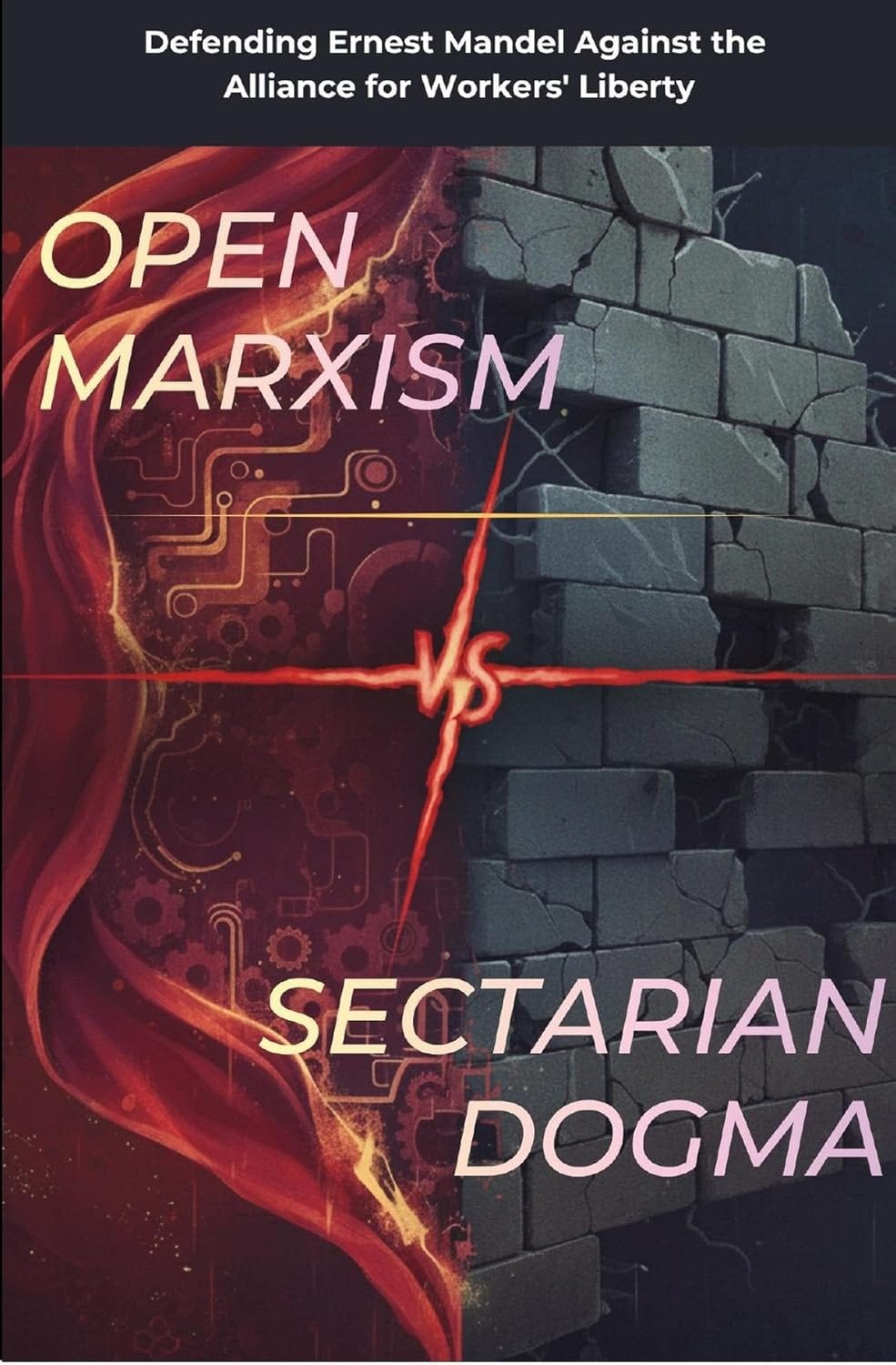
15 participants at the “Ideas for Freedom’ event bought Open Marxism vs. Sectarian Dogma: Defending Ernest Mandel Against the Alliance for Workers’ Liberty, our new book on the AWL's dishonest accounting of Trotskyism’s record with Stalinism. It’s available as a paperback and ebook.