

TL;DR: Three photographs prove Ukraine is Nazi. Except they don’t. Here is what happens when you hold the camera the other way round.
In the weeks since Zelensky attended the reburial of Andriy Melnyk in Kyiv, a particular set of three photographs has been circulating on the British left: in WhatsApp threads, Stop the War meetings, and the internal culture of organisations that have substituted geopolitical alignment for class analysis. Three photographs, three captions, and a conclusion that the Ukrainian state is Nazi-infested, that Zelensky presides over a fascist regime, and that the Russian army is therefore a suitable instrument of anti-fascist politics. It feels like evidence. It is not.
The Three Photographs
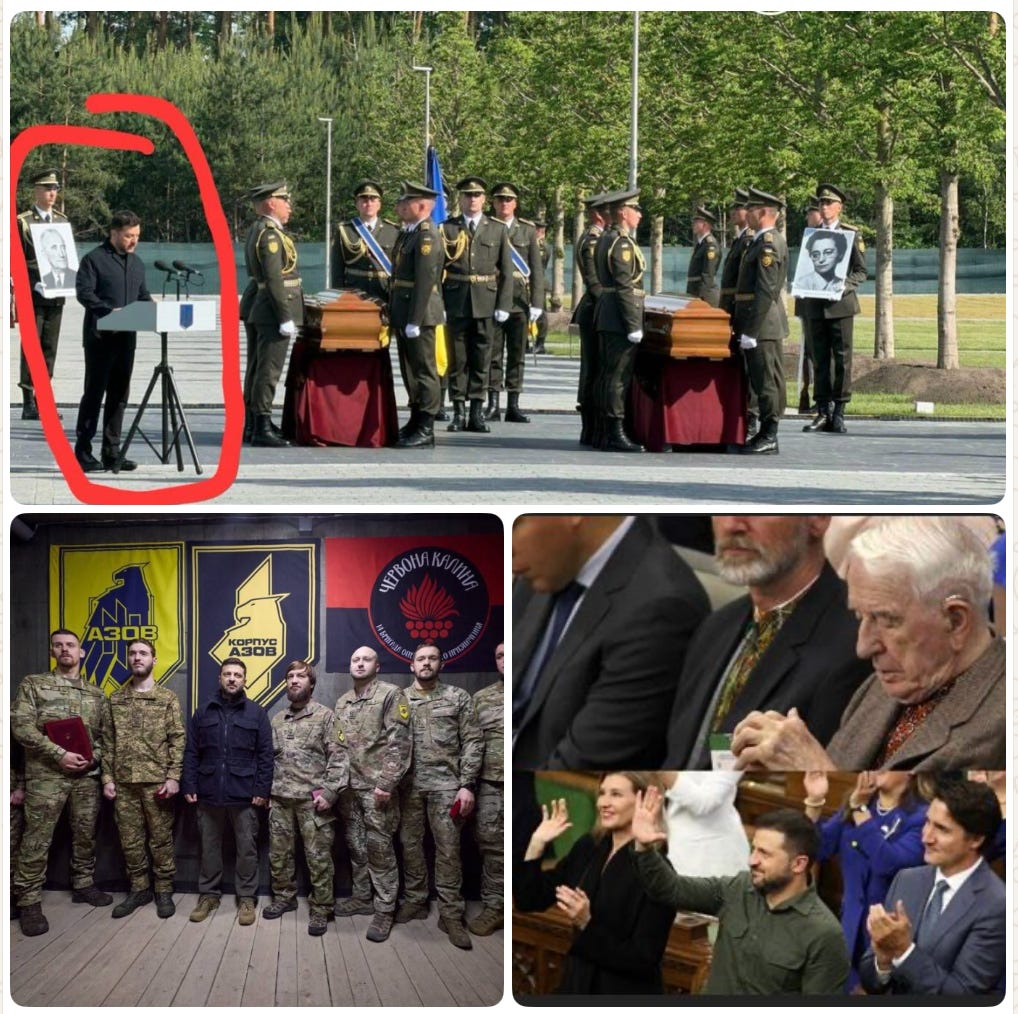
The first shows Zelensky at the reburial ceremony on 24 May 2026 for Andriy Melnyk and his wife Sofiia Fedak-Melnyk, whose remains were exhumed from Luxembourg and interred at the National Military Memorial Cemetery near Kyiv. At the ceremony, Zelensky announced that this was the first step in a planned programme of repatriations: Yevhen Konovalets, founder of the OUN, is next, with a list of more than a hundred figures from different eras under consideration. The red circle around Zelensky's figure is doing the argumentative work the caption cannot quite manage alone. Melnyk led the OUN-M wing of the Organisation of Ukrainian Nationalists, which cooperated with Nazi Germany during the early occupation period, principally in 1941-42. That is documented. So is this: by 1944 Melnyk was imprisoned in Sachsenhausen. The collaboration was real, concentrated, and then terminated by the Germans themselves when OUN-M became operationally inconvenient. 'Infamous Nazi collaborator' is a value judgment, not a historical description. A fair description is: a contested Ukrainian nationalist figure whose movement engaged with Nazi Germany, collaborated in atrocities against Jews and Poles, and whose political legacy remains genuinely disputed within Ukrainian historiography. Zelensky's decision to attend the reburial, and his announcement of a broader repatriation programme that will include Konovalets, is open to serious political criticism. It does not prove what the caption requires it to prove.
One more claim circulates alongside the first photograph: that Zelensky pretends he no longer speaks Russian, that Ukrainian language policy is an act of aggression against Russian speakers, and that the Donbas under Russian administration remains proudly multilingual while Kyiv suppresses minority languages. None of this survives scrutiny. Zelensky conducting official business in Ukrainian is not amnesia. It is closer to what the Moroccan footballers at the 2022 and 2026 World Cup did when they insisted on speaking Arabic to the media rather than French: resisting the cultural hegemony of a former colonial power, not pretending to have forgotten a language.
Consider what Ukrainian language policy is actually responding to. Soviet Ukraine was not a zone of bilingual equality: Russian dominated in official settings, in higher education, in management hierarchies, in the cultural prestige economy. That was not incidental. It was the product of Russification campaigns running from the Tsarist period through Stalin’s destruction of the ‘Executed Renaissance’ in the 1930s, through the systematic over-representation of Russians in leadership roles across Soviet republics, through the forced deportation of native populations, through the importing of Russian speakers into Ukrainian cities. In occupied Donbas and Crimea since 2014, Russian-backed authorities have reduced or removed Ukrainian-language instruction from schools and taken down bilingual signs, including trilingual signs in Crimea that included Crimean Tatar. The direction of linguistic coercion is not one-way from Kyiv; it’s overwhelmingly from Moscow toward Ukraine.
The campist interlocutor will object: Ukraine was not a ‘colony’ in the USSR, which was not imperialist. Stalinist chauvinism was a different phenomenon. This distinction is barely defensible, even technically, and politically evasive. Call it what you prefer: the mass movement of Russians into Ukraine and the Baltic countries, their over-representation in leadership roles, the forced deportations of native populations, the suppression of local languages, the Russification of public space, and the economic semi-colonial relationship between Ukraine and the rest of the CIS, these are not the marks of an equal union. And the process continues. UN and human rights reporting documents large-scale population transfer into occupied Crimea since 2014, with estimates ranging from over 500,000 to as many as 800,000 Russian settlers; exact totals remain uncertain because of the lack of reliable census data under occupation. Russian planning documents published in 2022 envisaged Mariupol’s population reaching 500,000 by 2035; Ukraine’s National Resistance Center subsequently said it had obtained occupation administration documents indicating a plan to relocate approximately 300,000 Russians to the city, though that claim originates with a Ukrainian official source rather than independent verification. The city was built on the graves of the Mariupol that existed before the siege. That is not a metaphor. It is a policy with a target date.
The second photograph shows Zelensky alongside Azov troops, the unit’s emblems visible on the wall behind them. Here the argument is strongest, and here it is also most carefully manipulated.
Azov’s founding symbolism was genuinely far-right: the early emblem drew on Wolfsangel-style imagery widely read as neo-Nazi coded, and the political milieu that created the unit in 2014 included people with documented ultranationalist and white supremacist politics. None of that is invention. The campist use of it, however, requires two contradictory claims to be true simultaneously.
By 2015 the unit had moved to a different emblem, and by 2022 new recruits were shown wearing trident-based insignia. More importantly: Azov was incorporated into Ukraine’s National Guard, brought under the Interior Ministry, subordinated to state command structures. The earlier political leadership was replaced: it separated and regrouped as the National Corps; the original hard-right leadership lost direct control of the armed formation precisely because formalisation within the state imposed different institutional logics. Azov’s broader political environment matters here: the far right’s electoral performance in Ukraine collapsed in the mid-2010s, never approaching the parliamentary thresholds that would have given ultranationalist parties institutional leverage. The formation that emerged from that process was more professional and less openly ideological than the 2014 original.
Even so: the state’s decision to absorb a formation with those origins into the National Guard is a real political criticism and not something to dismiss. Legitimising a unit with Azov’s founding history, whatever its subsequent evolution, is a choice that reflects poorly on Kyiv’s political judgment. That criticism stands. What it does not do is prove what the campist requires it to prove, namely that Azov controls the Ukrainian state rather than being controlled by it.
Regularising a unit with far-right origins into state command structures is the opposite of leaving it as an autonomous armed militia. The campist argument needs Azov to be simultaneously a rogue Nazi militia outside state control and proof that the state itself is Nazi. Choose one. And then apply the same standard to the Russian Imperial Movement: designated by the United States in 2020 as a specially designated global terrorist entity, the first white supremacist organisation to receive that designation, based in St Petersburg, running paramilitary training, building links to far-right networks across Europe. A far-right formation operating in proximity to the Russian state, with documented extremist politics, not identical to the state but not independent of it either. The parallel with Azov is exact. The campist does not apply to Russia the standard they apply to Ukraine.
The accompanying claim, that Azov had a genocidal programme against Russian speakers, does not survive contact with the unit’s actual composition. Azov’s personnel has included people from Kyiv, Kharkiv, Mariupol, Donetsk: many of them Russian-speaking Ukrainians. The accusation rests on a false equation, Russian-speaking equals Russian national identity equals targetable enemy, that Ukrainian social reality simply does not support. Millions of people in Ukraine speak Russian as a home language while remaining firmly Ukrainian in politics and identity. Language use does not map onto political allegiance. The ‘genocide of Russian speakers’ narrative is propaganda, not a legal claim with evidentiary support.
The third photograph is the Canadian Parliament standing ovation for Yaroslav Hunka in September 2023. This one is real, documented, and genuinely scandalous. A 98-year-old veteran of the SS Galician Division was invited to the gallery; Zelensky and Trudeau led a standing ovation before anyone present understood who Hunka was. And then: Speaker Anthony Rota resigned on 26 September 2023. Trudeau apologised publicly. Parliament debated removing the tribute from the official Hansard record. Western liberal institutions, under pressure, identified the association and rejected it. The campist use of this photograph treats it as proof of systemic Nazi alignment in Western states. What it actually demonstrates is that those institutions, when the association was made public, found it intolerable and acted. That is the opposite of what the argument requires.
Now Apply the Same Method
Take each of the following and ask what conclusion the campist caption-method would force.
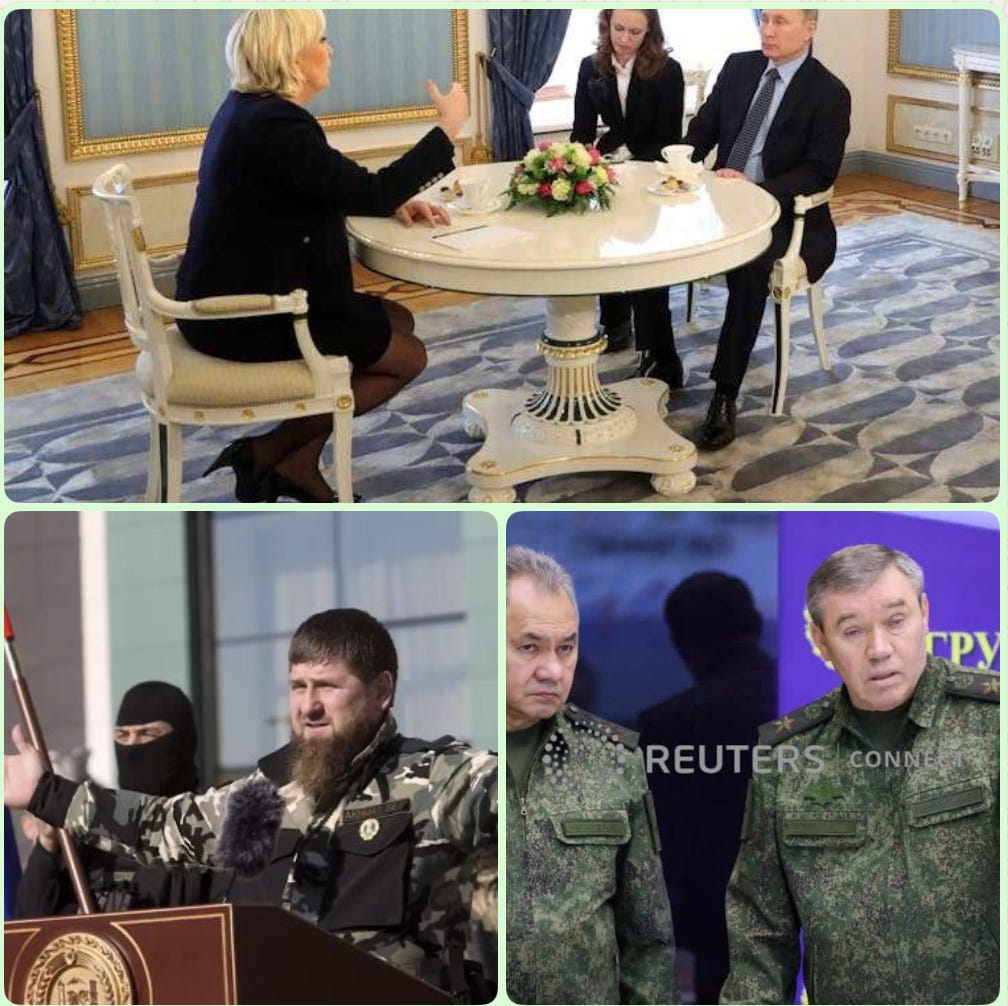
Putin meeting Marine Le Pen at the Kremlin in 2017. Not symbolic proximity, not a wartime honour guard, not a historical reburial. A private meeting at which the financial relationship between the Russian state and the European far right was already documented. Le Pen’s party borrowed €9.4 million in 2014 from the First Czech-Russian Bank, a Moscow-based institution. The debt was transferred through Russian-linked entities, restructured, extended to 2028, and finally repaid early in 2024 after a decade of dependency. This is not a photograph of association. It is a photograph of a client relationship.
Ramzan Kadyrov at a public rally. The standard campist response is that Kadyrov is ‘hardly a symbol of Russian nationalism,’ which is technically true and politically evasive. Kadyrov is not a Russian ethnic nationalist. He is a Chechen Bonapartist who holds power through personal loyalty to Putin, clan authority, armed suppression of any Chechen political alternative, documented persecution of LGBTQ+ people, and a form of Islamist-inflected reaction that destroyed what remained of the secular nationalist tradition the independence movement once represented. His rise must be understood against the backdrop of Russia’s brutal destruction of Chechen independence across two wars in the 1990s and early 2000s: those wars created the conditions for his Kremlin-backed consolidation of power. The Chechen working class, which fought Russian military occupation at enormous cost, now lives under a client regime built on the ruins of its own liberation movement. That is what ‘combined and uneven development’ looks like when the campist deploys the term in Russia’s favour.
Sergei Shoigu and Valery Gerasimov. Senior Russian military commanders. The ICC issued warrants for both men in June 2024, covering alleged attacks on Ukrainian civilian infrastructure between October 2022 and March 2023: directing attacks on civilian objects, causing excessive incidental harm to civilians, and inhumane acts as a crime against humanity. Shoigu was by then already serving as secretary of Russia’s Security Council; the warrants followed him out of the Defence Ministry. If the campist standard applied to the Zelensky photographs were applied here, the conclusion would be that Russia is governed by war criminals. The campist does not apply that standard here.
The Method Is the Message
That asymmetry is not incidental to the campist argument. It is the argument. Remove it and nothing remains.
Campism does not begin in bad faith. It begins with a legitimate anxiety: NATO expansion is real, US unipolarity produced catastrophic wars, Washington’s anti-imperialism is a cover for economic domination. The Fourth International has argued all of these. But the method that flows from those concerns, the binary division of the world into a Western imperialist camp and a counter-hegemonic capitalist bloc that must be supported against it, produces a politics that can only sustain itself through asymmetric evidentiary standards.
Apply the caption method to Ukrainian photographs: Nazi state. Apply it to Russian photographs: axis of resistance, context, complexity, historical nuance required.
The Trotsky analogy deployed in defence of this method deserves a direct answer. Preferring Putin to Zelensky, the argument runs, resembles Trotsky preferring Stalin to Hitler. Trotsky’s ‘Long live an independent Soviet Ukraine!’ was, the same argument continues, a tactic specific to conditions of Stalinist repression and Nazi advance, now long superseded. The first part is partially correct: Trotsky did frame the 1939 slogan tactically. But the underlying principle ran through his analysis from the early 1920s onward: Ukrainian self-determination against Great Russian chauvinism is not a tactical concession but a foundational commitment. The conclusion drawn from the tactical framing, that changed conditions make self-determination irrelevant, proves too much. Ireland’s right to independence from Britain did not depend on Ireland being outside the imperialist system. The Algerian right to independence did not depend on the FLN’s programme being satisfactory to European socialists.
More precisely: Trotsky in 1939 supported the Ukrainian working class’s right to self-determination against Moscow. That is closer to the Fourth International’s current position on Ukrainian resistance than to anything the campist is defending. The analogy does not merely fail. It inverts Trotsky’s actual argument and presents the inversion as orthodoxy.
The ICC warrants, it is sometimes suggested, are Cold War weapons; the sole exception is Israel, where accountability was ‘forced from below by a genocide.’ But this exception destroys the argument it is meant to rescue. If ICC warrants can reflect genuine accountability when mass pressure forces the institution to act, then the institution is not simply a Cold War weapon. It is an institution whose outputs are contested and whose independence is partial, which is a different claim entirely, and one that does not licence dismissing the Shoigu and Gerasimov warrants without engaging the evidence they rest on.
The post-capitalist deformations argument, that Russia retains enough Soviet-era institutional inheritance to warrant socialist defence, deserves more than a clause, but it has a short answer: the productive forces and institutional residues of the Soviet period do not constitute ongoing post-capitalist deformations in the Trotskyist sense. Capitalist restoration happened in the 1990s. There is no deformed workers’ state to defend. What remains is a capitalist state that industrialised under public ownership and retained some of those structures through transition. The political conclusion drawn from that inheritance, that socialists should support Russian military operations against Ukraine, has no theoretical foundation left to stand on.
The trophy cabinet method requires that you never look too closely at the photographs you have chosen not to display. Apply it consistently, and it proves too much in both directions. Apply it asymmetrically, and it proves only what you already believed.
Thank you for this. If I hear one more Putin-supporting Canadian so- called lefty rant about how Ukraine is led by Nazi-sympathizers I will have this article blasted out of megaphones into their bedrooms after midnight.
Seriously your research and analysis much appreciated.
Thank you for this valuable work, Duncan. The left needs to get its head together and stop being Putin apologists. The man is a vile dictator. The current plutocratic, fossil fuel oligarch-controlled Russia has nothing left within it which is even vaguely reminiscent of a workers' state. Ukraine, on the other hand, is at least a democracy. Some city and town councils have even been holding citizens' assemblies - during wartime! The situation of LGBTQI+ people is also far better in Ukraine than it is in Russia or would be if Russia took control of Ukraine. Trans people especially are persecuted in Russia. Support for Russia against Ukraine does not compute with support for trans rights. See my Substack on this: https://deborahwafoulkes.substack.com/p/beware-the-pitfall-of-false-anti?r=1f2ej0&utm_medium=ios