


"Palestine and the Arabs' Fight for Liberation," a 72-page pamphlet authored by Fred Feldman and Georges Sayad and published by Pathfinder Press in 1989, provides a concise yet comprehensive historical analysis of the Palestinian struggle. Pathfinder’s views moved sharply towards Zionism in 2021, and this pamphlet is one of a number of its publications that are now unavailable. In this summary, we aim to summarise a number of reviews and references to the book, while respecting Pathfinder’s copyright.
This booklet is a "gold mine of information and analysis of the struggle unfolding in the Middle East". Its central objective is to offer "an overview of the Palestinian struggle as part of the fight against colonialism and imperialist oppression in the Middle East". The historical narrative within the book spans a pivotal period, beginning with "the opening of World War I to the intifada, or uprising, of the Palestinian people that began in December 1987". This chronological scope provides essential context for understanding the protracted nature of the conflict.
A significant aspect of the book's purpose is to challenge prevailing narratives, aiming to "cut through the lies used by the U.S. government (and governments of Great Britain, France etc.) about their military and colonial interventions into the region". It underscores the "century-long struggle of the Palestinians—with its ebbs and flows—for national independence and to regain the land stolen from them by the Zionist state". Furthermore, the book highlights the enduring "centrality of the fight today for a democratic, secular Palestine". The explicit anti-imperialist framework of the book is crucial for interpreting its historical narrative. This perspective shapes how it presents events such as the formation of Israel or the actions of various Arab governments, focusing on power dynamics, exploitation, and resistance rather than a purely diplomatic or ethno-religious analysis. This indicates that the work is not merely a neutral historical account but rather a critical analysis from a specific political viewpoint, likely informed by socialist or anti-imperialist thought, given its publisher and emphasis on the broader implications for "working people everywhere".
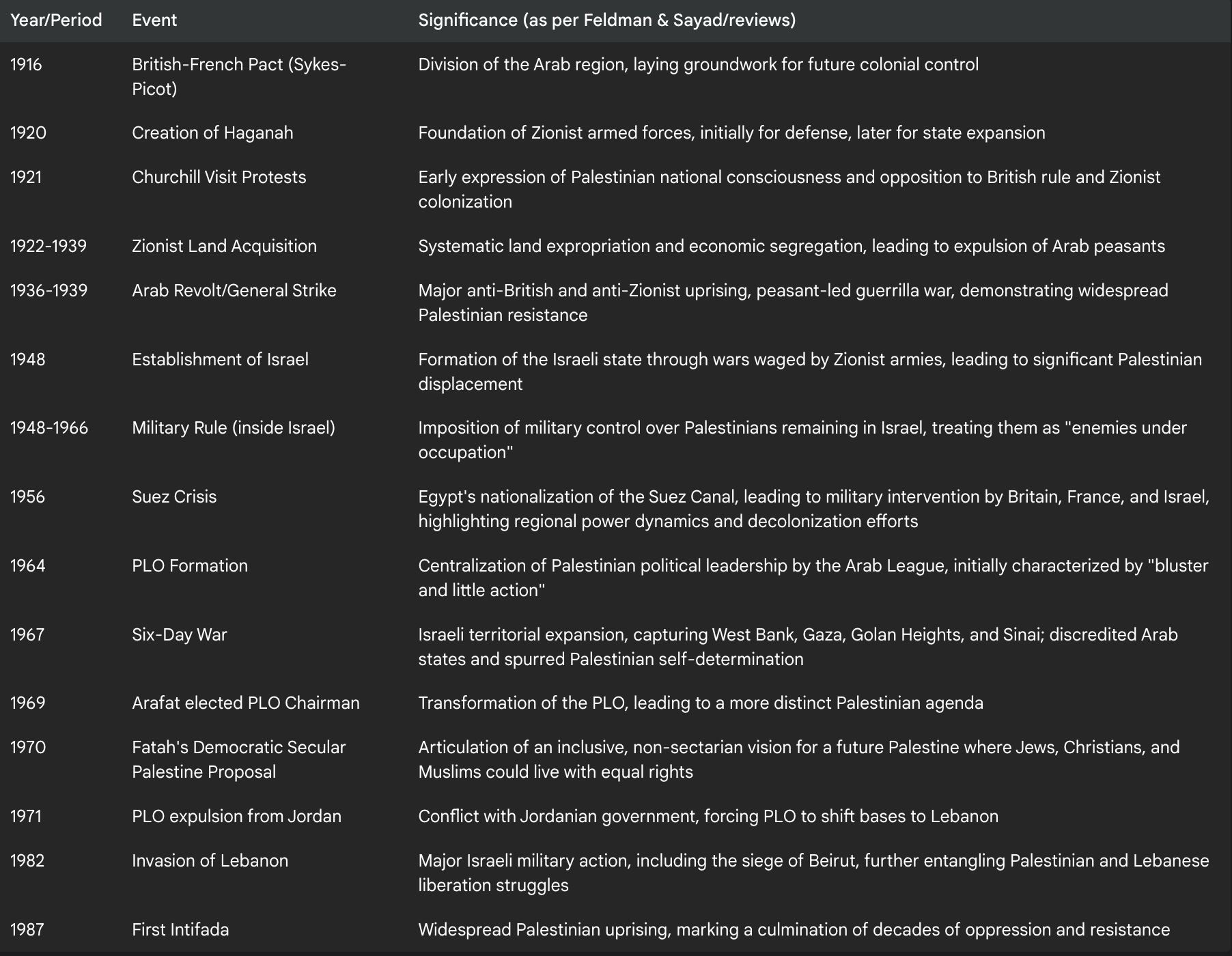
To provide a clear chronological framework for the events discussed in "Palestine and the Arabs' Fight for Liberation," the following table outlines key historical milestones and their significance as presented in the book:
Table 1: Key Historical Events and Their Impact (1916-1987) as Presented in Feldman and Sayad
Imperial Domination and the Genesis of the Conflict
The book meticulously details the imperial machinations that laid the groundwork for the Israeli-Palestinian conflict, tracing its origins to the aftermath of World War I. In 1916, "the British rulers signed a pact with their French counterparts dividing the Arab region between them". This agreement, often referred to as the Sykes-Picot Agreement, allocated "Lebanon and Syria... to France, while Iraq and the territory called Transjordan (today Jordan) would be under 'direct or indirect administration and control'". Initially, "Parts of Palestine would be placed under 'an international administration'". This division of the former Ottoman Empire's territories was a clear assertion of European imperial power over the Middle East.
Following World War I, a significant shift occurred in this British-French arrangement. "The British rulers took Palestine as part of their share of the booty". This British control was formally legitimized by a 1922 mandate from the League of Nations, an international body established by the victorious imperialist powers after the war. The book argues that the British had a strategic objective in Palestine: to create a "powerful new obstacle to the Arab independence struggle". To achieve this, Britain actively "backed plans of the World Zionist Organization to colonize Palestine with European Jews". The British leadership harbored the expectation that these "colonial settlers would feel they had a stake in helping combat the Arab democratic movement". This approach reveals a calculated strategy by the British to utilize one group, Zionist settlers, to counteract the nationalist aspirations of the Arab peoples. This is a classic application of a "divide and rule" tactic, further complicated by the establishment of a settler-colonial entity intended to serve as a proxy for imperial interests. The immense wealth to be gained from Middle East oil significantly heightened the stakes for the imperialist powers in suppressing the Arab peoples' desire for independence and social advancement.
The book extends this analysis of imperial interests into the post-World War II era. As direct colonial rule and occupation in the region began to wane, "the U.S. rulers viewed Zionist colonization as a potentially powerful weapon against anti-imperialist struggles in the region". This demonstrates a continuity of imperialist objectives, transitioning from direct European control to American influence, which leveraged the Zionist project as a strategic asset. The fundamental argument here is that the creation of Israel was not merely a fulfillment of Jewish national aspirations but a direct consequence and instrument of British imperial policy, later adopted and supported by the United States. This perspective fundamentally reframes the conflict, moving it beyond a purely ethno-religious dispute to one deeply rooted in global power struggles and the enduring legacies of colonialism.
Zionist Colonization, Land Confiscation, and the Establishment of Israel
Feldman and Sayad meticulously detail the systematic processes of land confiscation and economic segregation that characterized Zionist colonization in Palestine, leading directly to the establishment of the State of Israel. The Jewish National Fund and other Zionist organizations "stepped up land purchases from Arab landowners in Palestine". These purchases were not merely transactions; they were "often followed by expulsion of Arab peasants from the land, which was then turned over to Jewish settlers, set aside for future settlers, or used to foster Jewish-owned industry". This "massive infusion of capital from abroad to purchase land in Palestine caused a boom in real estate prices that encouraged the expropriation of ever more Arab peasants". Between 1922 and 1939 alone, "the amount of land held by the fund rose from 150,000 to nearly 400,000 acres".
Further exacerbating the situation for the indigenous population, the British authorities "imposed restrictions on the rights of Arab landlords and peasants to expand their holdings". This policy actively hindered Arab economic development and facilitated the continued acquisition of land by Zionist organizations. The economic discrimination extended beyond land. "Zionist organizations campaigned for the dismissal of Arab workers from jobs in Jewish-owned businesses and their replacement with settlers". Concurrently, "Arab-made goods were boycotted". This deliberate economic strategy fostered a "system of segregation... directed against the Arab population, including wage differentials and other privileges for the settlers". This systematic transfer of wealth and opportunity spurred the growth of a "strong capitalist class among the settlers".
This detailed account illustrates that the process was not simply about acquiring territory but involved the deliberate construction of an economic and social system of segregation designed to privilege settlers and dispossess the indigenous Arab population. The substantial "infusion of capital from abroad" fueled this process, creating a robust capitalist class among the settlers. This constitutes a clear description of settler colonialism, where the economic and social structures are explicitly crafted to replace and subordinate the native population.
To protect these newly acquired privileges and to advance their territorial goals, "the settlers formed armed units that eventually contributed to forging the Haganah and Irgun armies". These "armies waged the wars that established and expanded the State of Israel in 1948". The Haganah, established in 1920, initially served to protect Jewish communities but evolved into a primary military organization, forming the foundation for the Israel Defense Forces. The British authorities, for their part, "collaborated with the Zionist organizations as a means of reinforcing their own rule," particularly "against the growing Palestinian national struggle". This collaboration included "enlist[ing] the Zionist militia to combat the Arabs," establishing "a twenty-thousand-member Jewish Settlement Police and joint British-settler night patrols". While there was often close cooperation, conflicts did arise between British imperialism and the Zionist settlers, primarily because "the British opposed the Zionist goal of transforming Palestine into an independent, exclusively Jewish state". The book thus argues that the Israeli capitalist class and the Israeli regime were built upon and perpetuated this system of oppression and domination from their very inception, rather than it being an accidental byproduct of conflict. This implies that the conflict is not merely about borders or security, but about the fundamental nature and origins of the state itself.
The Evolution of Palestinian Resistance and National Consciousness
The book highlights that the systematic colonization of their homeland directly "spurred the development of national consciousness and opposition to British rule" among Palestinians. Early manifestations of this burgeoning national identity and resistance were evident in the "huge protests against British rule and Zionist colonization" that greeted Winston Churchill's visit to Palestine in 1921. These demonstrations marked a nascent stage of organized opposition to the dual forces of imperial and settler domination.
The growing national movement culminated in the "popular revolt against British rule" that exploded in the 1930s. This period saw a "general strike [that] swept Palestine in 1936 and Arab National Committees were formed across the country". The primary demand of this strike was the "suspension of Jewish colonization". For the subsequent "three years Palestinian peasants waged a guerrilla war against the British occupiers". By 1938, these "liberation fighters controlled the whole Arab area of the country, establishing an unofficial administration". This widespread uprising coincided with broader "unrest across the Middle East," including an uprising challenging British control in Egypt and a general strike in French-held Syria. The repeated emphasis on the role of "Palestinian peasants" in the "guerrilla war against the British occupiers" and as the "mainstay" of the 1936-39 Arab Revolt is a critical detail. This focus underscores the grassroots, socio-economic drivers of the early Palestinian struggle, directly linking it to the material conditions imposed by British and Zionist policies of land confiscation and economic oppression. The "fight for liberation" was deeply rooted in the daily lives and livelihoods of the common people, particularly the "workers and farmers."
The British imperialists, facing this significant "anti-imperialist upsurge," found it "only with considerable difficulty" that they finally "rooted out" this unofficial Palestinian administration. To suppress the rebellion, the British "enlisted the Zionist militia to combat the Arabs". At the peak of this uprising, "half of the British army was tied down in the Middle East". Official British figures, likely understated, reported that "two thousand Arabs were killed in suppressing the rebellion," and "some one hundred Arabs were hanged". This brutal suppression, often with the collaboration of Zionist forces, further solidified the anti-imperialist character of the Palestinian resistance. The continuous narrative of oppression and subsequent uprising suggests a cyclical pattern where acts of domination inevitably provoke resistance. The 1987 Intifada, as the culmination of the book's narrative, is presented as a direct, perhaps inevitable, response to the accumulated historical injustices and ongoing military rule.
The Palestine Liberation Organization (PLO) and the Vision of a Democratic Secular Palestine
The book traces the evolution of the Palestinian national movement through the formation and transformation of the Palestine Liberation Organization (PLO). The PLO was "formed in 1964" by the "Arab League". Its initial chairman was Ahmed Shukairy, who maintained "strong ties to the Egyptian government". Under Shukairy's leadership, the PLO was "characterized by bluster and little action," and he was notably attributed with "demagogic statements such as the call... to 'drive the Jews into the sea'". Shukairy resigned in 1967, a pivotal moment that coincided with a broader "upsurge of the Palestinian struggle in the 1960s".
A significant transformation within the PLO occurred after the 1967 Six-Day War, which discredited the Arab states and prompted Palestinians to seek greater autonomy. In February 1969, "Yassir Arafat, a leader of Fatah," was elected chairman of the Palestine National Council (PNC), which served as the PLO's parliament. Under Arafat's leadership, Fatah "put forward the perspective of replacing Israel with a democratic secular Palestine". This vision was formally articulated in their document, "Towards a Democratic State in Palestine," presented at a 1970 international gathering in Amman, Jordan. The book explicitly states that this proposed course of action was "completely counterposed to that of Hamas and some other Palestinian organizations today".
Fatah's declaration asserted that "The very existence of the racist oppressor state of Israel… is unacceptable to the revolution," and that "Any arrangement accommodating the aggressor settler-state is unacceptable and temporary". Crucially, the document articulated an inclusive future for the region: "Only the people of Palestine — its Jews, Christians and Muslims — in a country that combines them all is permanent". In such a democratic state, "All the Jews, Muslims and Christians living in Palestine or forcibly exiled from it will have the right to Palestinian citizenship". The "revolution" expressed a belief that "the majority of the present Israeli Jews will change their attitudes and will subscribe to the new Palestine, especially after the oligarchic state machinery, economy and military establishment are destroyed". This perspective, emphasizing a non-sectarian and inclusive future, "won wide support among Palestinians, the Arab masses, and around the world".
The book highlights this ideological shift within the PLO as a profound development. The move from Shukairy's "bluster and little action" to Fatah's concrete and inclusive proposal for a "democratic secular Palestine" represents a significant evolution in the Palestinian political project. The explicit inclusion of Jews, Christians, and Muslims with equal rights and citizenship, even anticipating a change in attitude among Israeli Jews after the dismantling of the existing state apparatus, suggests a revolutionary and non-sectarian approach to liberation. This vision is presented as a peak ideological expression of the Palestinian struggle for national liberation and self-determination. The book notes, however, that "no major Palestinian organization has advanced the demand for a democratic secular Palestine in the three decades prior to the article's publication" , implying a subsequent shift away from this inclusive, secular ideal, possibly due to "setbacks for the Palestinian struggle" after events like the Oslo Accords. This suggests a significant evolution and perhaps fragmentation of the Palestinian political project over time, influenced by external pressures and internal dynamics.
Arab Governments, Regional Conflicts, and Their Impact
The book analyzes the complex and often contradictory role of Arab governments and the impact of regional conflicts on the Palestinian struggle. The Suez Canal Crisis in 1956 is presented as a significant event, triggered when "Egypt nationalized the Suez Canal". This act led to a "military intervention by Israel, followed by the United Kingdom and France". The crisis marked a "significant moment in Middle Eastern history, influencing regional politics, the relationship between superpowers, and the process of decolonization". Gamal Abdel Nasser, then President of Egypt, emerged as a central figure, celebrated for "promoting Arab nationalism" and his "pivotal involvement in events like the Suez Crisis".
A critical turning point detailed in the book is the "Six-Day War" of June 5–10, 1967, the "third of the Arab-Israeli wars". This conflict began with Israel's "preemptive strike" against "Egypt and Syria". Israel achieved an "overwhelming victory on the ground," capturing the "Gaza Strip" and the entire "Sinai Peninsula" up to the Suez Canal, as well as the "West Bank," "Old City of Jerusalem," and "Golan Heights". The war had profound consequences, "creat[ing] hundreds of thousands of refugees and brought more than one million Palestinians in the occupied territories under Israeli rule". This devastating defeat "discredited the Arab states" and prompted Palestinians to seek "greater autonomy in their struggle with Israel".
The book describes how, from the late 1960s, the PLO, operating from its bases in Jordan, launched "guerrilla attacks against Israel". These actions led to "instability within Jordan" and a growing conflict with the "government of King Hussein of Jordan". Consequently, in 1971, "the PLO was forcibly expelled from the country by the Jordanian army". This expulsion forced the PLO to "shift its bases to Lebanon" , further entangling the Palestinian struggle with the complex internal dynamics of Lebanon.
The 1982 "invasion of Lebanon" by Israel is also covered. This invasion involved "constant attack by Israel," including "bombing Lebanon at will from land, sea and air," and was one of "six major invasions of Lebanon since 1978". It included the "siege of Beirut" for two months. The invasion had "huge repercussions" and inextricably "bound the liberation of Palestine and Lebanon together". The United States, through the Pentagon, "armed rightwing Lebanese groups, especially the Kataeb (Phalange)".
The book offers a critical perspective on the role of "Arab governments," often highlighting their "limited actions" and "demagogic statements". While Nasser was an iconic figure for many Palestinians, the book suggests he had a "noticeable distrust of Arab rulers" and a low "desire for war," warning that calls to "liberate Palestine from the river to the sea" were "counterproductive". The analysis implies that "Arab states have largely failed to aid Palestinians in Gaza significantly, and some actively cooperate with the US in ways that appear to support Israel and undermine Palestinian aspirations".
The narrative reveals a complex and often contradictory relationship between the Palestinian struggle and various Arab governments. Initially, the PLO was formed under the patronage of the Arab League and was closely tied to the Egyptian government under Shukairy, a period characterized by "bluster and little action." However, the devastating defeat of Arab states in the 1967 Six-Day War served as a critical turning point, discrediting these governments and compelling Palestinians to seek greater autonomy in their struggle. This led to the rise of Fatah and Arafat, and the PLO's subsequent expulsion from Jordan to Lebanon. This sequence demonstrates a clear shift: from Palestinian reliance on Arab governments to a more independent, self-determined Palestinian agenda, even as these governments are critiqued for their limited and often self-serving actions. The book suggests that the liberation of Palestine was increasingly viewed as a Palestinian-led endeavor, rather than solely an Arab nationalist one, forcing the movement to assert its own agency, even if it meant conflict with host Arab countries.
Military Rule and the Conditions of Palestinian Workers and Farmers
"Palestine and the Arabs' Fight for Liberation" provides a detailed examination of the imposition and enduring impact of "military rule" on Palestinians, highlighting its role as a tool of control and dispossession. Following the creation of the State of Israel, "The Palestinians who remained in Israel when the state was created lived formally under military rule from 1948 until the end of 1966". This period of military governance was a "blatant contradiction to claims of democracy in Israel" and treated Palestinians "as enemies under occupation". After the 1967 Six-Day War, Israel "seized the remaining Palestinian territories (the West Bank and the Gaza Strip)" and immediately imposed "military rule without granting citizenship".
Military rule served as the "primary tool" for controlling Palestinians, employing tactics such as "strict control of Palestinians' movements and organization," "suppression of any attempts to resist repressive policies," and pervasive "discrimination against them in all spheres of life". This control manifested in daily life through requirements for "movement permits" for "any kind of work or activity beyond the borders of their villages," dictating "livelihoods," and even intervening in personal "relationships" like marriage and divorce.
The book further details how Israeli policies actively promoted Jewish-Israeli settlements while simultaneously stifling Palestinian growth. Israel "expropriated land from Palestinians for Jewish-Israeli settlements and their supporting infrastructure," and systematically "denied Palestinians building permits". These measures severely "limited the expansion of Palestinian villages" and imposed "severe hardships" on residents, including long distances for "school" and limited access to "medical care". The proliferation of roadblocks and checkpoints further impeded movement, causing delays for ambulances and imposing significant costs on the "Palestinian economy". In some instances, these discriminatory policies resulted in the "forcibly displaced" of Palestinian residents from their communities.
The conditions of Palestinian "workers and farmers" are a central focus of the book's critique of military rule and Zionist colonization. As previously noted, the "expulsion of Arab peasants from the land" was a common consequence of Zionist land purchases. Furthermore, "restrictions on the rights of Arab landlords and peasants to expand their holdings" were deliberately imposed by British authorities. Economic discrimination was rampant, with "Zionist organizations campaign[ing] for the dismissal of Arab workers from jobs in Jewish-owned businesses and their replacement with settlers," leading to "wage differentials and other privileges for the settlers". While the Israeli economy's later need for "cheap labor" led to an "easing of military rule over Arab citizens" in 1959, necessitating "greater freedom of movement for Arab workers" , this adjustment did not dismantle the underlying system of discrimination.
The book demonstrates that military rule was not merely a security measure but a comprehensive system designed to control Palestinians both within Israel and in the occupied territories. This control directly facilitated land expropriation, denied building permits, and imposed restrictions on Arab landlords and peasants. The economic discrimination, including wage differentials and the dismissal of Arab workers, created a system of segregation that privileged settlers. This entire apparatus served to promote Jewish-Israeli settlements and forcibly displace Palestinian residents. The Israeli regime and its military rule are thus fundamentally linked to the economic and demographic goals of establishing and expanding a Jewish state. This perspective underscores the structural nature of the conflict, where military and economic policies serve a broader settler-colonial agenda, leading to the oppression and displacement of the Palestinian population, particularly its workers and farmers.
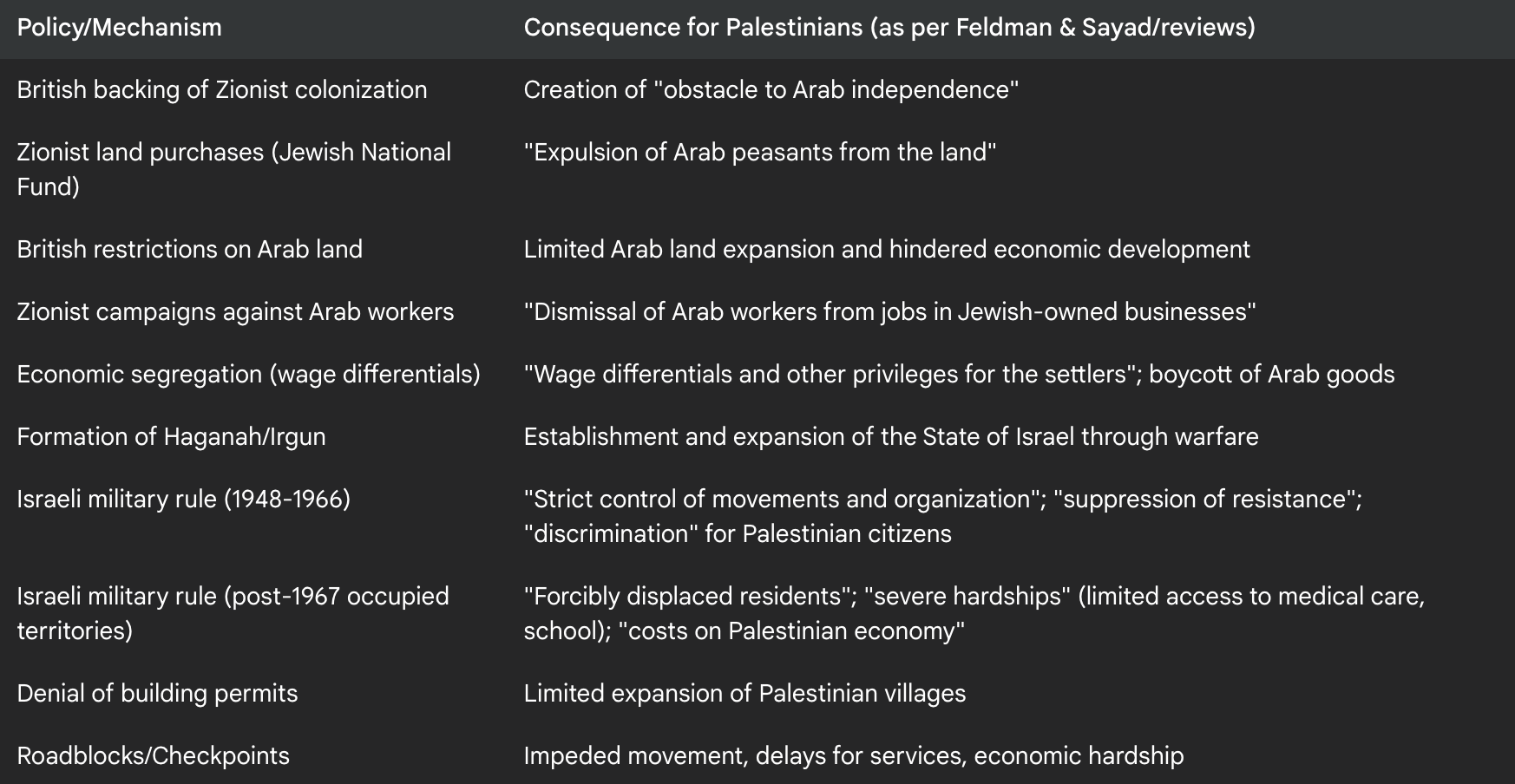
The following table further illustrates the systemic impact of these policies:
Table 2: Impact of Imperialist and Zionist Policies on Palestinian Life
Conclusion: The Enduring Fight for Liberation
"Palestine and the Arabs' Fight for Liberation" by Fred Feldman and Georges Sayad presents a compelling historical narrative that frames the Palestinian struggle as a continuous and multifaceted "fight against colonialism and imperialist oppression". The book systematically details the mechanisms through which land confiscation, economic discrimination, and military rule were implemented, contributing to the establishment and expansion of Israel. It traces the evolution of Palestinian "resistance" from nascent protests and peasant revolts against British and Zionist policies to the profound transformation of the Palestine Liberation Organization and its articulation of a vision for a "democratic secular Palestine". The work also critically examines the often-ambiguous role of "Arab governments" and the significant impact of regional conflicts, such as the Suez Crisis, the "Six-Day War," and the "invasion of Lebanon," on the trajectory of the Palestinian movement.
The book's narrative culminates at the "beginning of the intifada in 1987" , a major "uprising" of the "Palestinian people". This powerful ending underscores the enduring nature of the "Palestinian struggle" for "liberation" despite decades of systematic "oppression." The historical arc presented, from early British-backed colonization and land confiscation through various forms of Palestinian resistance, to the formation and evolution of the PLO, and culminating in the 1987 Intifada, reveals a cyclical pattern where acts of domination inevitably provoke sustained resistance. The Intifada itself is portrayed as a natural and perhaps inevitable outcome of the accumulated historical injustices and ongoing military rule.
Feldman and Sayad's work remains highly relevant, as it helps readers "see behind the diplomatic maneuvers and the [lies] of Washington's 'peace plans' to the key issues involved". It emphasizes the profound "stakes for working people everywhere" in the ongoing "fight against oppression in the Middle East". By framing the conflict as a continuous revolution against systemic injustices rather than a series of disconnected events, the book reinforces the idea that the "Liberation of Palestine" is an ongoing, fundamental objective. Its enduring value lies in its argument that true "peace" cannot be achieved without addressing the root causes of "oppression" and "domination," which are deeply embedded in the historical and structural foundations of the conflict.
Background reading
Stop the War on Gaza Now! - World-Outlook
Palestine and the Arabs' Fight for Liberation by Fred Feldman | Goodreads
8/25/97 -- `Palestine And The Arabs' Fight For Liberation' - The Militant
Review of Fred Feldman and Georges Sayad, Palestine And The Arabs' Fight For Liberation
Palestine Liberation Organization (PLO) Table of Contents - Jewish Virtual Library
Timeline: Key Events in the Israel-Arab and Israeli-Palestinian Conflict | AJC
Palestine and the Arabs' Fight for Liberation: Feldman, Fred, Sayad, Georges - Amazon.ca
Palestine Liberation Organization (PLO) | Leaders, History, Mission, & Relations with Hamas
Feldman, A Shadow over Palestine: The Imperial Life of Race in America
Palestine - The Arab Revolt | Britannica
Six-Day War | Definition, Causes, History, Summary, Outcomes, & Facts | Britannica
Unveiling Nasser's secrets: Arabs, Palestine and crucial timing - Middle East Monitor
Lebanon: A lesson in continuous and unconditional resistance - Liberation News