

Struggles across England and Wales are shaped by climate, and the Green party stands alongside most of them. At the closing plenary at ACR’s successful summer camp, I was invited to speak about why we have individual struggles but no unified movements. What is missing is the thing in between: the form that holds those struggles together. That is what the unions built over a hundred and fifty years. The nearest anyone has come is in Scotland.
In England the reference point is Leeds. Residents around the old Skelton Grange power station in Stourton have run the most sustained campaign against a hyperscale AI data centre in the country: a thousand planning objections, a petition past forty thousand. Leeds planning committee approved Microsoft’s campus unanimously in April. Most of those signatures arrived afterwards. One site, one campaign, one petition, and the decision already taken.
Scotland is a different order of thing, and the one to learn from. Twenty-one applications sit in the portals, some 7,300 megawatts against a country whose peak demand is a fraction of that. Auchtertool, a Fife village of two hundred homes, faces a 600-megawatt campus billed as the second largest on earth; it has drawn sixteen hundred objections. Larbert has drawn seven thousand, against an application proposing two hundred industrial diesel generators, at least three of them to run eight hours a day every working day of the year. Action to Protect Rural Scotland counts seventeen community campaigns and has knitted them into a shared demand, a shared map, a briefing for MSPs; on 3 September around fourteen of them brought several hundred people to Holyrood together. Ross Greer had already put the demand to John Swinney in June: a moratorium on new data centres above 50 megawatts until Scotland has a national strategy and guidance for councils. The SNP’s own National Council then backed a temporary moratorium in principle. Swinney has declined to commit, declined to visit Larbert, and sent his public finance minister to answer the rally in the language of balancing economy against climate.
There are climate struggles in England. There is no climate movement in the sense that there is a trade union movement, and England is behind Scotland in the particular work of linking those struggles up, of getting them to think socially and act politically instead of site by site. The Greens are a friend and an amplifier to every one of these fights, eleven councillors leading the Leeds opposition; the Scottish Greens have gone further and carried a threshold into the chamber. Fifty megawatts is a demand with a number in it, which is more than the rest of the left has managed.
The union comparison is exact. A shop goes into dispute over a rota changed without notice, and the union is the thing that was there before the dispute and is still there when it ends, holding the experience so the next one does not start from nothing. Scotland has come closest to that: a charity with a map and a co-leader with a threshold. Real, and not yet the same thing.
There has never been a mass movement explictly against surplus value. Not one, anywhere, since the category was named. Workers strike over pay, over a sacked steward, over the rota. Exploitation is the most universal fact of their working lives and the one thing that has never appeared on a placard, because the wage looks like a fair exchange at the point where it is handed over. People do not radicalise initially on causes. They radicalise on symptoms. The unions were built anyway, out of a century and a half of symptom-struggles solidified into something permanent, and nobody had to march against surplus value first.
We are formally in a climate emergency. The government voted for it, the councils voted for it, everyone voted for it. On 26 August a glacial collapse on the Nepal–Tibet border sent a debris surge down the Himalayan rivers and killed well over a thousand people, and the footage was grotesque enough that the first response was to wonder whether it had been generated. Some version of the dystopia is already paid for; what is still open is the height of the peak, the tempo and the breadth.
One obvious explanation for the gap is repression, especially is we think of Extinction Rebellion, and it is not a small thing. Roger Hallam got five years, reduced to four, for a conspiracy conducted over Zoom; four others were sent down for planning to climb gantries over the M25. Four of those who broke into the Elbit factory at Filton were sentenced this year with a terrorist connection attached, the first time property-damage defendants have been sentenced that way, one of them to eight years and eight months. That is real, and worse than most of the left has taken in since the miners. But it is not the whole story. The same state has thrown the same powers at the Palestine movement for two years and hundreds of thousands still turn out. Repression changes a movement: people weigh the cost, and anyone who cannot afford a conviction quietly stops being asked. What is left is smaller, warier, still on the street. That is a different thing from the absence of a movement.
Extinction Rebellion advanced total demands and was right about nearly all of them: tell the truth, declare the emergency and follow it through every part of society, then hand the decisions to the population through assemblies. Fame, talent, élan, an unusually good logo, and being correct. None of it grew roots deep enough to make the organisation a renewable resource for the movement, and a citizens’ assembly is not a thing anyone wins on their own estate. The maximum programme, correct and rootless.
The Green Party of England and Wales is the confirming irony, because the organisation that ought to open every conversation with climate has become yesterday’s Corbynism warmed up: housing, public transport, the rebuilding of a public realm run down over forty years, demands Labour or Plaid could raise without embarrassment. That is precisely why it is still here and XR is not. It became agitational, based itself on daily struggles, and acquired the grip the maximum programme never delivers. The bridge back the other way, from the substation at the end of the road to the thing the party is named after, is the one nobody is being asked to walk.
The Socialist Workers Party and the Revolutionary Communist Party fail at the far end of the same road, and not equally. Martin Empson’s book on ecosocialism is a good book and his practice across decades better than good. Above it sits an organisational line: raise degrowth or sustainability and working people will hear eco-austerity, so the safer course is to explain that capitalism is the cause. The RCP has made that an art form, answering climate the way it answers Palestine and women’s liberation, which is to say with socialism. It is propaganda delivered where agitation is called for, the cause offered as the answer to the symptom. And socialism does not resolve this automatically. The environmental record of the Soviet Union is the standing rebuke to anyone who thinks it does.
Somebody had carried chalk out to the camp and back, which is the only reason there was a diagram on the board at all. The diagram is Mandel’s, from chapter II of The Leninist Theory of Organisation. Three levels. The revolutionary nucleus comes to everything through the programme, the totalising vision, and cannot build itself by restating that vision to people who already share it: that is propaganda, many ideas to the few. The broad masses learn from action, from struggles that were theirs before anyone offered a framework: that is where agitation lands, a few ideas to the many. Between them are the advanced workers, and Mandel means more than activists: people who came to advanced ideas through an experience and kept the consciousness after the experience receded. That middle layer is the only one that can carry an experience upward and an analysis back down, and it is the layer nobody has equipped.
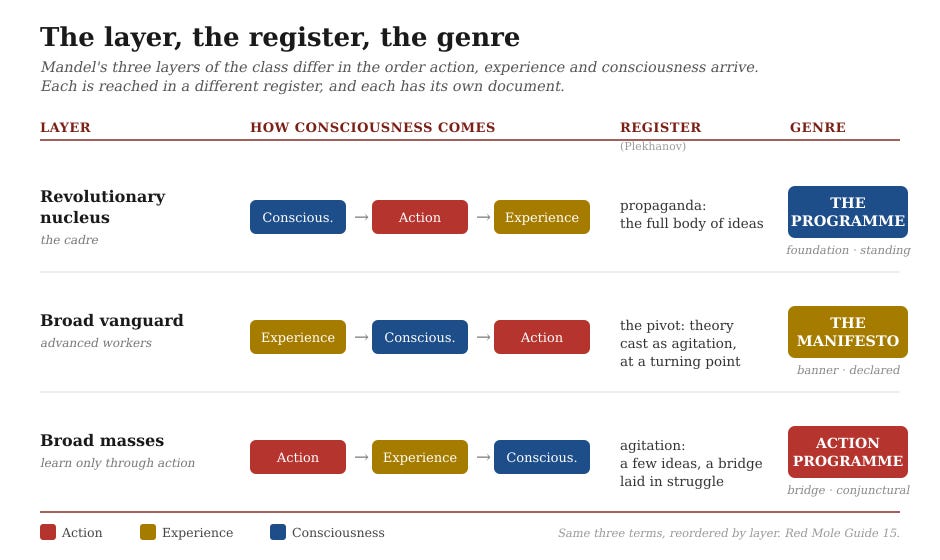
Equipping it means demands of a particular kind: simple enough to explain to a stranger who may disagree but will at least understand, concrete enough that a union branch or a student society could be argued into activity around one. The nineteenth-century movement had the maximum programme and Speakers’ Corner, and collected the few capable of hearing a totalising vision cold. The International Marxist Group built the Vietnam Solidarity Campaign the other way, through Labour and union branches, the growing women’s movement, student organisations, and published The Week, a duplicated bulletin where struggles spoke to each other in their own words, a 1960s caricature of Iskra. Dispersal across a dozen campaigns looked like weakness and turned out to be the thing that let ideas travel.
Look at why Skelton Grange was picked and the shape of a demand appears. The land was brownfield with industrial zoning and an accepted grid connection already attached. Microsoft went there because the connection was there and the planning was viable. That is the logic everywhere: compute lands where the connection is easy. Meanwhile the system pays out over a billion pounds a year to switch off wind in the north, because the transmission boundary south cannot carry it, and pays again for gas closer to the demand. So move the compute to the power instead of waiting for the power to reach the compute, and own the campuses publicly. A stranger follows that in one sentence; a union branch could vote on it; and it carries the argument about ownership and energy inside it without anyone having to say the word capitalism first.
Whether it is actually agitational, or only looks so from where I am standing, is a thing to test rather than assert, and there is a test. Does the demand fight the capitalist control of the technology rather than the technology itself; does it tell socially useful compute from the speculative kind; does it name someone who could act on it; does it stay on class ground, or could the nationalist right pick it up unchanged? Move-the-compute-and-own-it passes the first, the third and the fourth. Where it strains is the second, and the reach of its control: public ownership of the racks means little while the models are licensed from the same handful of firms that own the chips and the training data, and a demand that needs that much explaining before its second sentence may be a totalising demand in a hard hat. The real test is not mine to score. It is whether it can be put to a room of people who came out because two hundred diesel generators are proposed metres from a care home, and be recognised by them as their demand and not ours. Scotland is the only place with a national forum to try it in, and I have not seen anyone try.
Jessica correctly calls us pollinators. A pollinator’s job is to move pollen to where it can do something, and that is the whole of the job. Getting seventeen separate planning fights to think socially and act politically is that job exactly, and it is the work in front of us. A clear instance of the method was just discussed at this event, and is not on climate at all. The B.A.D. Coalition, Bodily Autonomy and Dignity, formed against the EHRC’s guidance on single-sex spaces and put a protest on the street as parliamentary scrutiny of that guidance ran out. It is small. On the opening Sunday of Congress it holds a meeting, Defending Trans Workers: the Fight for Bodily Autonomy, with Maria Exall of the TUC LGBT+ Committee on the platform alongside a PCS and a UNISON rep. Trans socialists taking their own struggle into a movement they were not part of, putting it in that movement’s terms, and getting that movement to send people: that is the leg nobody has run on climate, being run on something else.
We are running it on climate too, once, at the same Congress and with a number: a right to stop work above thirty degrees, twenty-seven for strenuous jobs, enforceable, a duty on the employer, Motion 29, the version of the emergency a branch can actually win. Two meetings, two days apart, in a town that empties of delegates on the Wednesday. What still stands on the Thursday is what nobody booking a room in Brighton this month gets to know in advance.