

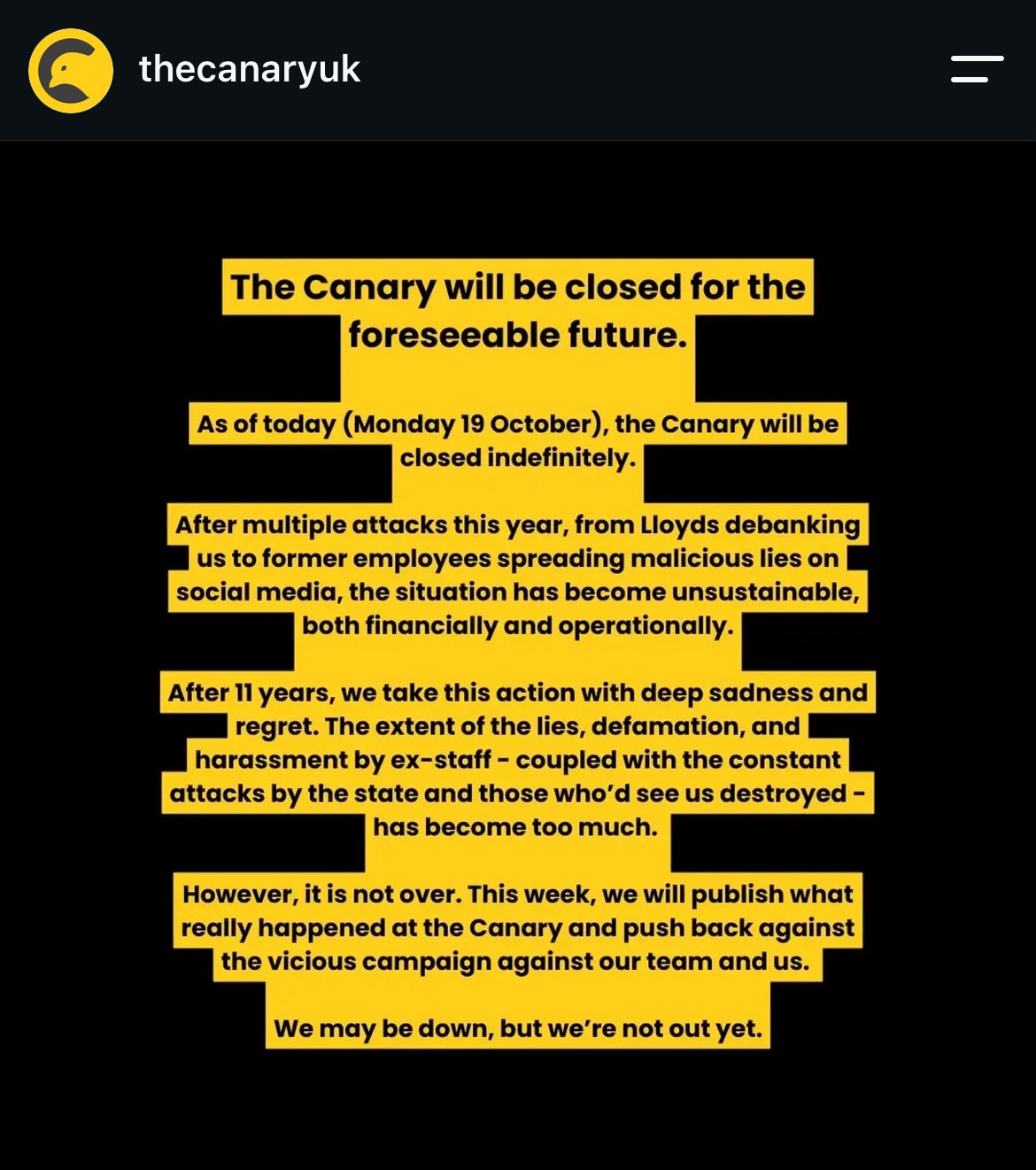
This morning the Canary announced that it is closed “for the foreseeable future”. After eleven years, the statement says, a year of attacks has made the operation unsustainable “both financially and operationally”. It names two causes: Lloyds debanking it, and former employees “spreading malicious lies on social media”. It promises to publish, this week, its account of what really happened.
We don’t intend to adjudicate the second cause. The dispute between the Canary and its former staff goes back at least to 2022, when staff took over the company and made serious allegations about how it had been run. Readers can weigh both sides when both sides are in. A socialist paper that takes a publication’s word against its workers, or its workers’ word against the publication, before the evidence is out isn’t doing anyone a favour.
The first cause is a different matter. It is a matter of record, it is not unique to the Canary, and it is aimed at all of us.
What happened
At the end of June, Lloyds closed the account the Canary had held for nearly a decade and kept back what the Canary called “a substantial amount” of its money. Lloyds said only that it does not comment on individual customers. The Canary had launched a daily print edition two weeks earlier, and it suspended the edition straight away. It moved its business to Metro Bank. On 4 September Metro froze that account too, again without giving a reason, and the Canary suspended operations. Some staff went unpaid for August. The day before, Bank of Scotland, which is part of the Lloyds group, closed George Galloway’s accounts after 39 years.
So the Canary did what the usual advice says. It found a second bank. The second bank did the same thing as the first.
It isn’t new, and it isn’t only the high street
Palestine solidarity has been the test case for twenty years. In 2005 Alliance & Leicester closed the Palestine Solidarity Campaign’s account. In 2015 the Co-operative Bank closed or restricted the accounts of about twenty Palestine organisations, PSC branches among them, and blamed due diligence on payments to “high-risk” places. Last year Virgin Money froze Greater Manchester Friends of Palestine’s account with more than £10,000 in it.
The case the left should study most carefully, though, is Unity Trust. Unity Trust is the bank the labour movement built for itself. Trade unions and the Co-op set it up in the mid-1980s, and our own archive finds it in 1986 being consulted over a Labour rally paper during the Wapping dispute (Socialist Action 142, 30 May 1986). Unions, campaigns and charities have banked there for forty years because it was ours. In June 2025 it froze the Scottish Palestine Solidarity Campaign’s account. The reason given was a donation link to Palestine Action on the SPSC website. SPSC took the link down once Palestine Action was proscribed. More than seventy unions, charities and community groups called for the account to be restored, and as far as we can find it is still frozen. Unity Trust’s statement could have come from Lloyds: there are “a variety of reasons why we may be required to, or decide to, suspend or close an account to meet legal and regulatory obligations”.
That is the point. A bank with a social purpose is still a bank. It is regulated by the same Financial Conduct Authority, it is bound by the same anti-money-laundering and counter-terrorism rules, and its compliance department reads the same “adverse media” screening reports as everyone else’s. When the state widens the definition of what is risky, whether by proscribing a direct-action group or by treating anything near Gaza as a high-risk payment, the ethical bank’s compliance officer sees the same flag as Lloyds does. Ownership determines who gets the profits. It does not determine who writes the rulebook.
None of this is a reason to avoid Unity Trust, Triodos or the building societies. Some of them may well be better to deal with than Lloyds. Triodos, for example, comes top in most ethical bank rankings and offers accounts to charities and businesses. But read its terms and you find the same clauses: it can close an account where it suspects a breach of law, regulation, sanctions or money-laundering rules, or where a customer no longer meets its eligibility criteria. The left press should look harder at the progressive banks before it relies on them. Ask before you open the account how the bank treats lawful political campaigning, payments connected to Gaza and adverse media, and get the answer in writing. And don’t confuse a shared ethos with a guarantee.
What a left publication should do
Take the risk seriously before it arrives. The Canary is a reader-funded outlet with paid staff and a print run. For a publication like that, a frozen account is not a nuisance. It is an existential threat, because payroll, the printer and the distributor are all paid from one place. Any left publication bigger than a mailing list should have a written plan for the day its main account is frozen. Where does money come in? Who gets paid first? How long can it keep going?
Spread the money, and spread it properly. The Canary had a second bank and lost both. Two accounts in the same jurisdiction, under the same regulator and run through the same screening vendors, don’t give you two independent risks. They give you one risk twice. Real diversification means accounts that won’t be frozen for the same reason on the same day.
Consider holding deposits overseas. For a publication with a sizeable reserve, that means a properly opened account with a bank in another jurisdiction: Ireland, the Netherlands, Germany or Scandinavia. A decision taken in London does not automatically reach it. This is not a way round UK law, and it shouldn’t be treated as one. A UK-registered organisation is still bound by proscription and sanctions law wherever its money sits, and a foreign bank does its own customer checks, which may well pick up the same British press cuttings. The UK deposit guarantee does not cover money held abroad. There are currency costs, and the accounts have to show up properly in the books. But the purpose is not to hide anything. It is to make sure one compliance officer’s decision can’t silence a publication by the end of the week. A reserve that pays the wages for three months while you fight a closure is the difference between a setback and a shutdown.
Don’t forget the payment rails. A reader-funded publication’s subscription income passes through card processors, platforms and donation services. Each of them can make the same decision a bank can, and some make it faster. Get the same written assurances, and have a second route in place.
Run a clean shop. This is the boring part, and it matters most. Publish your constitution and your officers. Keep accounts that can be audited. Hold donations to a strict policy. Keep campaigning content separate from fundraising links. Don’t link or pass money to proscribed organisations, however strongly you oppose the proscription. Oppose it in your editorials, not through your donate button. The SPSC case turned on one link.
A democratic demand, not a private grievance
Since April, new rules require banks to give ninety days’ notice before closing an account and, with exceptions, to give reasons. The exceptions include the anti-money-laundering and counter-terrorism grounds that banks invoke in exactly these cases. As drafted, the rules apply to contracts made on or after 28 April 2026, which would leave out an account held for a decade. The labour movement should demand that the protection covers every account, that a freeze for “regulatory obligations” has to be justified to an independent body within days and not months, and that money a bank is holding is never used to close a publication down before any wrongdoing has been shown.
That demand should be made for everyone. When Coutts closed Nigel Farage’s account in 2023, the left mostly enjoyed it. The right did not return the favour this summer. The Free Speech Union offered the Canary help, and few others on the right did. But a democratic right that you defend only for your friends isn’t a right. It’s a faction. The trade unions that own a stake in Unity Trust are in a better position than anyone to lead that campaign, starting with their own bank and SPSC’s money.
The left press has been here before. For a long time the weak point was the printer who wouldn’t print, or the wholesaler who wouldn’t carry the paper. Publications survived by owning presses, building their own distribution and never relying on a single supplier who could say no. The bank account is that weak point now. The Canary says it is down but not yet out. Whether it comes back or not, the rest of us should be learning the lesson now, while our accounts are still open.
Sources: Canary on the Lloyds closure, 30 June 2026; Press Gazette on the print edition and the Metro freeze; New Arab; Press Gazette on the 2022 staff takeover; Third Sector on SPSC and Unity Trust; Third Sector on the Co-op closures; Byline Times on Virgin Money and GMFP; Triodos business and charity terms; HM Treasury, contract termination rule changes; Socialist Action 142 (30 May 1986).
"A socialist paper that takes a publication’s word against its workers, or its workers’ word against the publication, before the evidence is out isn’t doing anyone a favour." Correct.
But then how is impunity for publishing articles from Iranian state, glorifying the killers of workers, ethnic and religious minorities and gender apartheid in Iran?
Duncan very helpful article, thanks