

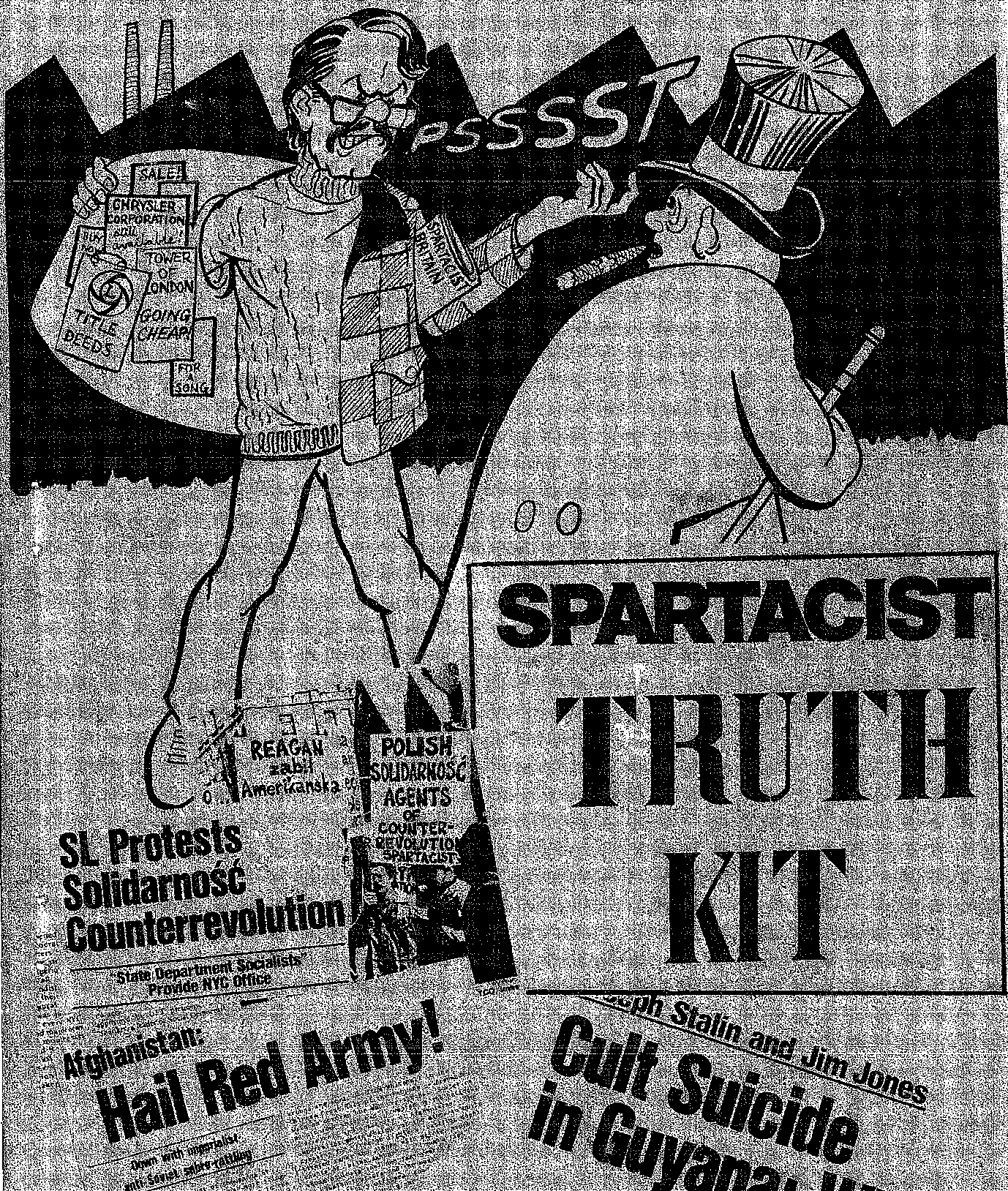
The question of how revolutionary socialists should approach elections, particularly when faced with the necessity of potentially voting for non-revolutionary, or even bourgeois, parties, has been a long-standing and often divisive debate within the Marxist movement. This was a central point of contention between the Workers Socialist League (WSL) and the Spartacist League (SL), as documented in the WSL's "Spartacist Truth Kit". The pamphlet extensively criticised the Spartacists' sectarian abstentionism. More recently, the International Communist League (ICL), of which the Spartacists are a part, has issued a self-criticism in the document "Revisiting Marxist Electoral Tactics", challenging some of its previous stances on electoral work. Adding a new dimension to this discussion is the ICL's recent analysis of the situation in Argentina, which includes the slogan "For a FIT-U/CGT/CTA Government!". Using the illuminating case of Argentina, we can examine the nature of the Spartacists' criticised "old" policy, the improvements offered by the ICL's "new" position, and where potential weaknesses might remain.
The WSL's Critique: Sectarian Abstentionism and the "No Support" Principle
A major flaw of the Spartacist League was its rigid position of "No support to Popular Fronts". The WSL argued that the Spartacists elevated this into an absolute "principle", leading to a policy of practical abstentionism in elections where workers' parties were involved in alliances with bourgeois forces.
The WSL contended that this stance was a distortion and falsification of historical Trotskyism. The "Spartacist Truth Kit" argues that Leon Trotsky advocated a tactical approach to such situations. While opposing the Popular Front alliances themselves, Trotsky, particularly concerning the Popular Fronts in France and Spain in the 1930s, argued for tactically supporting the workers' parties participating in these fronts, especially in runoff elections, as a means to defeat more reactionary candidates and engage with the masses who supported these parties. The WSL accused the Spartacists of inventing their "principle" of no electoral support, particularly for workers' parties in popular fronts, to justify their sectarianism and detachment from the class struggle. The WSL saw this rigid position as symptomatic of the Spartacists' broader sectarianism and their concept of a "fighting propaganda group" isolated from the day-to-day struggles of the working class. Their abstentionist stance in elections was viewed as incapable of connecting with and winning over the masses who still held illusions in bourgeois democracy and electoral processes.
The ICL's Self-Criticism: Abandoning Formalism
Decades after the "Spartacist Truth Kit", the ICL has issued a self-criticism in "Revisiting Marxist Electoral Tactics", specifically repudiating its 2007 position that it was unprincipled for Marxists to run for or take executive offices in capitalist governments. The article explicitly labels the prior approach, and the method behind it, as "sectarian and doctrinaire", based on "formalistic thinking and scholasticism completely alien to Marxism".
The core criticism is that the old position, like the one on executive posts, propagated abstract principles "totally divorced from the living struggles of the masses and the bourgeois illusions they hold". It offered "nothing to combat [illusions in bourgeois democracy] apart from abstract propaganda and the false answer of abstaining from participation in elections to executive offices". This method failed to engage with the working class on its own terrain and help it learn through experience.
The ICL now advocates for a “Marxist method” that approaches elections from the standpoint of advancing the class struggle, applying principles concretely, and engaging with workers' illusions in bourgeois democracy by participating in elections and, in specific circumstances, even taking executive posts. The aim is to use these platforms to expose the capitalist state and advocate for the need for workers' power. The article specifically criticises the idea of inventing "principles" based on internal motions rather than the development of the class struggle itself. "To ponder over the separation of powers, to pick and choose which terrain to wage battle on or which tool to use is something they did not have the luxury of doing and a method they wholeheartedly rejected," the document states, arguing that the "battle had to be brought into all spheres of social life". The position of rejecting "on principle" participation in a particular type of election or post is deemed "grotesque".
The 2002 French Election: A Case Study in Tactical Voting
The 2002 French presidential election runoff between conservative Jacques Chirac and far-right leader Jean-Marie Le Pen provides a concrete scenario to assess socialist electoral tactics. In this situation, the traditional left had collapsed, and a significant anti-fascist mobilisation occurred in the streets. The revolutionary left was divided.
Lutte Ouvrière (LO) maintained a hard-line position, arguing both candidates served the bourgeoisie and calling for a blank vote or abstention, refusing to join an "anti-fascist front" with bourgeois parties.
The Ligue Communiste Révolutionnaire (LCR) ultimately called for a vote against Le Pen, interpreted as a vote for Chirac, framing it as necessary to "block the way for the extreme right in the streets as in the voting booth". Crucially, they immediately linked this defensive vote to the need to prepare for struggle against Chirac's policies from the next day.
The LCR's approach was the "best tactical choice" in engaging with the mass anti-fascist sentiment while positioning the organisation to lead the struggle against the bourgeois winner. This scenario involved voting for a bourgeois candidate against a qualitatively worse fascist threat, and the lessons drawn include the possibility of "Tactical Voting in Runoffs" in such exceptional cases, involving a defensive vote against the greater evil without politically supporting the lesser evil's program.
Argentina: Spartacist mistakenly criticises the left ‘from the right’
The situation in Argentina under Javier Milei presents a different, but related, challenge concerning how socialists relate to existing mass organisations and the question of government. The country faces a devastating economic crisis and austerity measures, met by partial struggles led by the Peronist-controlled CGT and CTA union federations. These union leaders are criticised for betraying workers' interests, upholding capitalist interests, and seeking illusory compromises.
To the left of the Peronistas is the Workers and Left Front-Unity (FIT-U), an electoral alliance of several Trotskyist organisations. The left correctly supported the FIT-U in the 2023 elections. While the FIT-U parties denounces the bureaucracy's betrayals, the Spartacists criticise their method. It argues they portray the struggle as a "rising tide" while the Spartacists see dangerous stagnation. Crucially, the FIT-U are criticised for their approach to the unions, responding to the bureaucracy's betrayals by advocating that workers organise "independently," i.e., separately from the passive CGT and CTA unions. This creates an intriguing position, previously unthinkable but now repeated, in which the Spartacists criticise larger Trotskyist currents as being ultraleft. For the ICL, the organising of alternative, fighting unions is a mistaken attempt to work around the fundamental obstacle of the union bureaucracies (although, for example, the LCR and NPA in France have successfully organised in alternative unions) instead of focussing on attempts to replace the leaders of the bureaucratized unions with revolutionary leadership. The ICL describes what it calls a boycott of the May Day demonstration called by the unions by most of the left (PTS, MST, etc.), and even organising "independent columns" (PO, Izquierda Socialista), a stark expression of a sectarian perspective. Broadly speaking, this criticism from the ICL seems to be turning a tactical issue, whether or when to work through bureaucratised unions, into a principle: the same issue as that criticised by the WSL, but with the Spartacists’ polarity flipped.
In contrast to the mainstream approach of the Argentine left, the ICL's leafleting in Argentina advances a specific slogan: "For a FIT-U/CGT/CTA Government!". This is explicitly posed as a "perspective of political struggle for workers power" and an alternative to the dead ends of neoliberalism or a return to the hated Peronistas. The ICL notes that the FIT-U parties object to this slogan because it includes the unions, which they see as led by traitors. The ICL's counter-argument is sharp: "For the unions to fight for a workers government, the Peronista leadership needs to be removed and replaced with genuine revolutionaries... what the FIT-U’s objections reveal is that they simply cannot comprehend that the task of communists is to lead the unions in place of the Peronistas—not least by aiming for a government of trade unions and revolutionary parties, i.e., a workers government". The ICL recognises the FIT-U as the "political vanguard of the working class in Argentina". The call for a FIT-U/CGT/CTA government is posed as a way to address the problem that while workers support demands, they don't see who will accomplish them. The ICL argues that raising the slogan for an alternative government, even when the working class is not ready for power, is necessary to advance the cause and give workers something to fight for.
How Far Has the ICL Improved?
The ICL's self-criticism and the approach in Argentina represent a significant methodological shift away from the abstract, formalistic, and often abstentionist approach criticised in the "Spartacist Truth Kit". By repudiating the "principle" against running for executive office and instead stressing the need to engage with workers' illusions through electoral participation, the ICL's new stance is more aligned with the Marxist principle of linking party work to the realities of the class struggle. This is a clear departure from the "pure" sectarian activity the WSL accused them of. The ICL now explicitly advocates using elections and executive posts as "weapons in the struggle against the bourgeoisie".
The ICL’s call for a "FIT-U/CGT/CTA Government!" in Argentina, despite the widely acknowledged treacherous leadership of the unions, certainly indicates a move away from sectarian boycotting of mass organisations. The old Spartacist method often involved standing aloof and denouncing from the sidelines. In contrast, this slogan is a call for a government based on the major existing mass organisations of the working class and the left, aiming to link the fight for immediate demands to the struggle for workers' power. While the sources we reviewed don’t explicitly state that the ICL would therefore advocate voting for the FIT-U, CGT or CTA in a hypothetical runoff scenario against Milei, the slogan itself implies a tactical political engagement with these forces as the material basis for a workers' government, rather than dismissing them entirely based on the flaws of their current leaderships or perceived focus on electoralism. This orientation aligns more closely with the tactical flexibility advocated by Trotsky and stressed in the "Spartacist Truth Kit" regarding united fronts and engaging with the masses where they are.
However, the "Revisiting Marxist Electoral Tactics" article primarily focuses on the ICL's own participation (running for/taking executive office). While it criticises past scholasticism and advocates a more dialectical approach, it does not explicitly re-evaluate in detail the specific historical debates concerning voting for other workers' parties within Popular Fronts, which was a key focus of the WSL's critique of the Spartacists' "No support to Popular Fronts" principle. The 2002 French election case, while involving a tactical vote against a fascist threat, was distinct from the historical Popular Front scenario as it involved voting for a bourgeois candidate against the far-right threat. The Argentina slogan calls for a government of workers' organisations, which is fundamentally counterposed to the concept of a Popular Front that includes bourgeois parties.
Therefore, while the ICL's new position marks a significant improvement by rejecting abstract abstentionism and embracing a more tactical, class-struggle oriented approach to electoral work in general, particularly concerning their own campaigns, it does not explicitly detail how this new method applies to voting for other workers' parties in various complex scenarios (like alliances or runoffs against non-fascist reactionaries, which were central to the WSL's critique). The broader methodological shift suggests greater potential for tactical flexibility, aligning more with historical Trotskyism as interpreted by the WSL on tactical voting and united fronts, but the specific implications for critical electoral support to other parties in complex coalitions or runoffs remain less explicitly defined in the presented ICL self-criticism and the Argentina text when compared to the detailed critique in the "Spartacist Truth Kit". The Argentina slogan demonstrates the application of the new method in advocating for a workers' government based on existing mass organisations, which is a positive step away from sectarian isolation, but it is not a direct statement on electoral tactics for those organisations in every scenario.