

TL;DR: A hostile commenter on our original article issued a challenge: define exactly what trans liberation entails, and the argument would collapse. This article accepts that challenge — and reverses it. The Trans Liberation Group’s programme grounds trans liberation in class struggle, bodily autonomy, and democratic accountability. The YPML’s founding statement calls for the legal exclusion of trans women from spaces of safety, the deliberate dissolution of the LGB/T political alliance, and a “freedom of expression” framework that shields gender-critical positions from democratic accountability. One of these is socialist politics. The other is the culture war, imported into a socialist party and dressed in the vocabulary of the second wave. A postscript responds to initial comments on this post, including the finding, disputed by two readers, that trans women, like cis women, do more domestic labour than men.
A reader left a challenge in the comments under the original article, How Trans-Exclusion Became the Conservative Left’s Fifth Column. The demand to specify what trans liberation actually entails, she wrote, was legitimate: “The day you actually list EXACTLY what ‘trans liberation’ entails is the day your arguments lose all credibility.” The implication was that the programme, once stated plainly, would prove the case against it. Answer the challenge, lose the argument.
This article accepts the challenge. And then reverses it.
Here is what trans liberation entails. Here is what the Your Party Materialist Left proposes instead. Read both carefully. Then ask: which of these programmes is grounded in working-class politics, and which is a transmission belt for the legal infrastructure of the culture war right?
What the Trans Liberation Group Actually Says
The Trans Liberation Group‘s founding statement opens not with identity but with material conditions: “There is no trans liberation without class liberation. Trans people are disproportionately affected by issues with housing, education and employment. We are 66% more likely to need benefits. Domestic labour disproportionately falls on trans women, as it does on all women.”
Read that again. Domestic labour disproportionately falls on trans women — as it does on all women. This is Social Reproduction Theory, not liberal identity politics. The TLG grounds trans liberation explicitly in class struggle, rejecting what it calls the precarity of “freedom secured through liberal channels alone.” Its founding statement insists that liberation is “achievable only through active and equal participation in class struggle.” That is not the language of NGO diversity management. It is the language of historical materialism.
The demands themselves are concrete. Demand 0, the structural one, calls for democratic accountability within Your Party: a transparent disciplinary process, representation for trans people in party structures, compulsory political education for elected representatives. Nothing there that a trade unionist committed to democratic accountability could object to on principle.
Demand 1 addresses the legal position following the April 2025 Supreme Court ruling: amend the Equality Act to define sex as current lived sex, enshrine self-identification of gender, abolish gender markers from official documentation, reject restrictions on trans people’s access to public bathrooms and gendered spaces. Demand 2 covers conversion therapy, privacy rights, sex work decriminalisation, PIP. Demand 3 covers healthcare: end the puberty blocker ban, make HRT available on an informed consent basis, expand gender-affirming surgeries on the NHS, legally enshrine bodily autonomy — including, notably, the complete decriminalisation of abortion.
Not a single demand is incompatible with socialist feminism. Several — decriminalising abortion, ending the exploitative GIC pathway, guaranteeing bodily autonomy — are straightforwardly feminist demands that serve women whether trans or cis. The programme is, as Duncan’s reply to the comment thread noted, progressive. The reader’s response to that observation was: “Progressive demands??” — the double question mark doing the argumentative work that an argument could not.
What the YPML Actually Wants
Now read the YPML’s founding statement, “WHO ARE WE?”, published on the Materialist Left Substack in November 2025.
The YPML declares itself “a group of materialist socialists and feminists” who believe in “the reality of biological sex.” Fine — no serious Marxist denies that biological sex exists, or that capitalism organises the exploitation of women’s bodies through it. That is not where the YPML’s programme ends up.
It calls explicitly for “lawful provision of single-sex space for women and girls, including changing rooms, hospital wards, sanitary and sleeping accommodation, refuges, hostels and prisons.” The legal provision in question is the post-Supreme Court ruling that trans women can be lawfully excluded from these spaces as women. The YPML is not merely observing that the Supreme Court ruled this way; it is affirming that ruling as a positive achievement for women’s rights.
Consider what this means in practice. A trans woman fleeing domestic violence is excluded from a women’s refuge. Not because she has committed any offence. Not because any risk to other residents has been established. Because she is trans. This is presented as a victory for working-class women.
The YPML also “objects to the widespread use of the acronym LGBTQ+” because it “force teams” lesbians, gay men and bisexuals with trans and queer people. This is the explicit political goal documented in the YP cheat sheet: “Gay, lesbian and bisexual people should not be in political alliance with trans people.” No trade union ever demanded this. No tenants’ association ever put it on their agenda. No community campaign ever organised around it. This demand emerged from the same political infrastructure — Fair Play for Women, Sex Matters, the LGB Alliance — that has spent a decade engineering the culture war. The YPML has imported it into a socialist party and called it materialist analysis.
And when asked, at the founding conference of Your Party, to sign the joint statement “For a Member Led, Socialist Party” — the document endorsed by the Democratic Socialists of Your Party, the Trans Liberation Group, the Eco-Socialist Horizon, Organising for Popular Power, and the Democratic Bloc — the YPML declined. Every democratic-left faction in Your Party signed. The YPML stood apart. The YP cheat sheet records this plainly, listing under YPML alliances and slates: none.
The “Freedom of Expression” Framework
Valerie Coultas’s resignation statement introduces a concept that runs through the YPML’s entire practice: “Freedom of Expression and the right for women to express their own views in our branches must be made an absolute principle.” The motion she put to the Lambeth branch, and which was defeated, enshrined this principle — not as a positive programme but as a constitutional protection against accountability.
Note the architecture of the demand. Freedom of expression as an absolute principle means: no organisational consequences for positions that a democratic majority has already voted against. The Lambeth branch voted 35-5 to affirm trans liberation in line with party policy. That vote, on the YPML’s logic, cannot bind those who disagree. The majority have no right to implement their decision. The minority have an absolute right to go on advancing positions the branch has formally rejected.
This is not socialist democracy. It is the liberal rights framework — the one the conservative left has spent fifty years correctly identifying as a bourgeois distraction — deployed selectively to protect gender-critical positions from the democratic process. The Shahrar Ali employment tribunal victory gives this the force of law: gender-critical beliefs are philosophical beliefs protected under the Equality Act, which means any attempt at organisational accountability becomes legally exposed. The YPML did not invent this architecture. It inherited it. The legal infrastructure was built by the same organisations whose programme the YPML has adopted.
The Ameen Hadi case is instructive here — not as the YPML’s critics might have it, but in a more complicated way. The YPML’s statement in solidarity with Hadi, the UNISON steward attacked by far-right YouTubers at the Together Alliance rally, is unambiguous: it condemns the harassment, defends the anti-racist campaign, and explicitly distinguishes political disagreements from solidarity against the far right. This should be acknowledged. The YPML is capable of principled anti-fascist solidarity. But the same statement that defends Ameen Hadi is published by the same tendency that wants to exclude trans women from domestic violence shelters. The contradiction is not incidental to the YPML’s politics. It is its politics: solidarity available selectively, liberation offered conditionally, the working class defended as long as its most vulnerable members remain outside the definition.
Which Is the Conservative Programme?
The reader’s challenge was framed as a trap. State the demands, and their radicalism will damn them. One demand in particular she expected to land hardest: trans people’s right to access gendered spaces by self-ID, including prisons.
This is a serious question. It deserves a serious answer, not an assertion. The evidence on trans women in women’s prisons shows elevated rates of prior sex offences among trans women inmates compared to cis women — and rates far below cis men, comparable to cis women when adjusted for population. The question of prison policy is a genuine one. But it is worth noting that the same reader who raised it had, earlier in the thread, claimed that trans women are more likely to be convicted of sexual assault than to be victims of male violence — a claim that is straightforwardly false, and which she did not retract when challenged. The serious question was being deployed as cover for an unserious claim.
More fundamentally: the TLG’s demands can be argued with. One can disagree with self-ID access to all gendered spaces while remaining within socialist politics, provided the disagreement takes the form of evidence and argument rather than the assertion that trans women are men. What one cannot do — and remain within socialist politics — is assert that breaking the political alliance between gay, lesbian and bisexual people and trans people is a working-class demand; that the Supreme Court ruling that allows domestic violence shelters to exclude trans women is a feminist victory; that freedom of expression requires constitutional protection from democratic accountability.
The YPML presents itself as materialist socialists defending hard-won working-class and women’s rights against liberal identity politics. Its published programme tells a different story: the explicit dissolution of a solidarity alliance that workers built, the legal exclusion of trans women from spaces of safety, the deployment of liberal rights frameworks to defeat socialist democracy from within. This is not a mirror image of the TLG’s programme. It is a programme built from components manufactured outside the labour movement and imported into it.
The Challenge, Answered
The reader who demanded that trans liberation be defined in full left the thread before the exchange was done. “I am leaving this conversation now,” she wrote, “as have important work to do regarding my rights.” The timing is worth noting. She left after the demands had been quoted back to her, having called them progressive in a tone of contempt — and having offered no counter-argument as to why they were not.
She did, before leaving, make one substantive point: that Red Mole uses AI tools in research and drafting, the implication being that this invalidates the analysis. This is the argumentative equivalent of noting that a car uses petrol. The analysis stands or falls on its evidence. The evidence is the YPML’s own documents.
The challenge was: tell us what trans liberation entails. Here is what it entails: bodily autonomy, legal existence, healthcare access, democratic accountability, class struggle as the basis for liberation. These are progressive demands. The question is not whether they are well-defined. They are defined, in detail, in public, on the TLG’s website.
The question is whether the YPML’s alternative is socialist. On the evidence of its own founding statement, its own electoral behaviour, its own constitutional demands, the answer is no. It is the culture war, dressed in the vocabulary of the second wave, operating inside a socialist party as precisely the transmission belt the original article described.
The challenge has been answered. The reversal stands.
Postscript: On domestic labour and the quality of objections
A reader, Roy, challenges the claim from the Trans Liberation Group that “domestic labour disproportionately falls on trans women, as it does on all women.” He finds this offensive and implausible. It is worth addressing, not because Roy’s objection is sophisticated, but because the evidence is interesting.
The claim is that trans women, like cis women, do more domestic labour than men. This is what “disproportionately falls on trans women, as it does on all women” means: not that trans women do more housework than cis women, but that they are subject to the same gendered domestic burden. The research supports this through several distinct mechanisms. Trans women face severe labour market discrimination — unemployment rates roughly three to four times the general population in comparable studies — which reduces their bargaining power within households and increases domestic specialisation. The “doing gender” framework, well established in the sociological literature, predicts that individuals under pressure to demonstrate gender legitimacy will perform domestic labour with greater intensity, not less. Trans women, whose gender is routinely challenged by institutions and individuals, are under precisely that pressure. Beyond this, trans women carry an additional “third shift” of transition management — healthcare navigation, legal administration, safety labour — that cisgender women do not. Housing instability, disproportionately experienced by trans women, produces what researchers describe as “invisible rent”: domestic labour performed for hosts as a condition of continued shelter.
Does Roy genuinely believe that trans women, as a group, do less domestic labour than men? That would be the position required to contest the TLG’s claim. He does not make it. He asks instead about reproductive labour — by which he appears to mean biological reproduction — as though the inability to bear children disqualifies trans women from the domestic burden that falls on women generally. This is a non-sequitur dressed as a materialist objection.
The broader pattern of objections in this thread — Diane’s repeated copy-pasting of earlier comments, Roy’s rhetorical questions without substantive argument — does not require further response here. Readers can assess the quality of the engagement for themselves.
How to protect both cis women and trans people from discrimination?
Conor has put the passport point precisely and I won’t repeat it. The broader observation — that this entire exchange treats the current legal settlement as the natural baseline rather than a recent and contested political outcome — is exactly right. The Supreme Court ruling is four months old. The Equality Act is fifteen years old. Presenting them as the eternal framework within which “women’s rights” must be defended, rather than as one legal settlement among possible others, is a rhetorical move, not an argument.
The question Diane’s AI analysis doesn’t ask is the one that matters: what would a legal framework designed to protect both cis women and trans people from discrimination actually look like? That is the question the TLG’s demands are trying to answer. Whether their specific proposals are the right ones is a legitimate debate. But the debate has to start from the recognition that the current settlement was not handed down from above — it was fought for by some people, against the interests of others, and it can be changed.
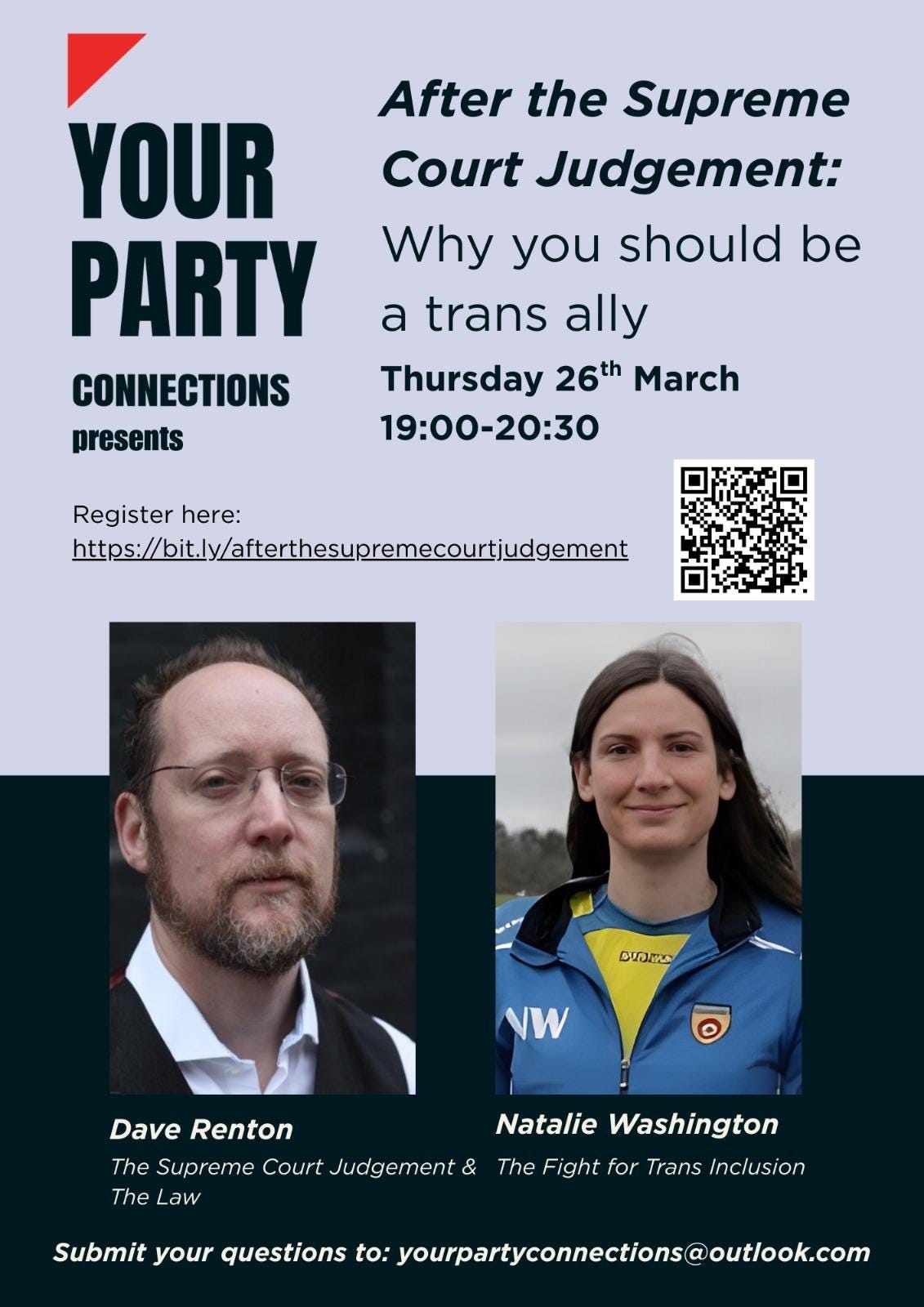
Thursday: “Why you should be a trans ally“
There’s a great opportunity to hear two great speakers address this topic. The timing is significant — the event falls during the FvT Week of Action, which ends on Transgender Day of Visibility.
Dave Renton is an excellent choice for this event. A barrister, historian and socialist, he is a former member of the SWP who resigned in 2013 during the “Comrade Delta” crisis and became a founding member of rs21. He has written directly on trans liberation from a socialist legal perspective, arguing that “all domination must be excluded, including the domination of transphobes over trans lives,” and his piece “Legal Abolition, Trans Liberation, Working-Class Tolerance” engages directly with the For Women Scotland ruling. He is therefore speaking precisely to the Supreme Court judgement framing of the event. His Substack, D K Renton, has significant audience overlap with Red Mole — it’s one of the three publications our stats identify as sharing readers.
Natalie Washington is the lead of the Football v Transphobia campaign. She had been with her club Rushmoor Community FC for ten years while voluntarily delivering training and consultation on trans inclusion, and received an Advocacy Award from the European Gay and Lesbian Sports Federation at EuroGames Lyon 2025. She is leading the FvT 2026 Week of Action, running from March 25 to 31, and notes that transphobic abuse reported to Kick It Out has doubled in each of the last three completed seasons.
This article is a follow-up to “How Trans-Exclusion Became the Conservative Left’s Fifth Column,” published 11 March 2026.
Related Reading:
The Persistent Struggle for Women’s Liberation Within Traditional Left Organisations: Revolution’s Blind Spot?
The Histadrut, and the Property Question the AWL Apparatus Erased: The Drift, Part Three
Together Alliance & the London March: Why Anti-Racism Needs Roots, Not Just Routes: What Your Party should do (and what it shouldn’t)
What Makerfield Tells the Socialist Federation: The amendment that Makerfield makes necessary
Reform’s Perfect Crime: What Your Party Still Refuses to Understand About Reform UK and Working-Class Women
Keep up the good work. The culture war is obviously the class war on a different terrain -- it's good to see that stance expressed so cogently and concretely.
Great work! Thank you very much indeed for the solidarity, especially today (I've just got back from the Trans Pride Scotland rally).