

Last week, the US government took an unprecedented 9.9% stake in Intel for $8.9 billion, marking the largest direct state intervention in a strategic industry since the 2008 financial crisis. This investment, a conversion of previously promised funds under the U.S. CHIPS and Science Act ($5.7 billion) and the Secure Enclave program ($3.2 billion), provides Intel with massive capital to expand domestic semiconductor manufacturing and build a more resilient supply chain. While officially presented as benefiting taxpayers through a discounted investment, this rare departure from typical US non-intervention in private enterprise—complete with a five-year warrant for additional shares—represents something far more significant. For revolutionary strategists, this development offers stark confirmation of Ernest Mandel's long-standing predictions about how advanced capitalism manages its inherent contradictions through state-guaranteed monopoly profits.
To understand this contemporary event, we must employ Ernest Mandel's "totalizing approach," which sought to ally robust Marxist economic theory to a general interpretation of the historical unfolding of modern capitalism. Mandel's framework, articulated in seminal works like Late Capitalism (1972) and his 1971 article "What is American Imperialism" (below, reprinted from Red Mole in 1971) posits that seemingly isolated events like government interventions in key industries are manifestations of deeper systemic drivers. He sought to "scrutinize capital with one's eyes wide open" to reveal how capitalism's internal logic—particularly the crisis of capital overaccumulation and declining average rate of profit—necessitates state intervention to sustain monopoly profits and manage its own crises.
Mandel's Predictions Vindicated: State Intervention and Inter-Imperialist Rivalry
Mandel's analysis of the fundamental economic roots of advanced capitalism provides a compelling explanation for the Intel investment. He contended that imperialism is not merely a policy choice but an "unavoidable product of the internal contradictions of monopolistic capitalism." The core issue, as Mandel saw it, was the existence of a "surplus of capital" that, due to a "decline in the average rate of profit," struggles to find sufficiently profitable investment opportunities in traditional sectors and thus seeks "superprofits" abroad. This problem intensifies in the "principal imperialist citadel" where the sheer volume of capital cannot be profitably invested in "normal sectors of the economy."
A critical mechanism for absorbing this surplus capital, as Mandel argued, is the "permanent arms economy" serving as a "substitutive field of unparalleled investment." This means substantial portions of capital are directed into military and strategic industries, where profits are often state-guaranteed, providing an artificial outlet for overaccumulated capital. The Intel investment, explicitly linked to the U.S. CHIPS and Science Act and the "Secure Enclave program," places semiconductors squarely within this category of state-backed strategic industries. This spending functions as an "artificial outlet" for surplus capital, creating a "continuous cycle of investment and obsolescence" that sustains profitability and counteracts the tendency toward long-term stagnation.
Mandel also highlighted the increasing importance of "technological rents," defined as surplus-profits derived from monopolizing technical progress through patents, large investments, and control over production. By providing this "massive infusion of capital," the government enables Intel to maintain and enhance its technological lead, effectively reinforcing its capacity to generate these "technological rents" in a high-stakes, high-tech sector.
Crucially, the Intel investment must be understood within the context of inter-imperialist competition. Mandel rejected the idea of "super-imperialism" in favor of a "continual struggle of imperialist forces." The drive to "compete more effectively" in semiconductors is directly linked to intensifying global rivalry, particularly between the United States and China. This rivalry manifests as a "multi-front struggle for dominance over the world system," encompassing trade wars, technological competition in AI and cybersecurity, and military build-ups. The investment serves to lessen dependence on overseas factories, particularly those in Taiwan, which is a geopolitical hotspot. This strategic calculation perfectly aligns with Mandel's analysis of how state intervention supports "the logics of profit-seeking of the private and power of the state" in fused imperialist strategy.
European Left Divisions Expose Strategic Contradictions
The Intel investment gains additional significance when contrasted with the fragmented response of European left parties to similar industrial policy questions. Recent analysis reveals that while European left parties share broad support for state intervention, they are deeply divided on whether to pursue "economic patriotism" at the national level or coordinate industrial sovereignty through EU institutions.
Germany's split between Die Linke and the new Bündnis Sahra Wagenknecht (BSW) exemplifies this tension. Die Linke maintains its traditional internationalist position, supporting state intervention through "democratic socialization" of key sectors while remaining committed to European integration. BSW, however, combines left-wing economic demands with explicit "economic patriotism," viewing Europe as a "digital colony of the United States" and advocating for national sovereignty over strategic industries.
In France, the New Popular Front alliance attempts to reconcile La France Insoumise's "souverainist" ideology—which sees the nation-state as the "only legitimate vessel of popular sovereignty"—with coalition partners who favor EU-level industrial coordination. This tension forces uncomfortable compromises between anti-capitalist principles and pragmatic electoral politics.
These divisions reveal a crucial strategic weakness. While parties like BSW and LFI frame their positions as "anti-imperialist," their economic nationalism actually reinforces inter-imperialist competition rather than challenging it. By shifting focus from global class struggle to national economic protection, they inadvertently serve the very imperialist logic Mandel identified—where states compete to secure their monopoly capital's position in global markets.
Strategic Lessons: Beyond State-Monopoly Integration
The US government's Intel investment, viewed alongside European left fragmentation, offers crucial lessons for revolutionary organizations:
1. Expose the Socialization of Risk: The Intel stake represents a textbook case of socializing losses while privatizing profits. While investors celebrated the government backing with rising stock prices, taxpayers bear the risk if Intel underperforms—as occurred with the General Motors bailout. Revolutionary analysis must highlight how "passive" government ownership still guarantees corporate profits without democratic control.
2. Challenge Imperialist Competition Through Internationalism: The fragmentation of European left parties over "industrial sovereignty" demonstrates the danger of economic nationalism masquerading as anti-imperialism. Rather than choosing between US and Chinese dominance, revolutionary strategy must build genuine international solidarity that transcends national economic interests.
3. Connect Industrial Policy to Democratic Planning: The increasing integration of state and monopoly capital—evidenced by the "blurring of lines between public and private sectors"—creates openings for demanding genuine democratic control. Instead of state interventions that reinforce capitalist structures, campaigns should demand public investment in sustainable industries under worker and community control.
4. Build Anti-Imperialist Clarity: The Intel investment's role in US-China technological competition underscores how domestic industrial policy serves broader imperialist strategy. Revolutionary organizations must develop analysis that connects local economic policies to global power struggles, avoiding the trap of supporting "our" national capital against foreign competitors.
The Intel investment perfectly illustrates Mandel's insight that late capitalism requires ever-greater state intervention to manage its contradictions. But this intervention comes at the cost of further socializing risks while maintaining private control—exactly the dynamic revolutionary movements must challenge through demands for genuine democratic planning and international solidarity against all imperialist powers.
Ernest Mandel: What is US Imperialism?
The article appeared in volume two, issue two of Red Mole, January 16, 1971.
The manifestations of American imperialism began to appear as early as the nineteenth century, relative to Latin American countries, and later in the Pacific zone (expansionism towards Japan, conquest of the Philippines). Since the beginning of World War I, American imperialism has extended itself on a global scale. Thus, in the framework of inter-imperialist competition, American imperialism appears as the great victor of two imperialist world conflicts. In point of fact, it is the only victor whose military and economic forces gained from these two wars. All of the principal competitors were enfeebled by either one or both of these conflicts.
It is not necessary to examine in detail the causes of this superiority of American imperialism over her competitors. The principal reasons are well known: immense richness in raw materials; greater equilibrium between industry and agriculture; broader territorial and demographic bases, which permitted the enjoyment of important economies of scale in matters of industrial mass production; the absence of semi-feudal vestiges, which allowed the expansion of a purer capitalism than that of the other imperialist countries.
The Dialectical Process
It must be accentuated, however, that the ascent of American imperialism towards the position of the first power in the world represents a dialectical process during which the contradictions of the rest of the world have had a tendency to breed, even in the midst of American society. The imperialist American bourgeoisie cannot engage in this expedition towards world domination without at the same time assuming the leadership of the entire capitalist world. In that position they are confronted by anti-capitalist forces which each day grow more numerous and powerful.
Because of this fact, American imperialism is often directed in its decisions by the political imperatives involved in the global defense of the international capitalist system, a system which at times may enter into conflict with the particular historical interests of American imperialism itself.
The Marshall Plan
The Marshall Plan has to be interpreted in this light. Far from being an enterprise of the pastoralization of Europe or of its submission to the will of Washington, historically the Marshall Plan was the initial phase in the reconstitution of an autonomous force in Western European imperialism—that is to say, precisely the recreation of a force competitive with that of the United States.
This decision was not, however, irrational. It simply reflects a choice between two evils, both of which Washington had to face following the Second World War: either assist in the collapse of West European capitalism, or permit the reappearance of a powerful competitor. American imperialism chose the lesser evil, by its lights.
These prefatory remarks are essential in order to avoid falling into economism, and to prevent too simple an interpretation of the economic roots of American imperialism.
1. Surplus and Export of Capital
The principal economic root of American imperialism remains the one classically defined by Lenin for the whole imperialist era: the existence, in imperialist countries, of a surplus of capital which is poured into other parts of the globe in search of superprofits.
The only modification which should be applied to the Leninist definition is the conclusion that, in the actual historical context of the period following the Second World War, this surplus of capital was no longer directed exclusively, nor even principally, into colonial or semi-colonial (i.e., underdeveloped) countries, but was spread equally and in increasing proportions among other industrially developed imperialist lands.
Factors Explaining This Variant
This important variant of the Leninist theory can be explained by the following factors:
Technology Gap: The significant difference in technology and productivity of labor between American imperialism on the one hand, and that of the other imperialist powers on the other.
Power Differential: The difference between the military and political power of the United States and that of the other imperialist powers, a difference which is even more pronounced than that in the economic sphere.
Investment Insecurity: The increasing insecurity weighing upon investments in colonial and semi-colonial countries, in which there is a growing profusion of revolutionary liberation movements.
Geographic Contraction: The contraction of the geographic area in which surplus capital may still be invested with profit, a contraction resulting notably from the overthrow of capitalism in an expanding portion of the world.
Investment Patterns
The end result of these diverse tendencies is that the difference between the rate of profit in the United States and that which American capital (exploiting advantages of productivity which consequently assured it significant monopolistic superprofits) may obtain in other countries is sufficiently large to make exportation of capital into other imperialist countries definitely more appealing than investments in under-developed countries where greater insecurity neutralises the attraction of an even higher rate of profit.
Certainly, as American capital gradually discovers outlets in the world, a process of equal distribution and the leveling off of the productivity of labor and technological development will progressively occur between the United States and the other imperialist countries. Such a process will reduce the difference in the rate of profit between them, and will "revalorise" the underdeveloped world as the only area where important superprofits may be acquired.
In the same way, an eventual prolongation of détente between the United States and the Soviet Union will open possibilities—although very modest ones—of investment of American capital in countries with a socialist economic base, similar to that already achieved by Fiat and Renault in the automotive field.
But all of the investment possibilities cannot change the fundamental fact that during the last quarter of a century the essential direction of the investment of exported American capital has been into other imperialist countries, rather than to the rest of the world.
Economic Necessity
It must be remembered that this export of capital admirably suits an economic necessity inherent in the capitalistic system of monopolies. It represents a response to a double menace: the decline in the average rate of profit experienced in the principal imperialist citadel, and the massive accumulation of capital which cannot be invested in that citadel without endangering the average rate of profit with a new, serious decline.
2. The Growing Role of the War and Armaments Economy in the U.S.
The accumulation of a growing surplus of capital which can no longer be profitably invested in the normal sectors of the economy not only encourages its export but also increases research in new fields of investment where capital will yield an average profit from the monopolized sectors of the economy without threatening the rate of profit from the entire system of monopolistic capital. The production of armaments (and its extension into space production) constitutes a similar "substitutive field of unparalleled investment" (to use Rosa Luxembourg's phrase).
Advantages of Military Production
The advantages of the realization of monopolistic capital in the area of armaments are obvious:
It does not reduce the scope of capital already invested in the rest of industry
On the contrary, it markedly stimulates the production of heavy industry and certain specific raw materials
It does not become a substitute for other products normally produced
It creates merchandise whose sole purchaser is the State, and whose only value in terms of consumption is the strengthening of the American economy against a return of a catastrophic crisis similar to that of 1929 (without the power, however, to prevent the appearance of periodic recessions which are not, finally, any less grave than the average crises which capitalism has knownthroughout its history)
It brings an automatic guarantee of profit to monopolies in a growing number of sectors (all those related to national defense)
Industrial Impact
The increasing importance of arms production in the American economy is indicated above all by the preponderance it acquires in expanding sectors, such as electronics, aircraft, and chemistry. It results in a double symbiosis which stimulates the imperialist expansion of American capital by producing a double self-perpetuation:
Industrial Symbiosis: The symbiosis of certain areas of the monopolies, and of the production of armaments in these areas, developing a "vested interest" in the maintenance and expansion of arms production.
Political-Military Symbiosis: The symbiosis of certain positions of authority in the armed forces and in the machinery of State, which gives these positions a "vested interest" in the maintenance and expansion of the military budget at an astronomical level.
The Military-Industrial Complex
This double symbiosis is all the more dangerous since it tends to reproduce itself in foreign countries, following the establishment of American bases abroad, the military missions in foreign countries and the military "aid" to "friendly" governments menaced by "internal subversion" or by "external Communist aggression."
Even former President Eisenhower, as conservative as he was at the end of his Presidency, publicly expressed his fears about the formidable growth of the industrial-military-political establishment. That establishment lives on and prospers essentially from the continual increase in arms expenditures, and it requires international conflicts in order to justify this expansion to the American taxpayer.
Systemic Necessity
Nevertheless, it would be foolish to consider the important role the production of armaments plays in the heart of the American economy as simply the result of maneuvers by this particular "mafia" in the center of the large American bourgeoisie. The entire bourgeoisie is condemned to practice the politics of permanent rearmament, confronted as it is with a permanent revolution on a worldwide scale and with the industrial and military growth of countries which have already overthrown capitalism.
The goal of every one of the disarmament conferences is not actual disarmament but the attempt to rationalize the course of armament, to render it supportable by the budgets of the USA and the USSR which are not, after all, unlimited.
In a world divided into two profoundly antagonistic camps, genuine disarmament is utopian. Still more utopian is the idea that monopoly capitalism could reorient the sixty or seventy billion dollars it annually spends on arms production to fields of public service, education, health, and aid to underdeveloped countries. Such a redirection would first of all require the conversion of the bourgeoisie, the very class devoted to profit motives, into a class working for the good of the human species. Any diffusion of masses of capital outside the areas of disarmament would rapidly menace the investment of "civil" capital and the rate of profit. It will never happen.
3. Supply of Strategic Raw Materials
Unlike most of its competitors, American imperialism was characterized by the fact that it found within its own borders the essential raw materials for modern industry. Even in the period immediately following World War I, the importation of raw materials remained fundamentally secondary—rubber, silk, sugar or tin, products easily replaced by synthetics.
Changed Circumstances
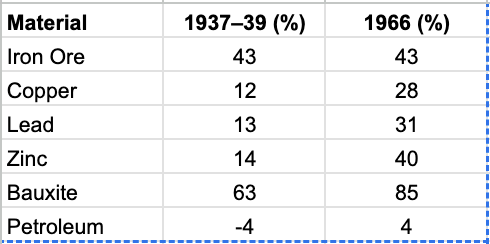
However, the formidable expansion of American industrial production at the end of World War II changed the situation. Today the USA must import increasing quantities of raw materials as essential as petroleum, iron ore, bauxite, copper, manganese, and nickel. Moreover, America's own resources in these areas are rapidly diminishing and, in the case of petroleum, could be exhausted by the end of the century. America depends entirely on imports for chromium, cobalt, and columbium [niobium], indispensable to iron production.
Global Competition for Resources
In other words, three-quarters of a century behind its principal competitors, the USA must now launch a drive for new sources of raw materials in the world:
For petroleum: in Latin America, the Middle East, and Nigeria
For iron ore: in Latin America and West Africa
For other minerals: in Canada, Australia, and Africa
In this search it will collide not only with liberation movements in various colonial and semi-colonial countries, but with the competition of other imperialist nations like Great Britain, Japan, France, West Germany, and even Spain.
Political Consequences
Often the appropriation and possession of these sources of raw materials involves political conflict, coups d'état and local war (notably in West Africa in the last few years). It may involve the establishment of missions, perhaps American military bases. The need for new sources explains the tenacity with which American imperialism clings to countries like Venezuela and Brazil, for they have become precisely the sources of supply of raw materials indispensable for Big Business in the United States.
4. Inter-Imperialist Competition in the Heart of the Third World
Although the export of American capital into under-developed countries has been of less volume than the same export into other imperialist countries, nonetheless it has not been negligible. When it concerns important countries, like Indonesia or Brazil, or countries of enormous, scarcely tapped potential, like the Congo, the export of American capital results in growing interference by American imperialism in the internal affairs of these semi-colonial countries. Conflicts develop with other imperialist powers, particularly the former colonial powers which American imperialism is gradually replacing.
Historical Examples
In the last twenty years, the most typical examples of the way in which American capital has taken over from former colonial capital are its domination of:
Indonesia (replacing Dutch capital)
Morocco (replacing French capital)
Iran (replacing English capital)
Without a doubt, in the Congo we are witnessing the debut of a similar replacement of capital, in this case Belgian, although at this moment it is reflected less in capital investments than in the reorientation of foreign trade.
Violent Transitions
All this imperialist substitution was not achieved simply by maneuvering behind the scenes. It produced acute national and international conflicts, often accompanied by bloodbaths. From the overthrow of Mossadegh to the assassination of Ben Barka and the ascent to power of Mobutu by a coup d'état, the course of this substitution was marked by murder, conspiracy, and oppressive operations whose victims number in the hundreds of thousands.
Limits of American Hegemony
In the end, American imperialism will not achieve world domination. The dream of an "American Century" lasted, in fact, only five years, from 1945 to 1950. The dream was destroyed not only by the strengthening of anti-capitalist forces on a world scale, but by the law of unequal development which functions inexorably in the heart of the imperialist world and does not permit any acquired position to last forever.
In comparison with the 1945-50 period, the principal competitors of American imperialism (with the exception of Great Britain) have strengthened, not weakened, their positions relative to American imperialism. The inter-imperialist competition is more acute than before. There will be no super-imperialism, but rather a continual struggle of imperialist forces to shift the balance of power in their favor.
New Global Context
However, the battle of inter-imperialist competition is taking place in a new global context: the loss to Capital of a third of the world; the constant extension of new revolutionary forces and movements that threaten to wrest new countries away from Capital. In these conditions, inter-imperialist competition will dissolve into inter-imperialist solidarity before the vital threats which weigh on the total system. Stalin's hope of seeing the outbreak of new inter-imperialist wars turns out to be in vain (assuming one disregards local conflicts between various pawns of imperialism in Africa, Cyprus, and elsewhere).
5. The Defense of General Conditions in the Realization of Capital
One of the economic motives appropriate to American imperialism is that of defending the conditions of realization of invested American capital when those conditions seem to be deteriorating, or when they are exposed to threat.
Specific Examples
It is precisely in this sense that the following interventions must be understood:
The coup d'état in Guatemala, in defense of the investments of United Fruit
The military mission to Venezuela defending the investments of Creole Petroleum
The intervention of the CIA in the military coup d'état in Brazil in defense of United States Steel Corporation investments
The intervention in the military coup d'état in Greece that permitted America's Litton Industries to make huge investments of capital under exceptionally favorable conditions
Strategic Considerations
However, it would be false to see this imperialist intervention in too restricted a way—that is, as merely the defense of capital already invested. Additionally, imperialist intervention is a question of preserving future opportunities and avoiding the danger of a chain reaction which would menace strong positions in one country by events in another.
The Vietnam Example
For example, direct investments of American capital in South Vietnam are very modest. But there are more important investments in Thailand, and considerably more important ones in Malaysia, in Indonesia and India. By intervening with a counter-revolutionary war of aggression in the civil war in Vietnam, American imperialism covers capitalist positions in all the neighboring countries and attempts to preserve its future opportunities in the eastern part of the Asian continent.
Today, the imperialist strategy is unavoidably a global one. Necessarily, the defence of capital does not take place where that capital is invested but occurs in other countries the collapse of whose advance positions would constitute a grave threat to those, properly called, strong areas.
Conclusion
That is why an analysis of the global, economic moving forces of American imperialism can come to only one conclusion: to be effective, anti-capitalist forces must oppose the international counter-revolutionary strategy of Big Capital with a corresponding, world-wide global strategy.
Statistical Notes
Note 1: An investigation by accountants in Chicago in 1960 revealed that 35 large American trusts had a net rate of profit (corporate profits after taxes) of 9.2% in the USA and 14.2% abroad (U.S. News and World Report, 1 Jan. 1962, and Newsweek, 8 March 8, 1965, arrived at analogous conclusions).
Note 2: Direct foreign investment by American corporations went from 7.2 billion dollars in 1946 to 40.6 billion in 1963 and 54 billion in 1966.
Note 3: According to Harry Magdoff, American imports of certain raw materials evolved in the following manner in terms of percentage of their production in the United States:
Related Reading:
Ernest Mandel: The Global Role and Economic Roots of American Imperialism: Ernest Mandel at the 1967 Marxist Symposium in London
Understanding Western Europe Through Inprecor: A Mid-1970s Perspective: The FAQ: our new series starts here
Class Organization: Pure Anti-Capitalism at its Limit: Jakob Schaefer reviews “Kapitalismus am Limit”
First time in English: Pierre Frank on the Popular Front in France: 1976: Part one: Frank discusses the 1930s popular front and the 1970s Union of the Left
Alex Callinicos ‘Introduces’ Kidron, But Misses Mandel’s Framework for Understanding Our Period: How the SWP Assesses Crisis, And Why Its Framework May Be Wrong