

TL;DR
Denmark’s solidarity problem is not primarily political — campism is marginal inside Enhedslisten — it is organisational: nobody has made the first call.
The debt and reconstruction question is the political lever that can unite the whole left, including people stuck on the arms debate.
The state’s solidarity is state solidarity. Only the labour movement can do labour solidarity. Those are different things.
Practical solidarity at branch level — a few hundred pounds, a bank transfer to a sister union — changes the political landscape faster than any resolution.
The forty minutes were done. The slides were still up on the screen, showing a matrix I had quickly thrown together. But the first question from the room was not about campism, not about NATO, not about arms. It was, in effect, about plumbing.
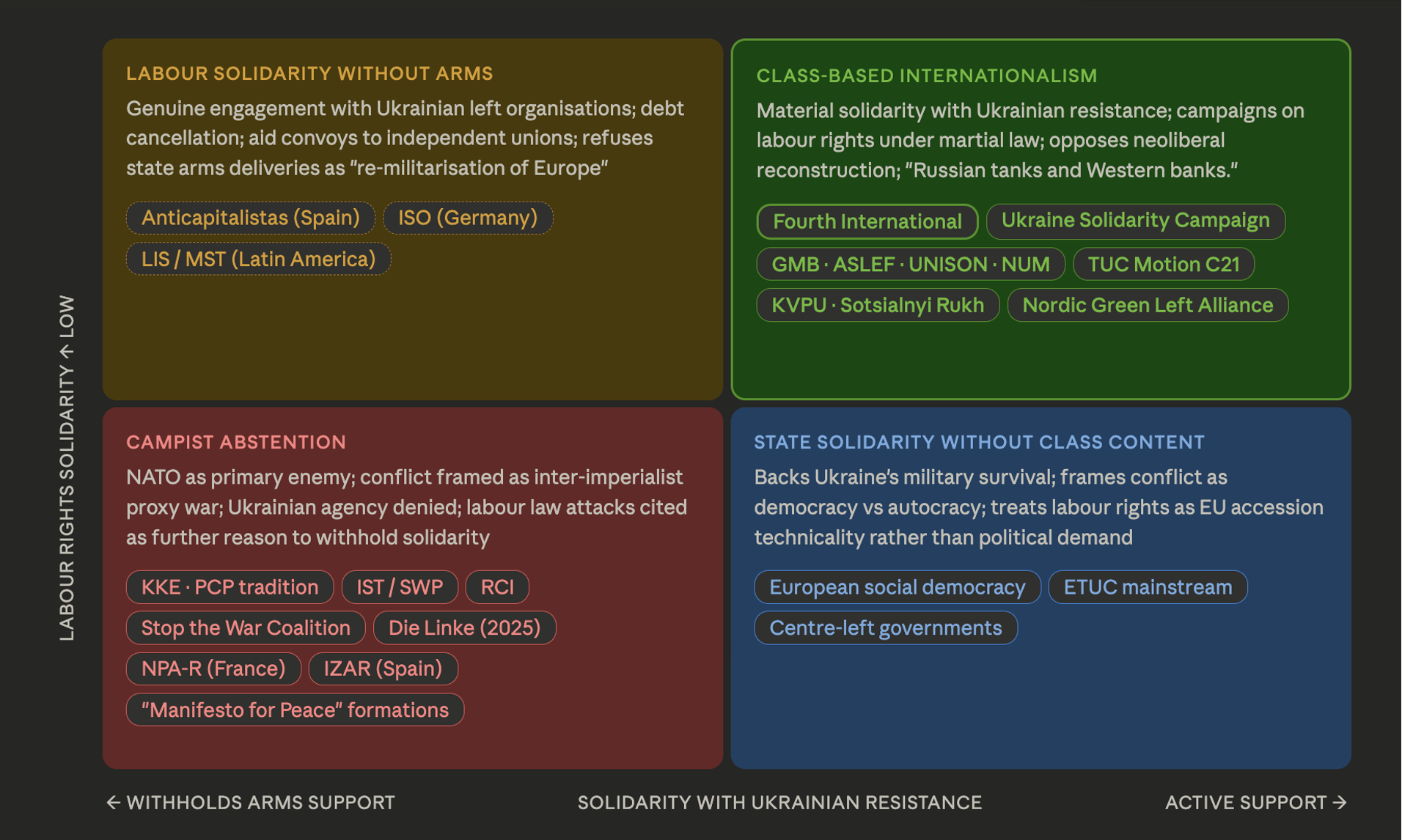
Not literally. But the comrade who spoke first had clearly been sitting through the framework thinking about a specific practical problem: how do you actually build a union-to-union link with a workers’ organisation in Ukraine when you don’t know where to start? The matrix, the four failure modes, the USC model: all very well. But who do you call?
That question did more analytical work than I expected. It kept surfacing, in different forms, throughout the discussion that followed. And by the time the session closed I had understood something about the argument that the talk itself had only half-captured.
★ ★ ★
The gap that the matrix misses
The political picture in Denmark, as the discussion made clear, is considerably less dire than in Britain. The campist tendency exists inside the broader left alliance, but it keeps a low profile; it cannot shift the alliance’s line, which is broadly consistent with the FI position and with SAP’s own stated stance. The campism is there, contained, not dominant.
What the discussion revealed, then, was not a political problem. It was an organisational one. The left-right axis on the matrix — no, not the matrix, I said I would think of it differently after this discussion. Let me be more precise. The political question — arms or no arms, resistance solidarity or campist abstention — is largely settled in Denmark in the right direction. The practical question — how do you build class solidarity rather than state solidarity, how do you create the union-to-union link rather than the government-to-government one — is where the gap opens.
There are people in Danish civil society collecting medical supplies and flying them into Kyiv. That happens. What does not yet exist in any systematic way is a workers’ solidarity campaign: union to union, branch to branch, with the explicit political goal of strengthening organised labour in Ukraine so that it can fight on two fronts. Against the occupation and against the neoliberal assault on collective bargaining rights that has stripped seventy to eighty percent of Ukrainian workers of the right to negotiate.
That second front matters. Not as a reason to withhold solidarity, which is the campist move, but as a reason to build the right kind.
★ ★ ★
The factory
The debt question came up more than once, in more than one form. And here I want to add something that the matrix does not capture, because it is mine to add and not something that can come from a search result or a research brief.
In the early 2000s, before Maidan, before any of what followed, I was working at a large manufacturer in Ukraine. We had large, long-term contracts with Russian distributors. Huge volumes. The scale of the entire operation had been built, during the Soviet period, to serve the Soviet Union as a whole. And we were selling to Russia at below full cost. Not through bad management. Because the trading relationship itself, inherited from the Soviet planning system, was structured to transfer value from Ukraine to the Russian economy. Up until Maidan, that was reflected in Ukraine’s two-to-one trade imbalance with Russia and Belarus.
And it was also the driver of orienting to Europe. I was helping the factory make the most of the new machinery it had bought from European engineering companies to produce higher-value exports for sale in Europe. That was the most effective way to make up the shortfall on the uneconomic, somewhat corrupt, supply chains in what was then called the Confederation of Independent States. Until 2918, Ukraine had a subordinate role in the CIS, a little like the EU “neighbourhood frameworks” which tie some of France’s former colonies into trading relations that benefit France.
It is a symptom of what the Fourth International has accurately named for years: the semi-colonial character of the economic relationship between Russia and Ukraine. Soviet planning did not develop Ukraine’s productive capacity for Ukrainian workers. It developed it to serve the needs of the centre. The enterprise was built in a way that made no sense unless you were selling cheaply to a small number of very large customers.
The debt question is continuous with that history — and it may be the political lever that moves people who are stuck on everything else.
The Western states are not engaged in charity. Some of the military aid that has kept Ukraine alive has been loaned, not donated, and the terms of repayment are beginning to look like a different kind of extraction: Ukraine bled dry by its creditors as the price of survival, permanently subordinated to the financial demands of the very powers that called themselves its allies. Trump’s mineral deal is only the most grotesque version of something already in motion.
What struck me in the discussion is that this argument cuts across the left-right axis of the matrix. Debt cancellation is a demand shared by Sotsialnyi Rukh, KVPU, and the FI majority. It is the point of convergence that the Western left has consistently failed to build on. The left has a track record on Third World debt campaigns; there is a large layer of civil society with existing awareness of that framework. The Ukrainian debt is a political lever. Opposing the exploitation of Ukraine by Western creditors is not a substitute for solidarity with Ukrainian workers’ right to resist. But it is terrain on which the whole left, and a good part of the centre, can be moved, including people who have not resolved their position on arms.
★ ★ ★
Two things can be true
One of the sharpest interventions in the discussion made a point I want to record, because it clarified something I had only half-articulated in the talk. There is a collapse of context on the campist and abstentionist left: a refusal, whether from bad experiences building coalitions outside the left or from simple analytical failure, to acknowledge that two things can be true simultaneously.
Yes, Western imperialism has interests in Ukraine. Those interests are not charitable, not disinterested, and will be prosecuted aggressively when the fighting stops. The social forces that are keeping Ukraine alive today are the same social forces that tomorrow will come for Ukraine’s resources, its labour standards, its capacity for independent economic development. We should have no illusions about that.
And: Ukrainian workers have a right to the means of resistance. Their expressed demands, stated directly and repeatedly to Western trade unions by KVPU and Sotsialnyi Rukh, are not negotiable by us on their behalf. The campist move is to treat the first truth as a reason to abandon the second. And the TUC’s answer to that move? Motion C21, carried overwhelmingly, moved by GMB, seconded by ASLEF: full restoration of labour rights in Ukraine and a socially-just reconstruction programme that rejects deregulation and privatisation. That is what class-based solidarity sounds like.
★ ★ ★
Rearmament: the argument that needs precision
There was a question about European remilitarisation that deserves a more careful answer than I gave it in the room. The objection is that opposing ReArm Europe and supporting Ukrainian resistance exist in tension. I do not think they do, but the argument requires precision.
Helping Ukraine, Finland, the Baltic states improve their civil defence does not require Britain to maintain nuclear weapons. It does not require the extension of military infrastructure that serves the projection of power into the Middle East, Africa, Latin America. The rhetoric of rearmament is also the rhetoric of social cuts; the paradigm of militarism that European right- and social-democratic governments are now deploying serves a multitude of purposes, most of them hostile to the working class. The Danish Prime Minister’s visibility on Ukraine has not, as far as I can see, produced any political pressure on the financial terms being imposed on Ukrainian workers.
Workers’ control over arms production, conversion planning, the arguments from the 1970s and 1980s about how arms factories can be retooled at the end of a conflict rather than privatised or mothballed: these are not dusty historical curiosities. They are live political questions. Ending profiteering in the military sectors being used to support Ukraine. Ensuring that the infrastructure built during this period does not permanently extend the machinery of NATO power projection. Ending the insane terms of debt that would leave Ukraine worse placed than Germany after the First World War. These arguments allow us to oppose European remilitarisation and support Ukrainian resistance in the same breath, which is precisely what the SAP slogan — støt ukrainsk modstandskamp, ikke monstrøse forsvarsplaner — actually does: Support the Ukrainian resistance struggle — not monstrous defence plans.
Though I notice, rereading it, that the slogan is easier to say than to build a campaign around. That is the practical axis again.
★ ★ ★
The first phone call
The practical starting point the discussion kept returning to was smaller than I expected. My own union branch raised about a few hundred pounds to donate to our sister union in Kharkiv: money partly used to help workers under bombardment. That is it. Not a campaign, not a programme. A branch meeting, a vote, a bank transfer.
The question that crystallises the argument: does any of this require resolving the arms debate first? No. It requires knowing who to call.
KVPU and Sotsialnyi Rukh can help Danish unions map the Ukrainian workers’ movement. Almost every Danish union is affiliated with an international federation that has a Ukrainian counterpart. The Danish government’s solidarity is state solidarity: it does not send equipment to unions, it does not supply breathing apparatus to mining rescue teams working in bombed shafts, it does not build the person-to-person relationships that will matter when the reconstruction begins and the creditors come calling. That is the unique role of the labour movement. That is what the state will not do and what the USC model shows can be done.
There was also something that came up in the discussion, which I did not know about before the seminar: that there has been quiet work in Denmark facilitating dialogue between Ukrainian leftists and anti-war Russians, held under conditions that protect participants’ security. That work goes under the radar for good reasons. But it is exactly the kind of practical internationalism that builds the relationships that outlast the immediate crisis.
The campist left is not building those relationships. It has, as I put it in the talk, effectively conceded the working class’s ability to build international solidarity. The passive left, the correct-but-inactive left, is not building them either. Every union link that is made now makes it easier to support Ukrainian workers when the reconstruction deals are signed and the plunder begins in earnest.
★ ★ ★
The comrades in Denmark are not politically confused. They know which part of the matrix they are in. The solidarity gap is not analytical. It is the gap between the position on paper and the first phone call.
The British model did not begin with a TUC resolution or a national affiliate. It began with a pickup truck and twenty thousand pounds raised at branch meetings, driven two thousand miles to Lviv, delivered to a battalion of Ukrainian miners. It began with someone deciding to make the call.
Duncan Chapel is the editor of Red Mole Substack and a member of the Fourth International. He presented at the SAP Easter Seminar in Denmark in April 2026.