


TL;DR At least seventy-one international tendencies claim the mantle of Trotskyism and about thirty-five still exist, on the count Vincent David gives in Spartacist No. 71. Every one of them holds that it is the continuation and the others are not. A criterion that produces seventy-one claimants and cannot reduce the number by one is not a criterion. It is tempting to think revolutionary ideas come down to us fresh, whole and uncontaminated, and that our job is to keep the flame alive. But it would be disloyal to Lavoisier’s method to defend Lavoisier’s chemistry against the chemistry we have now. What we are engaged in is theoretical practice: acting on the world, testing, getting things wrong in public, and remaking the programme. Three points follow. Revolutionary continuity has to be a continuity of practice rather than of doctrine, and the test of an organisation is not whether it raises the right demands but whether it can learn. Second, the texts will not settle it, because the record is not evenly distributed and never was. Third, we should be measured by whether we went through experiences with the broad vanguard rather than standing apart from them. And it would be wrong for us to apologise for that.
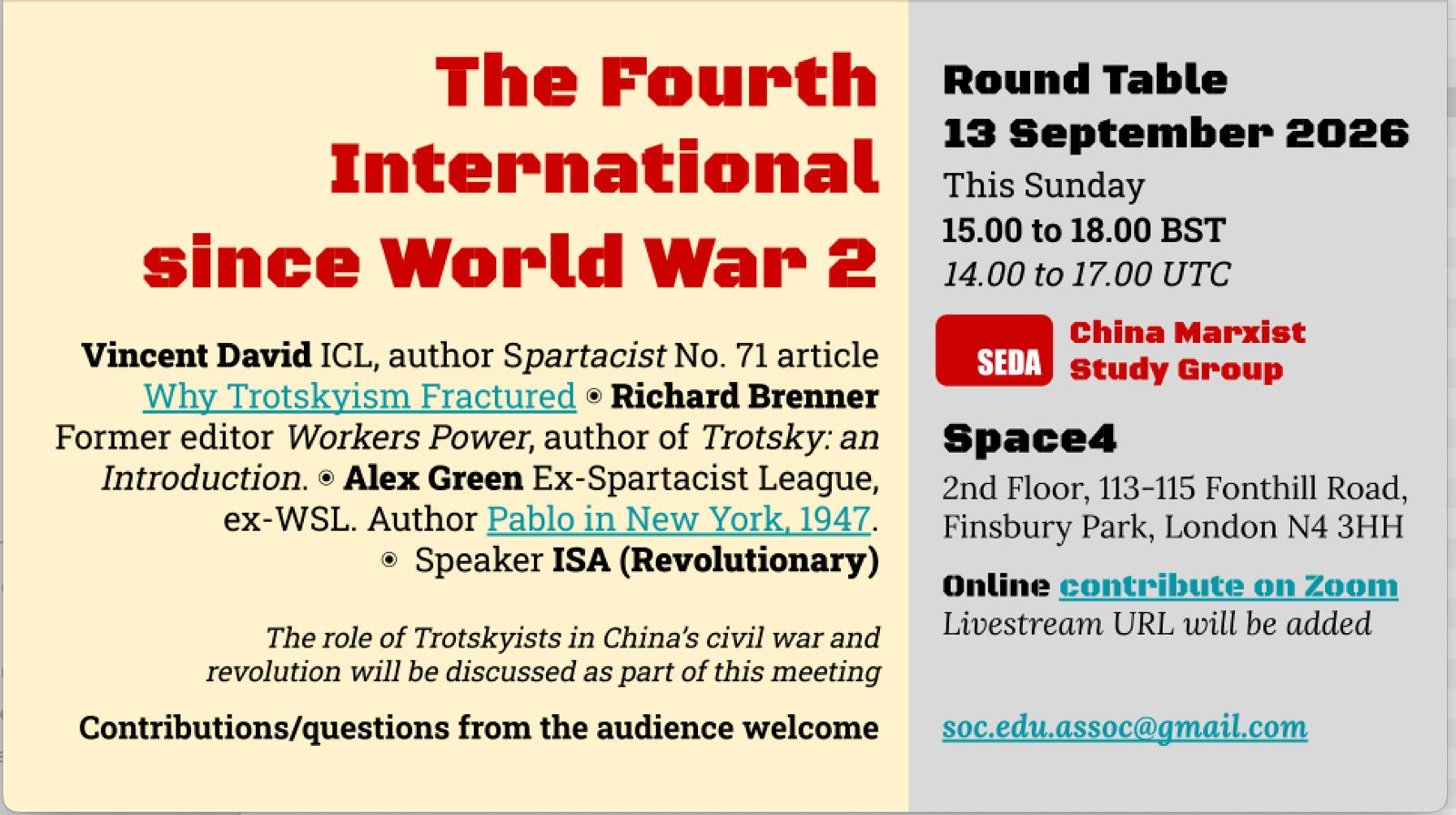
I am a supporter of the Fourth International, and in particular of its reunification in 1963. That is not an especially favourable thing to be in the argument being curated this Sunday, in a session on the Fourth International organised by SEDA (the Socialist Educational and Debate Association). The contributors advertised span both wings of Spartacism (the ICL and the ISA-R), through a former Spartacist, to the former editor of Workers Power.
Trotskyism is a competitive and polemical field, and the Fourth International has largely abstained from polemic with other Trotskyist tendencies since the exchanges with Healy’s Socialist Labour League in the 1960s and with the OCI in France in the 1970s, both of which were largely fruitless, and with the 1968-1970 exchange and 1990 debate over the theory of state capitalism. Where we have argued more passionately, it has been with currents that were diverging from within: Pablo and the LSSP in the 1960s, the Morenoists in the 1970s, the Australian and American SWPs in the 1980s, the former majority of our Brazilian section, and the former majority of the section in Sri Lanka.
Arguing with people you have never shared anything with is exhausting, because it is not really an argument about the world. There is what I think, and there is what you think I think, and those are two different debates. Gramsci is the example I keep coming back to. He was given a caricature of Trotsky’s real views by the Comintern, argued against the caricature and, in Livio Maitain’s opinion, ended up defending the standpoint of permanent revolution that Trotsky and Lenin actually shared.
So, three points.
One: continuity is a practice, not a possession
It is tempting to think that revolutionary ideas are passed down to us fresh, whole and uncontaminated, and that our job is to defend that continuity, keep the flame alive, hold the red thread. But we are engaged in a theoretical practice. The world changes and we continually enhance and develop the programme as we come to understand it.
It is like scientific knowledge. It would be disloyal to the method of Lavoisier to defend Lavoisier’s chemistry against the chemistry we know today. That would be weird. It would be wrong to defend Ptolemy’s cosmology just because at the time it was the best cosmology anyone had. What Marx and Engels and the Communist International handed us is invaluable, and it is also flawed in its own ways and unfinished, and working on it is the job rather than a betrayal of the job.
So an erroneous view of programme says you can tell whether an organisation is revolutionary by whether it has the right perspectives, or is raising the right demands in the right settings. The real test is whether it is able to learn.
Take the debate between Pierre Frank and Ted Grant on Bonapartism at the end of the Second World War. It is easy to say Grant predicted this. Grant, Morrow, the IKD, van Heijenoort roughly predicted what would happen, and the Fourth International got it wrong. We can quibble about how far wrong. Frank thought there would be different forms of Bonapartism across much of Europe, not that all of Europe would succumb to it, and if you look at central and eastern Europe, at the decades-long occupations of West Germany, at the Greek repression, at the rise of Gaullism, it would be hard to say post-war Europe was free of Bonapartism.
But more important than being right or wrong on a particular prediction is whether your predictions could be falsified, and whether you were able to learn from how they turned out. Frank was wrong in a way that could be marked, and he marked it: he rethought, changed course, and spent three decades writing an account of the International that concedes error by name. I would rather be in a tradition that acts on the world, tests things, argues, gets things wrong and revises, than in one that makes general hand-waving timeless predictions which are hard to falsify, celebrates itself as prophetic when they land, and goes quiet when they do not.
And notice what happens to a tradition that cannot have a knot in its thread. While Grant was alive and a force to be reckoned with, the prognoses had to be immaculate. The programme got treated as something already made, sealed in the past in airtight containers, stacked up and waiting for the moment. Grant’s own practice says otherwise: proletarian Bonapartism was not handed to him by anybody, he made it, because the states coming out of the colonial revolution did not fit the categories he had. His followers inherited the conclusion and not the method that produced it. So in 1982 he could write that the workers of Argentina “would then suggest a socialist federation of Argentina, the Falklands, and of a socialist Britain”, and forty years on the article gets republished on the party’s own site unrevised, with no balance sheet, while Ted Grant Selected Works, Volume Two: The Work of Marxists in the Mass Organizations has quietly gone out of the catalogue. What gets reprinted is a conclusion. What gets withdrawn is the book about the method.
Two: the truth is not in the texts, because the texts were never evenly shared
Great caution is owed to the idea that the truth is found in texts rather than in theoretical practice. Texts are useful. Practice is the thing, because theory is distilled practice. And the history of Trotskyisms in many countries is deeply deformed by two accidents: when Trotskyism was born in a given country (whether the core of the section was fighting the Third Period or the Popular Front), and what body of work happened to be available to it.
Everyone knows what Ted Grant and his party said about Pierre Frank and the post-war perspectives of the FI. But who has read what Pierre Frank said in his own words? Of the 142 articles or books of his in Red Mole’s inventory, forty are in English and thirty-eight of those are in periodicals produced by the American SWP. What exists of Frank in English is very largely what that party curated.
Pablo is the sharper case, because I got it wrong myself for decades. I had taken it in good faith that he advocated “centuries of deformed workers’ states”. Search for the phrase and it is everywhere: Peng Shuzi in 1955, David North on Cannon, the World Socialist Web Site, the Grant tradition’s site, Sean Matgamna for Workers’ Liberty, and a section heading in Spartacist last month. Seventy years of quotation marks around six words.
Go to the December 1949 bulletin and the words are a compression of a real sentence, not an invention. Pablo wrote that in the whole historic period of the transition from capitalism to socialism, “a period which can extend for centuries”, we shall encounter a more tortuous development than our teachers foresaw, “and workers’ states that are not normal but necessarily quite deformed”. Centuries and deformed workers’ states, one clause apart.
But then read the article he wrote eighteen months later to answer the reading, which is the document this whole dispute turns on and which almost nobody cites. In June 1951 he separates the two durations. The centuries measure the economic and social transition. On the bureaucracy: “We have never written or wanted to suggest that the political expropriation of the proletariat after the taking of power on an international scale could be envisaged as possible, and even less that it can stretch over centuries. Such an affirmation would be theoretically equivalent to admitting the theory of ‘bureaucratic collectivism.’” And four paragraphs on: “This struggle will not last for centuries but a much briefer period.”
That is a falsification condition, offered by the author, two years before the split it is blamed for. Nobody took it up.
Now the part that ought to give everyone pause. The one document ever produced to show Cannon holding the opposite view is a speech, “The Trend of the Twentieth Century”, printed in Fourth International in July 1951. The phrase is not in it and neither is the question. What is in it is this: Stalinism is “a degenerate growth on the labor movement”; fascism and Stalinism are “reactionary and transitory phenomena” which “must and will be obliterated in the next tidal wave of colonial uprisings and proletarian revolutions”; Stalinism has no right to “survive as anything but a horrible interlude in the march of humanity”; and the second half of the century “will see it carried through to a triumphant conclusion”. A horrible interlude, obliterated in the next tidal wave. A much briefer period, ending in the downfall of Stalinism. On the one question the famous phrase encodes, Cannon and Pablo published the same answer in the same season of the same year.
They differed about a great deal, and those differences were real enough to break the organisation two years later: entrism, what the Communist parties could be pushed to do, how the International should be run. What they did not differ about is the thing the split was named for.
This is not a complaint about anybody’s bad faith. The correcting text has been in the open for seventy-five years. It is simply that nobody needed it. A text that complicates the succession has no constituency, because nobody’s continuity depends on it. That is exactly why the Fourth International’s commitment to periodicals like Inprecor, Punto de Vista Internacional and International Viewpoint matters, and the work of the International Institute for Research and Education: a news service and an archive where the subjective factor can speak to itself in its own words across time and space. The linguistic gap is severe, and in my opinion it was a big part of what made the split between 1953 and 1963 unnecessary.
Three: judge us by whether we went through it with the vanguard
If we judge the Fourth International by whether it got everything right in hindsight, there is no point doing it at all. On that approach there are no good people, because we are all broken, and no good parties, because we all make mistakes. Much of it is the objective situation. When the class struggle is low and the Trotskyists are isolated, as in the 1950s, it was very hard for the American comrades to avoid a semi-sectarian experience. And however critical you are of the European choice to enter the social democratic and Stalinist parties, we would almost certainly have lost our bearings and possibly been extinguished, the way the other anti-Stalinist traditions of the 1920s and 1930s perished. Look at the other parties in that milieu of 1933. The ILP was immensely strong in this country. They are lost like tears in rain.
The Fourth International endured the isolation of the 1950s and came out of it into the 1960s on the basis of reunification, and those documents resolved a whole series of challenges. Imagine a Trotskyist movement that could not welcome the forward movement of the masses in Cuba and China. Imagine one that could not support the anti-colonial movement in Algeria. Imagine one that could not call for the withdrawal of occupying powers when they ruled East and West Germany to suppress the workers rather than to help them.
So measure us by our capacity for theoretical practice, and by whether we were willing to go through experiences with the broad vanguard rather than setting ourselves apart from it. And the broad vanguard is not the revolutionary party. Many Trotskyists equate the vanguard with the people who can easily be organised into the revolutionary left. It is something else, and when it flows into new formations we are not going to abstain.
In England and Cymru that has meant the Socialist Alliances, Left Unity, Respect, Your Party. We went into them not because they would be easy but because the political independence of the working class in Britain needs to go in that direction. The odds are massively against small electoral parties surviving when they are neither committed to staying out of bourgeois governments, nor committed to grassroots democracy rather than charismatic leadership. That is not a reason to stand aside. It is a reason to go with the vanguard, to learn from them, to help, and to be honest about what is coming.
Pat Jordan is the person I take this from. The IMG’s resolution for its March 1970 conference, which he almost certainly drafted, says: “It is for us to avoid the organisational sectarianism of IS and the SLL and build our organisation not in competition with but for the labour movement.” And the sentence I would put above all of this: “The era of the small group is now over; the main function of the Trotskyist movement is not any more that of preserving and defending a body of ideas against Stalinism and reformism.”
It is easy to look at the overturns in Cuba and Nicaragua and dismiss them because they failed, unsurprisingly, to build socialism in one country. It is easy to decry attempts at new workers’ parties. The obstacles are massive. And it is very easy to blame us for supporting progressive struggles whether or not they were going to succeed, because participating in them, serving the broad vanguard, helping them learn and warning them honestly about what will happen, is how to contribute and learn.
What we will not do is stand to one side, as the Socialist Labour League did with its little leaflets on the Vietnam marches explaining why it was not marching, or as most of the revolutionary left does by abstaining from material solidarity with the labour movement in Ukraine. If you only engage in propaganda, if you do not work with the broad vanguard, if you do not engage in theoretical practice so that you can learn from them and renew the programme, then you are stuck in the past, and the only way forward is backwards. Back to the methods of the Second International, standing on soapboxes, shouting at clouds. Back to ideas that may have been the best the communist movement had at the time, and which need to be transcended by revolutionaries today.
That is messy work. It is not smooth. It involves people, humans, misunderstanding each other. It does not always work out.
But it is the task we were built for, and it would be wrong for us to apologise for it.
This is the argument of Red Mole Guide No. 23, The Custody Claim: continuity and practice, the Fourth International since 1945, and how anyone would know, which prints the documents so a reader can test it against them: Pablo in his own words in 1949 and 1951, Cannon’s speech of July 1951, the Third World Congress resolutions, the 1959 open letter to the Socialist Labour League, Dynamics of World Revolution Today and the reunification charter of 1963, Pat Jordan and the IMG on the united front, and the custody claims of the ICL, the League for a Fifth International, the Grant tradition and the International Bolshevik Tendency in their own words.
Hi, there is a big factual blunder in your text:
The ISA-R is a left opposition recently expelled from International Socialist Alternative.
They previously had nothing to do with the Spartacists, as their history rather goes back to the CWI and before that Militant.
It is therefore even more remarkable that they have reached a memorandum of a understanding with the ICL for joint work and are working towards a fusion, since they DO NOT share close historic proximity.
The statement that the people who went into formations from the Socialist Alliance to "Your Party" were the vanguard (of class struggle? of the political independence of the working class?) does not appear to be supported.