

TL;DR The Transitional Programme assumed forms of organization and leverage tied to large industrial workplaces, whereas today’s working class is more fragmented, geographically dispersed, and structurally heterogeneous. For a feminised, precarised, and racialised working class whose primary terrain of exploitation is the reproduction of daily life, the classical demands for workers’ control of production need a supplement: community control of social reproduction. This is not a revision of Trotsky and Mandel. It is an application of their method to terrain they identified — and where the left has engaged inconsistently, often substitutionally, and in large part neglected. Mandel’s own definition of the broad vanguard explicitly includes the women’s emancipation movements. The Maison des Femmes in Saint-Denis is the empirical case study: it starts from material need, builds collective agency, and makes demands on the state that capitalism cannot fully satisfy without transforming the power relations that define it. The revolutionary left’s failure is not theoretical. It is organisational: the infrastructure exists, the organic leaders are there, and the formations capable of arming them with a revolutionary programme are absent.
Thursday’s elections in Britain — Scottish Parliament, the Senedd in Cymru, English and Welsh councils and mayoral elections — will produce predictable results, commentary, and recrimination. Reform will win more council seats, especially from the Conservatives. In Cymru and Scotland, the governing parties are both weakening, with votes flowing to their natural alternatives in the centre-left and social-democratic space, with Labour on the right, Plaid Cymru on the left, and the SNP in the middle. To their left are the Scottish Greens and the Green Party in England and Wales: they will continue their long-term, though uneven, rise. TUSC will likely win less than one per cent of the total vote. All of that matters. None of it addresses the strategic question this article is about: which formations are building organisational presence in the communities where the contemporary working class actually lives, and which are contesting an electoral terrain while the real terrain slips away. The answers will be the same on Friday morning as they are today.
In January 2013, the Socialist Workers Party’s conference voted 231 to 209 to protect a senior leader accused of rape from accountability. The Disputes Committee had consisted largely of his colleagues. The organisational model made justice structurally impossible. Nearly two thousand people left.
In March 2026, a working-class woman in Saint-Denis walked into a converted hospital unit, received medical care for injuries caused by her partner, met a lawyer who explained her rights, attended a group session where she discovered that seven other women in the same room had experienced the same thing, and left with the phone number of a community legal adviser. Six weeks later, she was helping another woman navigate the same process.
These two events are connected. Not by coincidence but by the same strategic failure: a revolutionary left that built its politics around a class formation that no longer defines where exploitation and resistance are primarily concentrated, and that consequently has nothing to offer the woman in Saint-Denis except correct positions stated at a safe distance.
This article argues that the Transitional Programme requires a supplement. Not a revision, not an abandonment, not a capitulation to social movement politics at the expense of class analysis. A supplement: a theoretically grounded extension of the transitional method to the terrain of social reproduction, where the decisive struggles of the contemporary working class are increasingly concentrated, and where the revolutionary left is, with very few exceptions, absent.
What Mandel actually argued
The argument starts with Ernest Mandel’s 1977 polemic against Moreno, the most sustained theoretical account of the Transitional Programme’s essential function in the FI tradition. Mandel’s central point is deceptively simple: a transitional demand is not defined by its popularity or its radicalism but by its structural logic. Trotsky’s own formulation, which Mandel quotes directly, is that the transitional programme “issues from the conditions of capitalist society today, but immediately leads over the limits of capitalism.” The phrase “leads over the limits” is doing the theoretical work. It does not mean the demand is unachievable in any individual instance. It means that fully satisfying it would require transforming the property relations and power structures that define capitalism as a system.
Workers’ control is the paradigm case. It starts from the immediate material need to protect jobs and wages against the arbitrary power of management. It demands the opening of the books, the inspection of the real finances of the firm. It builds collective capacity in the rank and file. And it cannot be permanently institutionalised without capitalism ceasing to be capitalism, because a permanent state of dual power in the workplace transforms the relationship between labour and capital at the point where capital extracts surplus value.
But the key passage for this article’s argument is not the famous formulation on transitional demands. It is Mandel’s own definition of the broad vanguard, toward whom the transitional method is primarily directed. He defines it as: “that section of the advanced workers (or, more generally, the most resolute combatants, the most active, the most listened to across all sectors of the mass movement, including the women’s emancipation movements, the youth movements, the anti-imperialist movements, etc.) who, at least on certain key questions of the class struggle, act independently of the class-collaborationist orientation of the great bureaucratic apparatuses.”
The women’s emancipation movements are not a later interpolation or a concession to social movement politics. They are named by Mandel in 1977 as a primary site of the broad vanguard, alongside the industrial workplace. The extension of the transitional method to the terrain of social reproduction is not a revision of Mandel. It is an application of what Mandel already argued, to terrain where the left has sometimes organised — in the 1970s and 1980s especially — but rarely with the sustained, non-substitutionist presence the method demands.
Mandel then quotes Trotsky on the French general strike of June 1936: “The movements of 1936 as well as 1938 have enriched the entire proletariat with an invaluable experience and developed thousands of local workers’ leaders independent of the official bureaucracy. It is necessary to understand how to find access to these leaders, to link them with one another, to arm them with a revolutionary program.” (”The Decisive Hour in France,” December 1938)
Three verbs: find, link, arm. The task is not to substitute the party for the organic leaders that struggle produces. The task is to find them, connect them to each other, and give them the programmatic tools to make the next step concrete. The woman who has spent three months at the Maison des Femmes helping others navigate the system is an organic leader in Trotsky’s sense. Finding her, linking her to others, arming her with a programme: this is what the revolutionary left is not currently doing in the terrain where she operates.
The social reproduction turn
The theoretical foundation for a supplemental transitional programme is provided by the tradition of social reproduction theory, associated most prominently with Silvia Federici, Tithi Bhattacharya, and Nancy Fraser. Their central argument is not that domestic and care labour is more important than waged production. It is that the two are part of a single integrated circuit, and that capitalism’s ability to extract surplus value from the workplace depends absolutely on the unpaid and underpaid labour of social reproduction: the work of feeding, clothing, caring for, educating, and emotionally sustaining the human beings who show up at the factory gate.
Federici’s contribution is to historicise this. The transition to capitalism required, as she shows in Caliban and the Witch, a primitive accumulation that was not merely the enclosure of land but the enclosure of women’s bodies and labour: the disciplining of reproductive work into the private nuclear family, where it could be extracted for free and rendered politically invisible. The commoning of reproductive labour, when women organise collectively around shared care, is therefore not a welfare supplement to the class struggle. It is a direct challenge to one of capitalism’s foundational mechanisms of exploitation.
Bhattacharya’s contribution is to frame the political implication. Capitalism has a reluctant dependence on the processes of life-making. It cannot function without them. But it treats them as external, as free inputs. When workers fight for socialised childcare, public health infrastructure, or community control of care services, they are not making welfare demands on a neutral state. They are fighting to put the dynamic of profit-making over life-making into crisis. They are making demands that capitalism cannot fully satisfy without transforming the priority structure that defines it. This is the transitional logic applied to the terrain of social reproduction. The demand starts from material life. It builds collective agency. It leads somewhere capitalism cannot follow. Fraser’s essay in New Left Review adds the structural context: the crisis of care, the collapse of public services, the feminisation of poverty, the double burden of waged and unwaged work falling on working-class women, is not a policy failure. It is the predictable outcome of financialised capitalism’s systematic redirection of social wealth from life-making to profit-making.
The five stages and the community gap
Mandel’s account of the five stages of class consciousness is directly applicable to the community organising terrain, and it reveals a gap that the transitional programme’s classical formulation does not address.
The five stages run from elementary trade union consciousness (recognition of collective economic struggle against employers) through elementary political consciousness (recognition of the need for an independent workers’ party), elementary socialist consciousness (anti-capitalism), revolutionary socialist consciousness (the necessity of revolution), and finally the highest level of socialist consciousness that encompasses strategic and tactical knowledge of the revolutionary process.
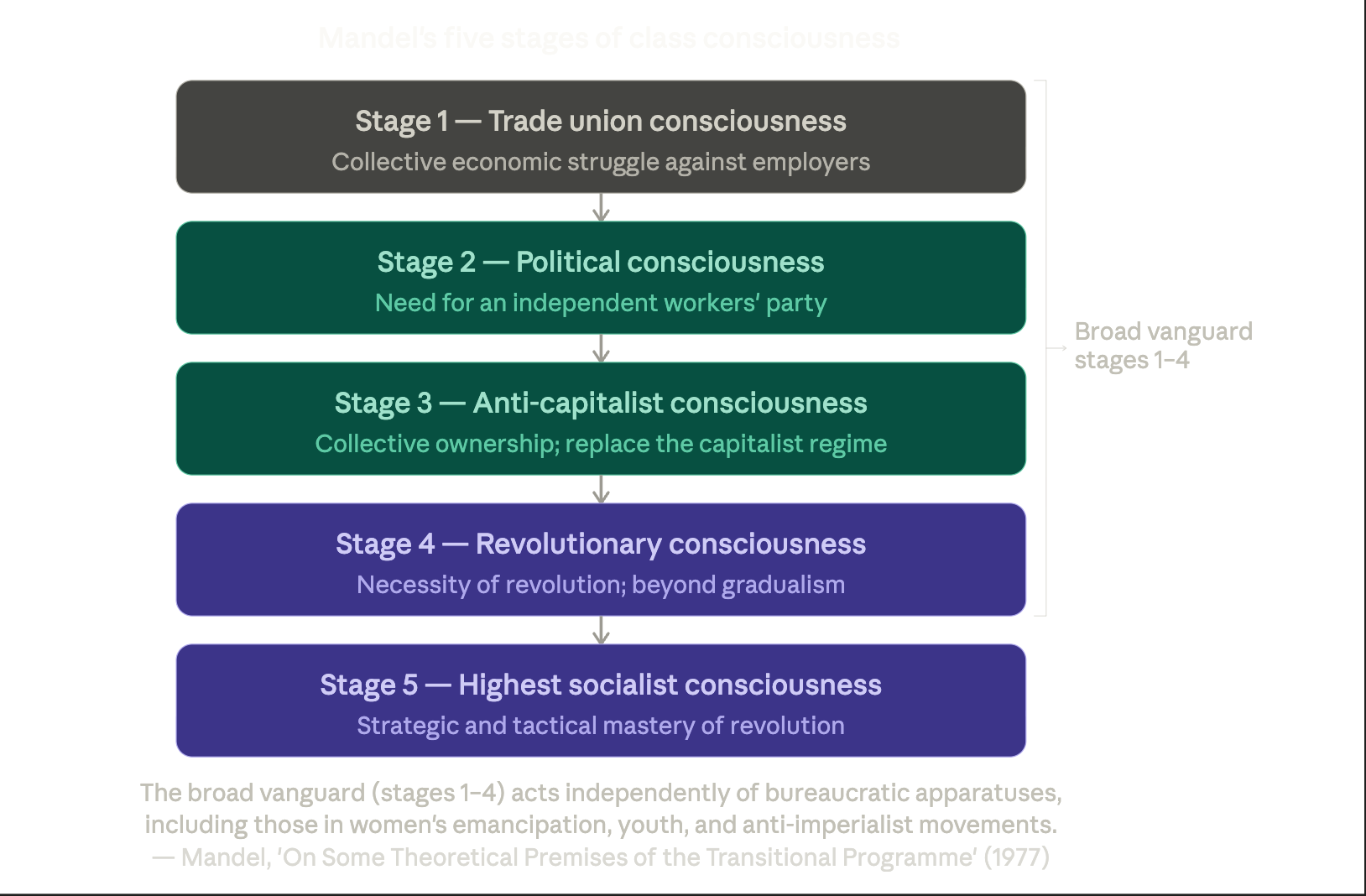
The classical transitional demands are designed to move workers from the lower stages toward the fourth and fifth. They are primarily formulated for workers who have already reached the first two stages through workplace organisation. The demand for workers’ control presupposes workers who are already organised in trade unions, who have basic collective experience of economic struggle, and whose primary terrain of political formation is the workplace.
The feminised, precarised, racialised working class concentrated in the care economy and in peri-urban and deindustrialised communities often enters political consciousness through a different route. Not through the union meeting and the collective wage dispute, but through the recognition that individual experience is collective: the discovery, in the group-parole session, that seven other women in the same room have experienced the same thing. This is not yet the first stage of Mandel’s schema in its classical formulation. But it is political consciousness in formation, on terrain that the transitional programme was not designed to address.
The gap this creates is the space where the revolutionary organisation should be working. Not to leapfrog the stages, but to be present as consciousness forms, to give it organisational expression, to connect it to the demands that lead over the limits of capitalism. The woman who discovers that her situation is collective and systemic is at a threshold. What she finds on the other side of that threshold depends on who is present.
The terrain the left has not held
Walk into a peripheral French town, a deindustrialised northern English city, or a peri-urban banlieue. The large workplace may still exist, but it is no longer the organising centre of working-class life as it was in 1938 or even 1968. What has replaced it? The care economy: the hospital, the school, the creche, the home care visit, the domestic violence service, the food bank. The workers in these spaces are overwhelmingly female, disproportionately racialised, systematically low-paid, and politically underorganised. Their daily experience of exploitation is not the foreman on the shopfloor but the closing of the local maternity ward, the twelve-month wait for a psychology appointment, the impossibility of finding childcare that costs less than the wage it enables.
This is not to say the organised left has ignored this terrain entirely. In the 1970s and 1980s, sections of the FI tradition and the broader radical left engaged seriously with the women’s movement, anti-racist organising, and movements of the oppressed. In France, the LCR’s relationship with the autonomous feminist movement produced real political work. In Britain, the SWP’s involvement in the Anti-Nazi League and later in anti-racist campaigns connected revolutionary politics to community terrain in ways that the workerist framework alone could not reach. These engagements were real and sometimes significant.
But the engagement was rarely sustained, rarely non-substitutionist, and disproportionately absent from the largest formations on the left. Substitutionism is the persistent failure mode: the party intervenes in the movement rather than building the movement’s own capacity, treats the community as a site for recruitment rather than a terrain for organisation, and withdraws when the conjuncture shifts. The SWP’s Women’s Voice was shut down in 1982 when the leadership decided it was a diversion from the class struggle: the logic of workerism reasserting itself over the engagement it had momentarily permitted. Large sections of the Trotskyist and communist left treated women’s liberation and anti-racist politics as secondary contradictions throughout this period and never seriously engaged at all.
What the revolutionary left does not have today, with very few exceptions, is sustained organisational presence in the spaces where this exploitation is daily lived: the community health clinic, the domestic violence service, the advice bureau. NPA-R knows that the pension reform was a feminist issue. It returned to the factory. LFI knows that childcare and domestic violence services are central to women’s lives. It subordinates them to republican universalism. The gap between knowing and organising — between a correct position and a sustained presence — is the gap between a correct programme and a political force.
The Collectif Rosa Bonheur’s research on centralité populaire in peripheral French cities maps this terrain ethnographically. Even after deindustrialisation, the working class produces forms of collective life through residential anchoring. Women are disproportionately the navigators of these networks because the gender division of labour within families concentrates the management of reproduction on them. The neighbourhood is not a secondary space where class struggle sometimes intrudes. It is where the contemporary working class primarily experiences both its exploitation and its collective capacity.
The Maison des Femmes: a case study in transitional practice
The Maison des Femmes in Saint-Denis opened in 2016 in a converted unit of the Centre hospitalier de Saint-Denis, founded by Ghada Hatem with an explicit political orientation: to treat violence against women not as individual pathology but as a systemic social problem requiring a multi-professional, integrated response. Healthcare, legal aid, psychological support, job-search assistance, and group-parole sessions under the same roof.
The standard description of the Maison is as a healthcare innovation. That description is accurate but insufficient. What makes the Maison des Femmes relevant to this argument is not what it provides but how it provides it and what it demands in exchange.
The how: women do not receive services as isolated individuals. The group-parole sessions are structured to produce the recognition that individual experience is collective: the discovery that the woman across the room has the same problem, that it is not fate or personal failure but a systemic condition with a name and a legal framework. Patient testimonies consistently document this moment of recognition: ‘I discovered I was not alone.’ That is not therapeutic language. That is political subjectivity in formation.
The what it demands: the association attached to the Maison, Re#Start, is engaged in explicit plaidoyer directed at the state. Revaluation of the MIG (Mission d’Intérêt Général Violences) funding stream. Full reimbursement of psychological consultations. A specific legal status for Maisons des Femmes recognised by the Ministry of Health. Hatem has stated publicly that the Maison has helped “faire évoluer les politiques publiques.” This is not the language of a service provider. It is the language of a formation using service delivery as leverage against the state.
Is this the full transitional logic? Not yet, and the evidence demands honesty about what is established and what is not.
The transitional claim requires that community control of social reproduction leads somewhere capitalism cannot follow. The Maison des Femmes demonstrates the first part of that logic: it starts from material need, builds collective rather than individualised responses, and makes demands on the state that the state has not fully satisfied. The 2023 activity report shows continued underfunding of the MIG, continued non-reimbursement of psychological consultations, continued dependency on corporate mécénat from Kering and L’Oréal to fill the gaps the state leaves. Those funding gaps are not accidental. They reflect the structural limits of what the state is prepared to concede.
What is not yet established is the full trajectory from service user to organised political actor with systemic class consciousness. The sociological and ethnographic research that would document that trajectory does not yet exist. The evidence is programmatic and testimonial: women reconstruct themselves, discover their rights, build peer networks, sometimes accompany others through the same process. That is not nothing. But it is not the same as a documented pipeline from the group-parole session to the political organisation.
This gap is itself politically significant. The Maison des Femmes is doing the first part of the work: building collective agency, naming the systemic character of oppression, making demands on the state. The second part, connecting that agency to a broader political programme, is what the revolutionary left would need to provide. The infrastructure for finding organic leaders exists. The formation that should be linking them to one another and arming them with a revolutionary programme is conspicuously absent.
The NGO-isation risk must be named directly. The Maison des Femmes is funded 55% from public sources and 45% from private mécénat, with corporate donors that should make any Marxist cautious. The expansion model, targeting 38 structures by 2026 through standardised quality manuals and Re#Start’s professional templates, has the characteristics of a semi-centralised, institutionally embedded network rather than a grassroots movement. The Maison des Femmes is operating in the danger zone between transitional infrastructure and co-opted service provision. Which side of that line it ends up on depends in part on whether a revolutionary organisation is present to anchor the political content.
The missing nuclei
Return to Mandel’s account of May 1968. Workers were ready to go further in hundreds of key factories. But there were no nuclei of revolutionary socialists to stand up in the general assembly and make the concrete proposition. Mandel quotes Trotsky: “It is necessary to understand how to find access to these leaders, to link them with one another, to arm them with a revolutionary program.” The Communist Party won the many of the advanced workers instead, held that hegemonic weight for decades, and used it to block the revolution.
The contemporary version of this problem is structural rather than conjunctural. The terrain where political consciousness is forming among the feminised and racialised proletariat is the community and the care economy. The revolutionary left has largely not been building there. It has been building in the diminishing terrain of the large industrial workplace, and in the electoral arena where it competes, usually unsuccessfully, for the votes of people it is not organising.
The ex-OPG social centre in Naples, occupied by the collective Je so’ Pazzo and used as the organisational base for Potere al Popolo, provides the closest existing model of what presence in this terrain looks like. The concept the organisers use to describe their method is ‘conflictual mutualism’: service delivery that unmasks state failure rather than concealing it, that builds legitimacy through care while simultaneously mobilising that legitimacy for broader political confrontation. The free clinic is not offered as a permanent substitute for public health provision. It is offered as a demonstration of what the state is refusing to provide and as a recruitment ground for the people most directly affected by that refusal.
Jane McAlevey’s “whole worker” organising model provides a complementary tactical framework. Her distinction between organising, mobilising, and advocacy maps directly onto the NGO-isation problem. Organising identifies the organic leaders within a community, the people with natural standing among their peers, and builds power from the inside out. These are precisely the figures Trotsky calls for finding and arming. In the care sector, where McAlevey has applied this model most successfully, the organic leaders are often women who have worked in the same nursing home for twenty years, who know every family in the building, who are trusted across racial lines, and who have never been asked to lead anything. Finding those people, connecting them to each other, giving them a programme: that is the work.
Toward a supplemental transitional programme
What would a supplemental transitional programme for the terrain of social reproduction look like? The structural logic is the same as workers’ control. The demand must start from present conditions and exceed what capitalism can deliver. The demand must build collective agency and dual power. The demand must lead to questions about who controls the fundamental conditions of social life.
Community control of care infrastructure is the demand that has this transitional character. Not community consultation. Not local authority commissioning. Community control: where the women who use the domestic violence service sit on its governing body and set its priorities; where the parents who depend on the childcare provision have a democratic mandate over its staffing and its relationship to the state; where the tenants of the social housing estate have real power over its maintenance and management. These demands exist on a spectrum of partial realisation in various European countries. And they are demands that capitalism cannot fully satisfy without transforming the power relations that define who controls the reproduction of daily life.
The demand for workers’ control includes the opening of the books: making visible the real financial position of the firm, demystifying the market. The equivalent demand in the community terrain is for full transparency of state funding of care services: what is being funded, what is being cut, what is being outsourced to the private sector and at what cost. Several of the Maisons des Femmes’ Re#Start campaigns are already in this territory: making visible the underfunding of the MIG, documenting the gap between stated policy and actual resource allocation, demanding that psychological care be publicly funded rather than dependent on corporate philanthropy.
Workers’ control cannot be permanently institutionalised without capitalism ceasing to be capitalism. The equivalent claim is that a state that genuinely prioritises life-making over profit-making cannot coexist with a financialised capitalism that systematically redirects social wealth away from the reproduction of life. Following through on the demand leads to the question of what kind of economy is compatible with genuinely meeting human need. That is the transitional horizon.
This is an extension of the transitional programme, not a departure from it. Trotsky and Mandel wrote for a class formation centred on the industrial workplace. That formation was not wrong or arbitrary; it reflected the actual concentration of the working class in the capitalism of their time. Mandel himself named the women’s emancipation movements as a primary site of the broad vanguard in 1977. What he did not do, and what has not been done in the intervening decades, is develop the transitional demands that would correspond to the terrain those movements inhabit. Meeting the class where it is, building organisation in the terrain where its consciousness is forming, connecting that organisation to a programme that leads beyond capitalism: this is what the transitional method requires.
The formation problem
The argument to this point is theoretical and historical. The practical problem is formations.
In Britain, the SWP cannot do this work. Its organisational model makes it structurally incapable of the patient, decentralised, community-embedded organising the terrain requires. The model that produced the Delta case is the same model that produces a branch meeting where people are trained to run front organisations and sell newspapers rather than to identify organic leaders in the local care home. The two failures are connected: both reflect an apparatus that substitutes itself for the class rather than serving as a tool for the class’s self-organisation.
In France, LFI could, in principle. It has the banlieue geography and the demographic base. But its republican universalism, its hijab positioning, its Quatennens response, and its Bonapartist internal culture are not incidental pathologies. They are structural features of a formation whose politics of social reproduction is consistently subordinated to electoral calculation. The Chikirou campaign in Paris in March 2026 was fighting the Grégoire list as the primary enemy while the Maison des Femmes two arrondissements away was doing the actual work of feminist politics in Saint-Denis.
NPA-A is closest. Its organic relationship with Nous Toutes and the feminist strike movement, its insistence on feminist struggle as constitutive rather than secondary, and its united-front orientation in the NFP: these are the right political instincts. What NPA-A lacks is the territorial presence in the places where the work needs to happen.
In England and Wales, Anti-Capitalist Resistance, which joined the FI in 2024, is one formation with the right political orientation. But its size and reach remain limited, and the organisational legacy of groups like the SWP has left a deposit of distrust that makes the mutual recognition required for a pluralist coalition harder to build.
The honest conclusion is that no existing formation in France or Britain is currently doing this work at scale. The ex-OPG in Naples and Potere al Popolo represent a model of what it could look like. The Maisons des Femmes represent an infrastructure that could be the basis for it, if a revolutionary organisation were present to provide the political content that the Maison’s service-delivery model cannot itself supply.
The task is not to wait for the upsurge and then arrive with the correct programme. That is the Moreno error that Mandel spent a career arguing against: the belief that it suffices to have the correct agitation slogans for the masses to immediately recognise their party. The task is to be present in the terrain where consciousness is forming, building the nuclei that will be able to make the concrete proposition when the moment comes. To find the organic leaders, link them to one another, arm them with a revolutionary programme. In 1938, those nuclei needed to be in the factories. In 2026, they need to be in the community centres, the care homes, the domestic violence services, and the group-parole sessions.
Thursday’s results will be known on Friday. The terrain will still be there on Saturday.
Notes and sources
Ernest Mandel, ‘On Some Theoretical Premises of the Transitional Programme: Subjectivist Scholasticism or Marxist Dialectics’ (1977), translated and published by Red Mole Substack, 2026. All Mandel and Trotsky quotations are from this translation. Trotsky’s ‘The Decisive Hour in France’ (December 1938) is available at marxists.org/archive/trotsky/1938/12/france.htm.
Social reproduction theory: Silvia Federici, Revolution at Point Zero (PM Press, 2012); Tithi Bhattacharya (ed.), Social Reproduction Theory: Remapping Class, Recentering Oppression (Pluto, 2017); Nancy Fraser, ‘Contradictions of Capital and Care,’ New Left Review 100 (2016).
Maisons des Femmes: primary sources are the association’s own activity reports (2021, 2023) at lamaisondesfemmes.fr and the Re#Start plaidoyer documentation at egalite-femmes-hommes.gouv.fr. The claim about political subjectivity-building is supported by programme and testimony but not yet by independent ethnographic or longitudinal sociological research — an acknowledged gap in the available evidence.
Ex-OPG / Potere al Popolo: ‘Power to the People!’, Viewpoint Magazine interview with Je so’ Pazzo (March 2018); ‘Fighting Hopelessness,’ Jacobin (March 2018).
Centralité populaire: Collectif Rosa Bonheur, Sociétés Contemporaines (OpenEdition); Prendre la ville (La Découverte, 2022). McAlevey: No Shortcuts (Oxford University Press, 2016).
Sorry some cases from Cymru re my first comment: https://pawalescymru.blogspot.com/2021/11/our-free-school-meals-victory-will-help.html?m=1 and. https://pawalescymru.blogspot.com/2020/09/save-royal-glamorgan-accident-and.html?m=1
Duncan you may be intered in an article I wrote 9 years ago for the Transform Journal, which from a different but possibly converging perspective, covers similar ground for similar reasons: https://lenarthur01.blogspot.com/2017/07/transitional-demands-and-action.html?m=1 As Cymru'n Codi we have consciously tried to apply such an approach in our 'provisional' programme - provisional as it remains work in progress: https://docs.google.com/document/d/1jzpwUmGZ2e_dS6_41rtD6ZnyAHKbcSviuIJQds0_V3M/edit?usp=drivesdk