

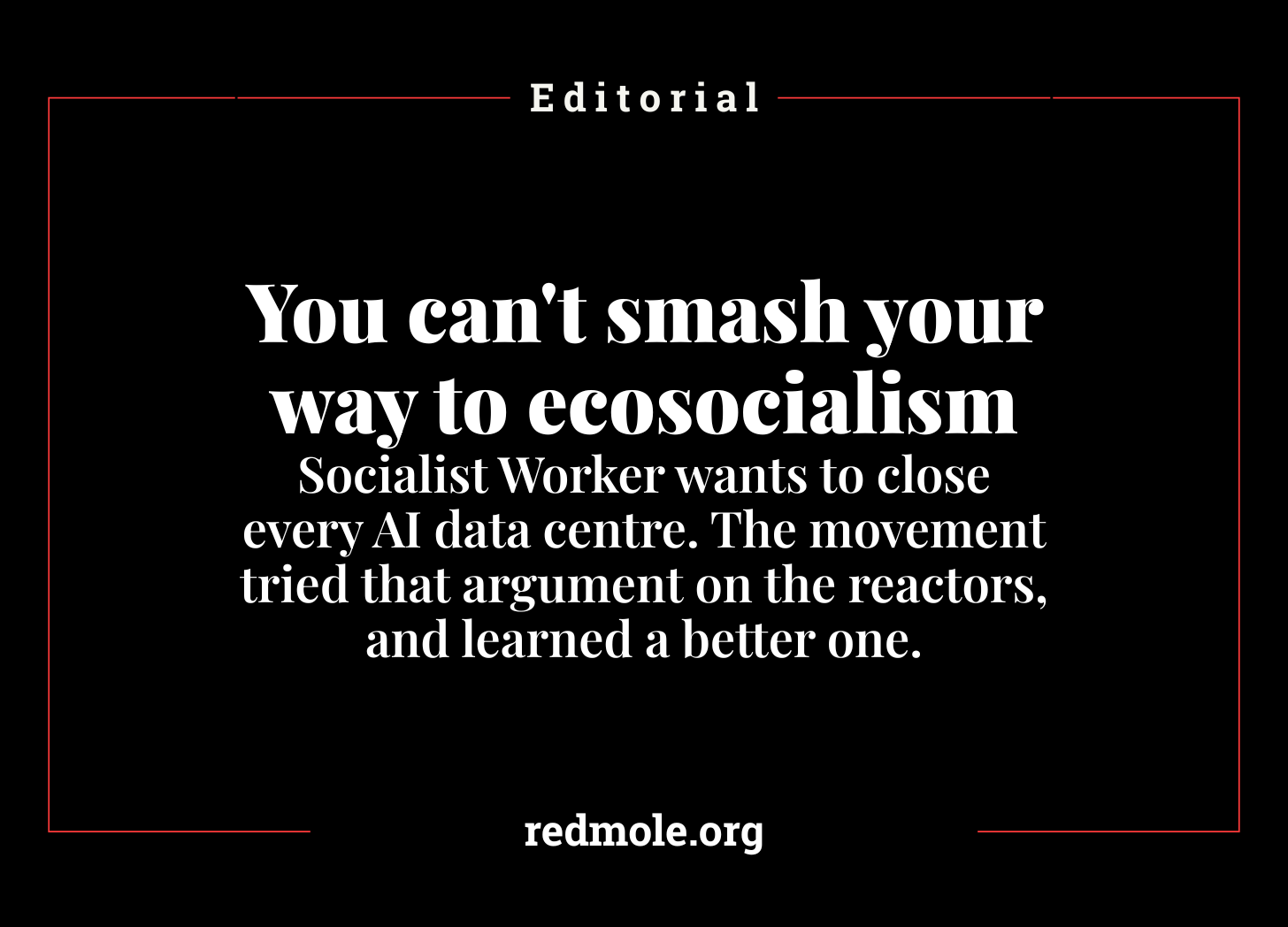
Socialist Worker wants to close the AI data centres. All of them. The demand has the virtue of fitting on a placard and the vice of being aimed at no one. It asks nothing of any union, any council, any government, or any worker anywhere, and it would sweep away in a single sentence the machines that model the climate it means to defend and the ones that let a City bank shave a microsecond off a trade. The strength and the weakness are the same thing. A slogan that undifferentiated will catch a mood. It will also gather, under one banner, people who could never march in the same direction for more than an afternoon.
It feels like the most radical thing you can say. It is also the oldest, and the comparison usually thrown as an insult runs the wrong way. In 1812 the croppers of the West Riding broke the shearing frames at night, and they were neither a rabble nor fools. They ran one of the strongest unions in the country, strong enough a decade earlier to beat Benjamin Gott, the greatest manufacturer in Leeds, in a strike that lasted months, and for years they had petitioned Parliament to enforce the old laws that protected their trade. It was the state that closed every door, repealing those laws and, under the Combination Acts, making the union itself a crime. Frame-breaking was the last weapon of an organised trade after the law had confiscated the rest. They were never confused about what a machine is. They broke the frames that were being used to break them, and they aimed at particular masters, not at machinery as such.
What changed over the century that followed was not that the movement grew wiser about machines. It was that it won back, and then more, everything the state had stripped from the croppers: the legal right to combine, the vote, a party of its own. A class that holds those can fight in daylight over who owns the machine and what it is for, and need no longer break it in the dark.
We know this because we did it the last time a technology became the enemy. In the 1970s the reactor stood where the data centre stands now: a vast, capital-hungry installation, sold as progress, dropped on communities that had not asked for it, and answered by the first genuinely mass ecological movement. Ten thousand people occupied the site at Wyhl in 1975. In Sweden the call to shut down the Barsebäck plant was carried by a hundred and thirty-seven organisations. And the movement was, from the beginning, the same cross-class thing the anti-data-centre movement is becoming: in Sweden the bourgeois Centre Party fought a whole election on opposition to nuclear siting. “The social neutrality to which the ecological debate lays claim,” Hans Magnus Enzensberger wrote in 1974, in an essay the French section reprinted two years later, “is a fiction.”
The revolutionary left did not answer this by standing outside the movement and correcting it, and it did not answer by dissolving into it. It went in to give the movement a class content it did not yet have. When the French section’s Jean-Paul Deléage wrote on nuclear power in 1978 he refused the easy slogan his own side was reaching for. To say “nuclear equals unemployment,” he wrote, “would be to attack the machines alone and not the society that makes them.” His first heading was flat: nuclear power is not an inevitability. The Swedish comrades put it as a method rather than a mood. The fight against building the plants was worth waging, they wrote in 1976, “both as a specific question and as an occasion” to argue for something larger, “a planned economy under the direction of the working class.” Not shut it down and go home. Shut this down, and see, in the shutting, who decides what gets built.
Behind all of it sat one sentence of Marx’s, and it is the sentence the croppers had already worked out with their hammers: the enemy is never the machinery, but its capitalist employment. The movement tested it on the great technological panic before nuclear, which was automation. Four times the Marxist press announced that the machine was about to abolish work, in the mid-fifties, in 1962, in the early eighties, and now with AI, and four times the aggregate forecast was wrong. What was never wrong was the question of who took the gain. In 1962 the electricians of Local 3 in New York met the automation of their trade not by trying to halt it but by striking for, and winning, a twenty-five hour week at the same pay. In 1971 Mike Cooley, a designer at Lucas Aerospace, watched computer graphics gut the drawing office he had trained in, saw a calculation that had taken six months done in under six minutes, and drew from it not a call to smash the terminals but a strategy: organise the proletarianised technicians, turn the concentration of capital into a new power to stop it, and fight for a world in which the same machines could “do all the things which we do now, and an increasing range of things that technology would make possible,” under control. Cooley’s colleagues at Lucas went on to write the most famous document of that whole tradition, an alternative plan for their own factory that proposed building kidney machines and heat pumps where the bosses wanted weapons. The Lucas plan is what “what you’re for, not what you’re against” looks like when it stops being a slogan. It is the frame-breaker’s grandchild, this time with a union card and a blueprint.
Which brings us to the servers. The most serious ecosocialist statement on artificial intelligence yet written is Daniel Tanuro’s, whose theses International Viewpoint published in February. Tanuro is not soft on the machine. He calls it the “hostile force par excellence,” counts the seventeen billion gallons of water the American data centres drank in 2023, and demands a moratorium on the construction of new AI infrastructure. Then read what he does not demand. He does not call for closing the data centres. He writes, in the same document, that “in a non-capitalist world, other AIs could relieve humanity of tedious and repetitive tasks,” that “another kind of digital, public and democratic, is possible,” and that the answer at work is a trade-union veto over the introduction of AI, workers’ control of the workload, and a reduction of hours with no loss of pay. The oldest transitional demand in the file, take the gain as time, sits in the newest theses on the newest machine. Tanuro’s line is a moratorium on new build, workers’ control of the rest, and an honest ecological limit on all of it, because ownership alone will not shrink the footprint. It is to the left of Socialist Worker in everything but the slogan, and the slogan is the only place Socialist Worker is ahead.
That is the trouble with “close the data centres.” It is not too radical. It is not radical at all, because it asks nothing of anyone and builds nothing. It is even less discriminating than the croppers, who at least knew which frames to break and whose. It names no enemy: the City firm and the cancer researcher are equally guilty of running a server. It names no agent: no union, no council, no worker is asked to act. And it gives away the one piece of ground the right cannot follow us onto. There is already a reactionary anti-AI politics, protectionist and technophobic and glad to blame the machine for what the market has done, and an undifferentiated “shut it down” is the exact spot where Steve Bannon and a Unison branch can stand in the same crowd. The anti-nuclear movement was captured that way, by the Centre Party in Sweden and the realos in Germany, and the answer the tradition found was never to drop the demand. It was to anchor it in the unions and in workers’ control, so the question stopped being “machines, yes or no” and became “this machine, in whose interest, decided by whom.”
So the demand is not to close the data centres. It is to stop the ones that meet no need where the homes should go, to put a union veto on the ones already running, to take the saved labour as shorter hours instead of unemployment, to build a public and democratic digital in place of a private and extractive one, and to plan the whole of it inside limits we do not get to vote away. That is harder to fit on a placard. It is also the difference between a movement that wins something and a mood the far right can borrow.
The croppers broke the frames after the state had taken their union and their law and left them nothing else to reach for. We have not been stripped that way. We have unions, a vote, a century of the argument already won, and the most advanced machinery in human history humming in sheds outside towns that need houses. To reach for the hammer first, while we still hold everything that was taken from them, does not honour them. It is cruder than they were, and it volunteers us back into the defeat that was done to them.
Sources. Daniel Tanuro, “Theses for an ecosocialist critique of artificial intelligence,” International Viewpoint 616, 9 February 2026 (the water figure corrected here to gallons, per the Lawrence Berkeley National Laboratory, 2024 United States Data Center Energy Usage Report). Jean-Paul Deléage, “Énergie nucléaire et transition au socialisme,” Critique Communiste 23 (May–June 1978), and the resolution of the Swedish section (KAF) reported in Inprecor 59, 30 September 1976: both translated here from the French. Hans Magnus Enzensberger, “A Critique of Political Ecology,” New Left Review I/84 (1974), p. 10, translated by Patrick Camiller, reprinted in French in Critique Communiste 7 (1976). Mike Cooley, “The Proletarianisation of White-Collar Workers,” The International (IMG), January–February 1972. The automation forecasts and the 1962 electricians’ settlement are drawn from Red Mole Guide 16, The Fourth Forecast. On Wyhl and Barsebäck, Inprecor 23 (April 1975) and International Viewpoint. On the croppers’ union, their defeat of Gott, and Luddism as a targeted trade struggle rather than blind machine-hatred, E. P. Thompson, The Making of the English Working Class (1963), and E. J. Hobsbawm, “The Machine Breakers” (Past & Present, 1952).