The Buses Have Gone Yellow: Manchesterism, the technocrat, and the terrain administered from above
Part 4 of “The Terrain of Survival”
TL;DR Andy Burnham’s Makerfield landslide is being read across the press as the moment Labour found the formula to beat Reform. It is the opposite. The majority doubled because the Liberal Democrat, Green and Conservative votes collapsed into Labour as a defensive bloc, and Reform’s own vote rose 3,000 against its 2024 figure. ‘Manchesterism’ contests the exact terrain this series has mapped, the buses and the housing and the cost of keeping a household alive, but it contests it as administration from above rather than power from below. Burnham is not a techno-fascist; he is a technocrat, and technocracy is not the antidote to the populist surge but its incubator. The terrain of survival cannot be delivered to people. It has to be organised by them. This is the governing prospectus of the man who may be in Number 10 by the autumn, and it is the negative image of everything the People’s Assembly Wales won at the Royal Glamorgan.
The yellow buses are the first thing you notice. They are genuinely everywhere now; you cannot stand on Oxford Road for five minutes without three of them going past, the Bee Network livery doing exactly the job of municipal confidence it was designed to do. The franchising began in September 2023, the first time any English authority had taken control of its buses since the 1986 deregulation, and the early passenger numbers went up. The buses are better. That is not in dispute, and a left that pretends otherwise has lost the argument before it opens its mouth.
Which is why the most quietly devastating line of the entire Makerfield by-election came from the Reform candidate. Robert Kenyon, a local plumber, ran a campaign that landed one sentence cleaner than anything Burnham’s own machine produced: the only thing that’s changed is that the buses have gone yellow. He meant it as a sneer. He did not understand that he had written the most accurate one-line review of Manchesterism available in print. The livery changed. The relations of power did not.
Red Mole Substack is a reader-supported publication. To receive new posts and support my work, consider becoming a free or paid subscriber.
The misread landslide
Begin with the numbers, because the press has already decided what they mean and the press is wrong. On 18 June, Burnham took Makerfield with 54.8 per cent of the vote against Reform’s 34.5, a majority of 9,231, returning him to the Commons for the first time since 2017. Compare that with 2024, when Josh Simons held the seat for Labour with a majority of 5,399 over Reform. The Labour majority did not just hold. It nearly doubled. Four days later Keir Starmer resigned, and Burnham announced he would stand to replace him.
The obvious reading is that Burnham beat back the Reform tide. But that is not quite right either, and the gap between the obvious reading and the real one is the whole story.
Look at where the doubled majority came from. It did not come from beating Reform down. Reform’s share rose, from 31.8 per cent in 2024 to 34.5, and on a turnout almost six points higher than the general election it rose in raw votes as well. The majority widened because the Conservative, Liberal Democrat and Green candidates were squeezed into nothing: all three lost their deposits. An organised tactical-voting operation, Forward Democracy, running a Stop Reform UK campaign, polled the seat and worked to herd the anti-Reform vote behind the only candidate who could stop the populists. It worked. The frightened centre voted Labour to keep Reform out, and the headline writers mistook a defensive consolidation for an advance.
There is a complication, and the piece has to meet it head on or a sharper reader will use it against us. Measured against Reform’s own high-water mark, the by-election was a retreat: in the May local elections Reform had swept all eight Makerfield wards on the Wigan council with around half the vote, helped along by a low turnout and an unusually motivated protest electorate. A right-wing splitter, the Restore Britain candidate, pulled votes off Reform on polling day and left it ‘spooked’. So the mainstream account has a point on its own terms. Against the locals, Reform fell back.
The answer is that the local high-water mark is the wrong baseline. A low-turnout council protest vote inflated by abstention is not the structural position of the seat; the general-election result is, and against it Reform is up. What Makerfield actually shows is a constituency reorganised into two blocs with the middle annihilated: a delivery-Labour pole and a grievance-Reform pole, and nothing of substance in between. That is not Burnham defeating the surge. That is Burnham completing the polarisation that produces it. He absorbed the anti-Reform vote. He did not dissolve the Reform vote, and he has no programme that could.
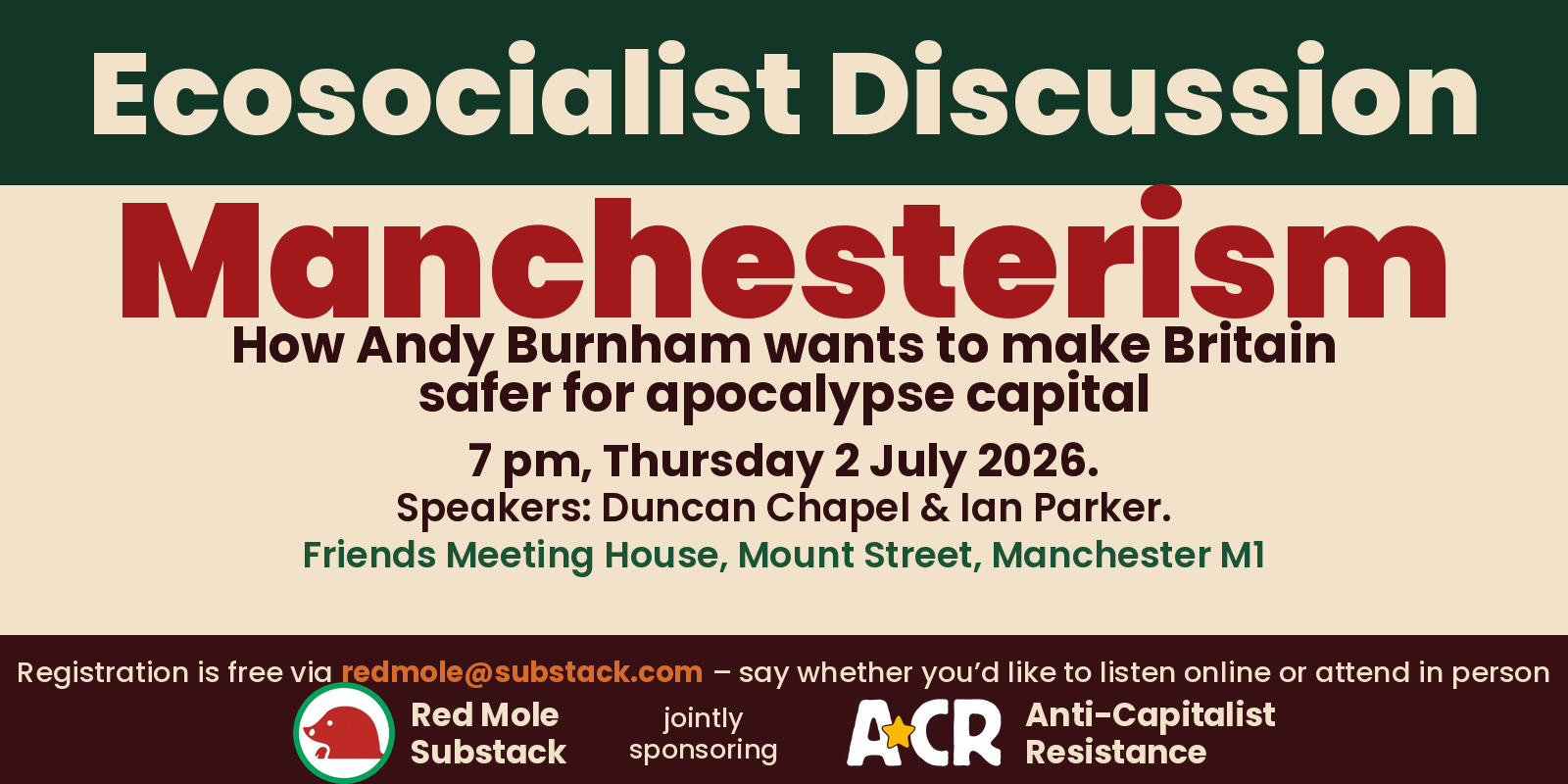
This is the proposition the forthcoming Red Mole and Anti-Capitalist Resistance meeting at the Friends Meeting House on Mount Street puts in its title: a Labour majority of twenty points should worry the left more than a narrow win would have. A narrow win is a contest. A landslide built on the evaporation of every alternative is a warning.
A terrain-of-survival programme in a technocrat’s hands
Manchesterism is not a slogan Burnham invented for the leadership campaign. It has been given an intellectual architecture, most fully in The Productive State, written by Mathew Lawrence of Common Wealth with Alex Williams and published through the Labour pressure group Mainstream the week of the by-election. The argument is serious and, on its own terrain, often correct. Forty years of privatisation produced an economy that extracts where it should invest and prices for profit where it should meet need; the answer is a public institutional architecture that reasserts control over the essentials, a decommodified foundation under the market. The New Statesman trailed it as the supply-side completion of the project Burnham has been running in Greater Manchester, with the Bee Network as the proof of concept.
Notice what the essentials are. Buses. Housing. Water and energy. The cost of the daily business of staying alive. This is the terrain of survival, named almost exactly as this series has named it: the household, the neighbourhood, the care infrastructure, the things the working class in post-industrial Britain experiences as the immediate texture of its subordination. Manchesterism is a terrain-of-survival programme. That is precisely what makes it worth taking seriously, and precisely where the problem lives.
Because the method is the opposite of the one this series has been documenting. The Royal Glamorgan accident and emergency department was saved by twenty-five thousand people, open meetings in a community arts venue by the river in Pontypridd, every email shared, every decision taken from the floor, the experience of collective power against a public body that the Rhondda had not tasted since the miners’ strike. The Grève Féministe in France put two hundred and one actions on the map on a single day in March through a network of a hundred and forty organisations. Those are the terrain organised from below. Manchesterism is the same terrain administered from above: specified by a combined authority, delivered by a competent mayoralty, franchised to private operators under public contract, and handed to the public as a finished service. The buses are franchised, not owned by the people who ride them or driven by workers who run them. The control sits with the apparatus. The user is still a customer; the driver is still an employee. Better buses, yes. Power, no.
The New Statesman’s own left critics have already said the quieter part. Their piece, bluntly titled ‘Manchesterism is not socialism’, points out that the agglomeration gains of the Greater Manchester model over forty years have been captured as rent by property investors and landlords and sucked out of the households they were meant to lift, and that the trajectory continues the entrepreneurial-city and Northern Powerhouse strategy rather than breaking with it. Our quarrel is not with that. Our quarrel is with the framing that treats the question as whether Manchesterism is socialist enough, a question of degree. The question is one of kind. A programme can decommodify every utility in the country and still leave the working class as the object of competent delivery rather than the subject of its own power. That is not a watered-down socialism. It is a different thing entirely, and it has a name.
The technocrat, not the techno-fascist
The name is technocracy, and the distinction from managerialism matters. Managerialism is a sociology of who governs. Technocracy is the ideology that legitimates them: the claim that the fundamental questions are settled and technical, that politics reduces to delivery and competence, that what works can replace who decides. It is the move that lifts a question out of democratic contest and hands it to the experts. And the experts, in Burnham’s case, are arriving.
The clearest tell is the company he is now keeping. The Guardian reported that his team have spoken to Jim O’Neill about becoming his chief economic adviser, with the FT and Bloomberg adding the names of other City and establishment figures to a widening list. O’Neill is the signal. He chaired Goldman Sachs Asset Management, coined the BRIC acronym, and served as a Treasury minister under Cameron and Osborne, where he was among the leading advocates of the Northern Powerhouse, a project whose regional-growth promises have been delayed and unmet for a decade rather than delivered. This is the man brought in to reassure capital that Burnham’s talk of public control will not threaten profitability or debt servicing. The operational logic remains pro-system even where the rhetoric is anti-privatisation. That is how social-democratic projects are domesticated: they hire establishment economists to whisper to the bond markets that change is safe.
And Burnham has already told us where the real limits sit. In January he complained that Britain was stuck ‘in hock to the bond markets’ and set out his case for what he called ‘business-friendly socialism’. The bond-market line was the truth slipping out, and he spent the following weeks taking it back, telling Reuters and Bloomberg the remark had been misunderstood and that gilt investors were safe with him, before pledging to keep Rachel Reeves’s fiscal rules in full. Submitting the economy to creditor discipline and declaring the fiscal rules untouchable is depoliticisation in its purest form: the removal of the largest questions from the demos and their surrender to the markets. ‘Business-friendly socialism’ is the phrase of a man trying to reconcile two classes whose interests do not reconcile. It is not a synthesis. It is a hostage note.
Here the homonym is too good to leave on the floor, though it has to be handled honestly, because it is a rhyme and not a lineage. Andy Burnham owes nothing to James Burnham; the connection is ours, not his. But James Burnham wrote The Managerial Revolution in 1941 to announce that the working class was finished as a historical agent and that a new class of managers and administrators would inherit the earth, Washington and Moscow and Berlin all converging on the same managerial form. He arrived there by way of the 1939 fight in the American Socialist Workers Party, standing with Shachtman against Trotsky, before bolting Marxism altogether and ending up at the founding of National Review. The managerial thesis was the right-hand exit from that crisis, the Third Camp the left-hand one, and both abandoned the proletariat as subject: one walked to the boardroom, the other to the propaganda group. Orwell saw the trap in 1946. His ‘Second Thoughts on James Burnham’ is a warning against mistaking the momentary balance of forces for permanent inevitability, against the worship of the competent and the strong. Two Burnhams, then, and the second offers as a prospectus, in jeans, what the first theorised as destiny.
The theory that makes this rigorous belongs to Peter Mair. In Ruling the Void he described representative democracy hollowing out as elites and citizens withdraw from each other, the popular component of party democracy emptied until governance is all that remains, and he named the two formations that rush into the emptied space: technocracy and populism, the competent administrator and the angry demagogue, the twin successors to a politics that no longer represents. That is the real adjacency, and it is the one the earlier drafts of this analysis kept reaching for and missing. Burnham and Reform are not opposites locked in combat. They are the two faces of the same hollowed settlement. The technocrat administers the exclusion of the masses from power, and the populist harvests the resentment that exclusion produces. Each needs the other. Makerfield is what it looks like when both poles consolidate and the ground between them is salted.
What the terrain demands
So what is the alternative, and here the honest difficulty has to be admitted rather than smoothed over. The yellow buses are real. The improved service is real. A revolutionary left that answers a better bus with a lecture on commodity fetishism, that treats every gain delivered by a reformist mayor as a snare to be denounced, is a left that has confused purity with strategy and will be rightly ignored by the people queuing at the stop. The point was never that provision does not matter. Provision matters enormously; the whole terrain-of-survival argument rests on it mattering. The point is what provision does to the people who receive it, and whether it leaves them stronger or merely served, and on that question the answer is not yet clear even in the cases where the left has won, which is the unfinished business this series keeps circling back to and has not closed.
What separates the Royal Glamorgan from the Bee Network is not the quality of the service. It is the transitional content. Len Arthur’s framework, set out across Part 3, holds that a demand becomes transitional when it exposes the mechanism rather than reversing a single decision, and when the collective capacity built in winning it is retained and pointed forward. The hospital campaign did not just keep one A&E open. It exposed the deliberate rundown, the unadvertised consultant posts, the austerity dressed as clinical necessity, and it left twenty-five thousand people who now know they can beat a health board. The franchised bus network leaves nobody with anything except a timetable. One builds subjects. The other delivers to customers. That is the entire distance between a transitional demand and a managerial offer, and it runs directly into the capstone this series is building toward, ‘Life-Making as Class Struggle’, where Mandel’s transitional method meets social reproduction: the demand is never simply for the service, but for the service under the democratic control of those who provide and depend on it, because the struggle for the day-to-day demand poses, at the same time, the question of who holds power.
Put the two programmes on the same terrain and the difference is exact. The Productive State would own the water company. A transitional demand would put the water company under the control of the workers who run it and the communities who drink from it, and would treat the fight to get there as the point, not an inconvenience on the way to a balance sheet. Burnham would never accept that, because it crosses the line his bond-market advisers are there to police. Which is the whole argument: the limit of Manchesterism is not a failure of ambition but a structural commitment to leave class power where it is.
The danger is not that Burnham is secretly Reform, or secretly a fascist, or secretly anything. The danger is exactly what he openly is. A competent administrator of a terrain he will not let the people who live on it control, clearing every alternative off the field, presenting a frightened electorate with a choice between being managed well and being told their anger has a flag. The yellow buses run on time. The question Makerfield actually poses is whether anyone is building the thing that turns a better bus into collective power before Reform finishes turning exclusion into something worse, and on the evidence of the seat where it was just tested, the honest answer is that we are not yet, not at the scale the moment now demands.
Red Mole Substack cosponsors Manchester Ecosocialist Discussion. To continue the discussion, join this meeting in person or online.
Red Mole Substack is a reader-supported publication. To receive new posts and support my work, consider becoming a free or paid subscriber.
Another excellent analysis and we are really pleased you have followed through using the example of our success as People's Assembly Wales in saving the Royal Glam as a campaign rooted in transitional demands. We've posted it to our Cymru'n Codi Substack website. Thanks Duncan.


Another excellent analysis and we are really pleased you have followed through using the example of our success as People's Assembly Wales in saving the Royal Glam as a campaign rooted in transitional demands. We've posted it to our Cymru'n Codi Substack website. Thanks Duncan.