

TL;DR Turkey shows how a modern state decapitates its opposition: not by coup but by court order, and the cage was built during the ‘reformist’ years before anyone was put inside it. Britain’s equivalent apparatus, the Public Order Act, Prevent, the manufactured anti-migrant consensus, is already largely in place, which is why ‘creeping fascism’ is the wrong image; the creeping is behind us, not ahead. The phrase was always an awkward name for something real: the far-right space cleared by state racism. A Reform government in 2029 would inherit that apparatus intact. The task now, and the lesson of the Turkish left’s failures and its present fight alike, is independent working-class organisation that refuses to dissolve into the liberal-bourgeois pole, which in Britain means Labour, the government currently doing the building.Last week, the heads of NATO’s governments met in Ankara. Trump came. Rutte read out the communiqué. And an hour from the summit venue, in a cell at Silivri, sits Ekrem İmamoğlu: mayor of Istanbul, the man whose party outpolled Erdoğan’s AKP in the 2024 local elections, the challenger the polls showed beating Erdoğan himself in a run-off, detained on 19 March 2025 and formally arrested four days later, on the very day the Republican People’s Party named him its candidate for the presidency. His trial opened on 9 March 2026. There are 142 charges. The prosecutors are asking for two thousand three hundred and fifty-two years.
He is not the only one inside. Can Atalay was elected to parliament in 2023 for Hatay, the province whose ruins TİP’s volunteers had reached with food and rescue teams when the state did not, in the weeks after the February earthquakes flattened Samandağ and Defne; he has sat in that same Silivri prison throughout, serving eighteen years from the Gezi trial, while the Constitutional Court twice ruled his imprisonment unlawful and the lower courts simply declined to comply. Amnesty calls him a prisoner of conscience, alongside Osman Kavala. His seat is a working-class mandate the state will not honour.
On 21 May 2026 a court of appeal in Ankara declared the CHP’s 2023 congress void under a doctrine called ‘absolute nullity’, removed the party’s elected leader Özgür Özel, and restored to office the man he had beaten, Kemal Kılıçdaroğlu. Kılıçdaroğlu’s first act as court-appointed leader? He sacked the lawyers who were appealing his own reinstatement, and dropped the appeal.
No tanks. No march on the capital. No single afternoon of rupture. The Turkish opposition has been decapitated by warrant, indictment and appeal-court ruling, by the ordinary machinery of a bourgeois state turned to a single purpose. This is the fact British socialists need to sit with, because it is the fact that travels.
On the Anti-Capitalist Resistance website there is a tag, ‘Creeping Fascism’, and it runs forty-two articles deep. The phrase is Neil Faulkner’s, from the book he wrote with Samir Dathi, Phil Hearse and Seema Syeda, and it has shaped how the British far left talks about the present danger more than anything the sects produced in the same years. It deserves better than the caricature its critics reach for.
Faulkner never argued that Britain had become Nazi Germany. He was explicit that fascism is not a fixed state to be checked off against a list but a fluid political process, that arguing over whether Trump or Erdoğan is ‘technically’ a fascist is a waste of breath, that what matters is the direction of travel of the Right as a whole. He insisted, against the grain of the tradition, that the primary agent of fascist repression is not the paramilitary street gang but the existing bourgeois state, reshaped from within by purge and intimidation. And in the book he finished the day he died, Mind Fuck, he pushed further than most Marxists dared, into the psychology of the thing: the narcissism of the atomised consumer who finds in the strongman not a father but a mirror. Ian Parker, who reviewed that book and argued with Faulkner about it as a comrade should, is a Manchester psychoanalyst; their disagreement, over whether fascism is a sickness or a politics, was never settled, and Faulkner died with it open.
Most important, and least remembered by those who invoke the label loosely: Faulkner’s conclusion was a frontal attack on popular frontism. Reviewing Paul Mason and Luke Cooper, he tore into the idea that the answer to the far right is an alliance of the left with the Liberal Centre and a liberal-run state. The interwar record, he wrote, shows the opposite; wherever fascism was stopped, at the biennio rosso, at Cable Street, it was stopped by united fronts of working-class forces, not by popular fronts that harnessed the workers to their bourgeois allies. Build from below, he said, do not hold up a placard begging liberal politicians and the police to save us.
Set against Faulkner is a different reading from inside the same International. At a study day of the Ernest Mandel Foundation in Antwerp last December, Alex de Jong, who directs the Fourth International’s school in Amsterdam, and the historian Vincent Scheltiens argued that naming the contemporary far right ‘fascism’ is not merely inexact but self-defeating. Geert Wilders, on their account, is a radicalised liberal rather than a neofascist: free-market where the interwar fascists were anti-capitalist, working through media saturation where they worked through paramilitaries, a party of two members that coincides entirely with one man. The Blackshirts are absent because there is no organised labour movement left to smash, which makes the far right’s non-violence tactical, not principled. And the label itself, Scheltiens warned, alienates the very passive supporters the left needs to peel away, people who do not recognise themselves as heirs of the brown past and will not be argued out of their vote by a history lesson.
Behind them stands Mandel, who saw all of this coming in 1969. He warned then against loose talk of ‘creeping fascization’, on the grounds that fascism draws its mass from a ruined and desperate petty-bourgeoisie, and that a satisfied, propertied petty-bourgeoisie does not brawl in the streets: it calls the police, and asks them to be better armed. He drew the distinction the whole argument turns on, between fascism proper and the authoritarian ‘strong state’ that represses hard without atomising the class or smashing its organisations. And he mocked, in advance, the habit of calling every authoritarian ruler with a leader-cult a fascist, which is worth remembering when we look at Ankara.
Here is what the quarrel is not about. It is not, at bottom, about whether Britain is fascist yet. Read Faulkner and read de Jong to the end and they arrive at the same door: no subordination to the Liberal Centre, no faith in the capitalist state, build the counter-power from below. The disagreement is narrower and sharper than the shouting suggests. It is whether the word ‘fascism’ clarifies the danger or disarms us before it. Faulkner says the refusal to say the word breeds the complacency that gave us Lexit. Scheltiens says the word loses us the room. I am not sure the argument can be won on the terms it is usually fought, and I am not going to pretend here that it can; what I am sure of is that both men are describing something real, and that the name has been the least useful part of the description.
Because the phenomenon is real, whatever we call it. The space in which Reform now grows was cleared by the state itself: by the Public Order Act and its Serious Disruption Prevention Orders, by the new offences of ‘locking on’ and ‘tunnelling’, by Prevent, by a decade of small-boats theatre and a panic over trans lives conducted from the despatch box. ‘Creeping fascism’ was an awkward name for this. The thing it named is state racism, and the far right is the tenant that racism built the house for.
The apparatus does not need a fascist to build it. Turkey’s Anti-Terror Law dates from 1991, a decade before Erdoğan took office, and the AKP amended it rather than repealed it in the years when Brussels still called them reformers; what changed after 2016 was not the statute but the will to use it, and the courts then took a funeral attended, a speech given, a municipal decision made in elected office, and called it membership of an armed organisation. Britain has its category ready. Counter-terrorism policing calls it Left-Wing, Anarchist and Single-Issue Terrorism, and its own published assessment concedes there has never been a completed LASIT attack in this country and that one remains highly unlikely; the 2024 strategy refresh says the thing is not present here at any significant scale. None of which stopped the diagram being drawn, with socialism and communism and anti-fascism inside the circle. Palestine Action was proscribed anyway.
And the powers keep coming. The Crime and Policing Bill would make it an offence to wear a face covering to conceal identity inside an area a police officer has designated, and the officer may designate that area for up to forty-eight hours on a belief that a protest may take place there and that offences are likely. Not that offences have occurred. That a protest might happen, and that something might follow. Read the two clauses together and the shape is familiar: Turkey’s courts moved the line back from what you did to who you were seen with, and this moves it back from what you did to where you stood and what was on your face. There are exemptions, the government says, for health. The exemption is argued in court. The arrest happens on the street, which is where the demonstration was, and the demonstration will be over by the time anybody is vindicated. Consider, then, who cannot take a mask off in a crowd: the immunocompromised, for whom a mask is the price of being in public at all. Consider who needs to see a face to be spoken to. A law about covered faces falls hardest on the people for whom faces are how language works, and ACR members have been organising against it alongside activists from Liberty and from deaf and disabled people’s organisations, which is the sort of unglamorous defensive work that decides whether there is anyone left on the streets when the powers are finally used.
The bill was drafted before Ann Widdecombe was beaten to death in her Devon home in July, a woman of seventy-eight killed in the place she lived. Counter-terrorism police have taken over the investigation. They have not designated it as terrorism; they say they are still working to establish the motive. That did not slow anyone down. Within a day Robert Jenrick was on the Today programme, pressed on whether the killing conveniently changed the national subject away from Nigel Farage’s five million pounds, and answering that Reform were not mainstream politicians and would not back down. The powers were already drafted. The killing arrives as the weather they will pass in.
Which is why the metaphor has outlived its use. To say fascism is ‘creeping’ towards Britain is to look down the road, when the development that matters has already happened behind us. The obvious reading is that Britain is simply further back on the Turkish road, with the jailings still to come. But that is not quite right either. The lesson of Turkey is not in the jailings; it is in the order of operations. The apparatus that now holds İmamoğlu was assembled during the AKP’s ‘reformist’, pro-EU decade, when Erdoğan was the West’s favourite Muslim democrat and the liberals applauded each expansion of executive power as a blow against the old generals. The cage was built first, in the good years. The prisoner was put in it later.
Britain is in the good years. The 2024 riots, the mosques attacked, the asylum hotels besieged, were a spasm. No, not a spasm: a rehearsal, and the state that stood back and watched them is the state that already holds the powers a future government will need. We are not waiting for the machinery of authoritarian rule to be built. We are living through its construction, and the hands doing the building are Labour’s. Starmer is on his way out even as these words are written; his successor will inherit the apparatus fully assembled and the habit of using it.
For the machinery does not care who inherits it. A Reform-powered government in 2029, and the polling no longer lets us treat that as fantasy, would take office already equipped: the protest law, the surveillance architecture, the Prevent apparatus, the anti-migrant common sense, all built and normalised by others and handed over intact. That is the warning Turkey issues to the British working class, and it is not a warning to be answered at the next election. By the next election the tools are already on the shelf.
So what is to be done now, in the years that feel too early to matter? The Turkish answer is written twice over. It is written in the failure of the old Workers’ Party of Turkey, which won its fifteen seats in 1965 and then let its independence dissolve into the strategic fantasies of others, the officers who would supposedly make the revolution from above. And it is written, more hopefully, in what the present TİP is doing this week. As the NATO leaders meet in Ankara, TİP’s ‘No to NATO’ initiative, in which Fourth International militants are active, has convened an anti-imperialist counter-summit in Istanbul, and the Turkish state has answered it in the only language it now speaks fluently: by arresting anti-war organisers, Muhammed Hizmetçi, Songül Yücel and Sena Şat among them, in the weeks before the cameras arrived. Independent organisation, and an internationalism from below that does not wait for permission. That is the content of the alternative.
TİP knows this tightrope better than we do. It gave Kılıçdaroğlu critical support in the 2023 presidential run-off while running its own candidates for parliament, and it has heard from its critics on the Turkish left ever since that it lent its name to a neoliberal bloc; the sharpest form of the charge, that it kept lending that name even after Kılıçdaroğlu signed a deportation pact with the far right, deserves an honest answer rather than a wave of the hand. But the line those critics point to is the one that matters. You may lend a bourgeois candidate your vote to bury a Bonapartist and still keep your own programme and your own slate on the ballot; fold your organisation into his bloc and you have crossed from the united front to the popular front. That crossing is the thing a British left tempted by Labour will have to refuse, and the tactical vote was never the danger.
And here the Turkish lesson turns inside out as it crosses to Britain. The temptation of the Turkish left is to dissolve itself into the CHP, the liberal-bourgeois opposition, in the name of stopping Erdoğan. The temptation of the British left is to dissolve itself into Starmer’s Labour in the name of stopping Reform. The same imperative, mirror-imaged: the CHP is out of power, and the party the British left is tempted by is in office, administering the very consolidation this meeting is called to warn against. The united front the tradition keeps rediscovering, from Cable Street to Antwerp, is a front from below, of the working class and the oppressed, or it is nothing.
On 3 September the argument gets a room, in Manchester, where ACR and TİP sit down together, and where the comrade asked to defend ‘creeping fascism’ will be defending an ACR book against the Fourth International’s own school, quite possibly with Ian Parker in the audience. Good. That is the argument worth having, and it is better had in public than in a group chat.
None of which resolves the thing that should keep us up. The cage in Turkey was built in the years when building it looked paranoid, and used in the years when it was too late to object. The window in which a counter-power can be built is precisely the window in which the need for it looks least urgent, which is to say now, in the quiet before Reform, in the good years that are also the years the machinery is going up.
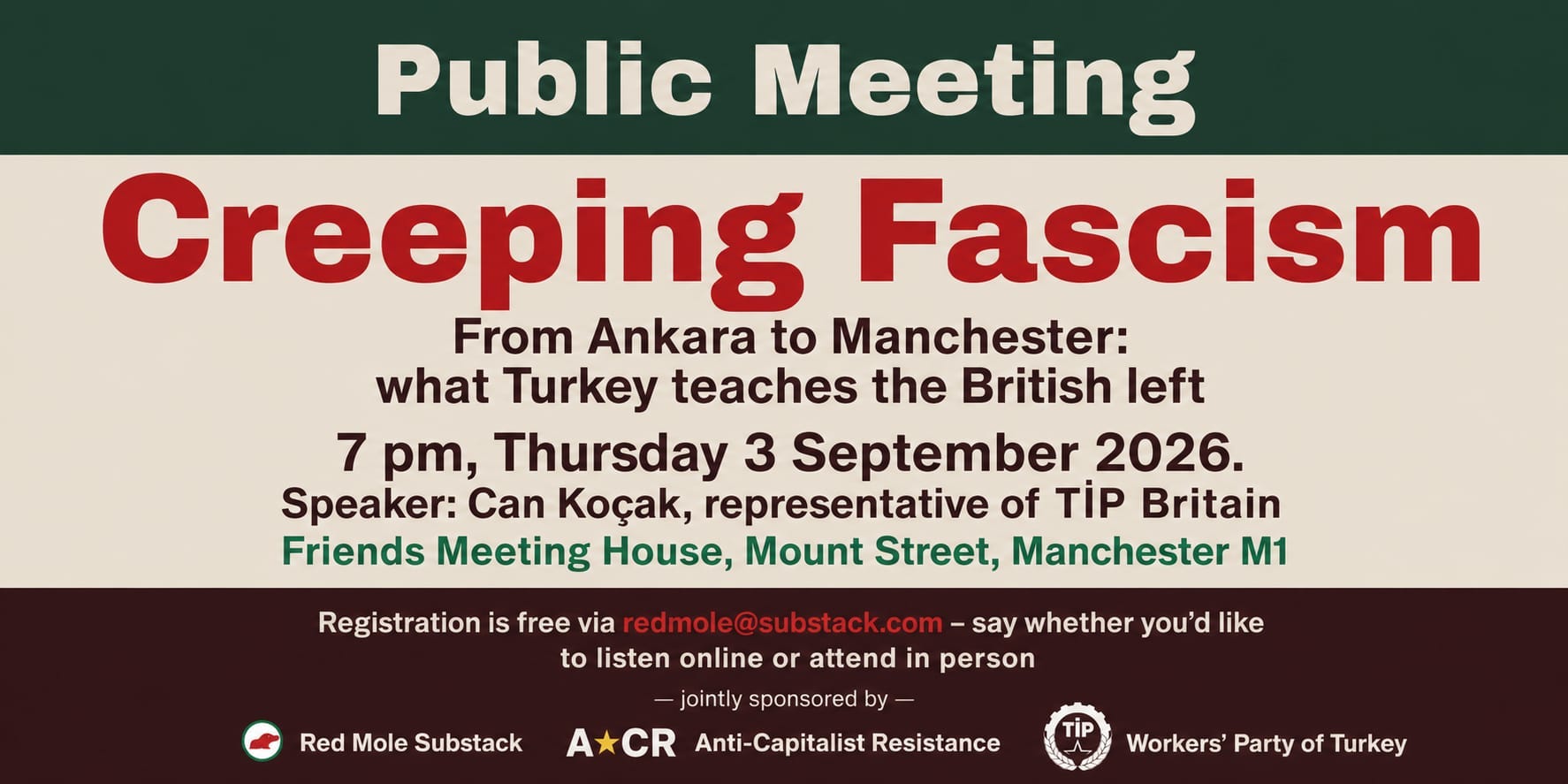
Register online at https://forms.gle/gxhJ6ecWNcUHcj177
Related Reading:
Combating the Far-Right: Lessons from 20th Century Revolutionary History: Lessons for Today
Fighting Fascism: Lesser Evils, United Fronts, and Leftist Strategy: A companion FAQ to ‘The French Left, Le Pen, and the 2002 Presidential Runoff’
After Holyrood: Reform’s Seventeen and the Limits of Electoral Refuge: 2029 prognosis: Reform will rule Britain, even if outside government
What Socialist Outlook Saw: Reading the IMG- & WSL-tradition’s journal from the late 1980s, with a view to the present
In the Greens, Against Absorption: What Anticapitalistas Can Teach the rs21 Comrades Debating the Question: At rs21’s ‘Ballot Box or Barricade?’ panel, part of its Festival of the Oppressed in London on 20 and...
Thanks for this timely and important article. I make a similar point about rejecting Popular Frontism in opposing Reform UK/Restore in a paper I have recently written for the Cymru'n Codi Cyngor (Council): Notes on Ecosocialist Republicans and Elections
Informative, analytical and excellent. Thank you.