

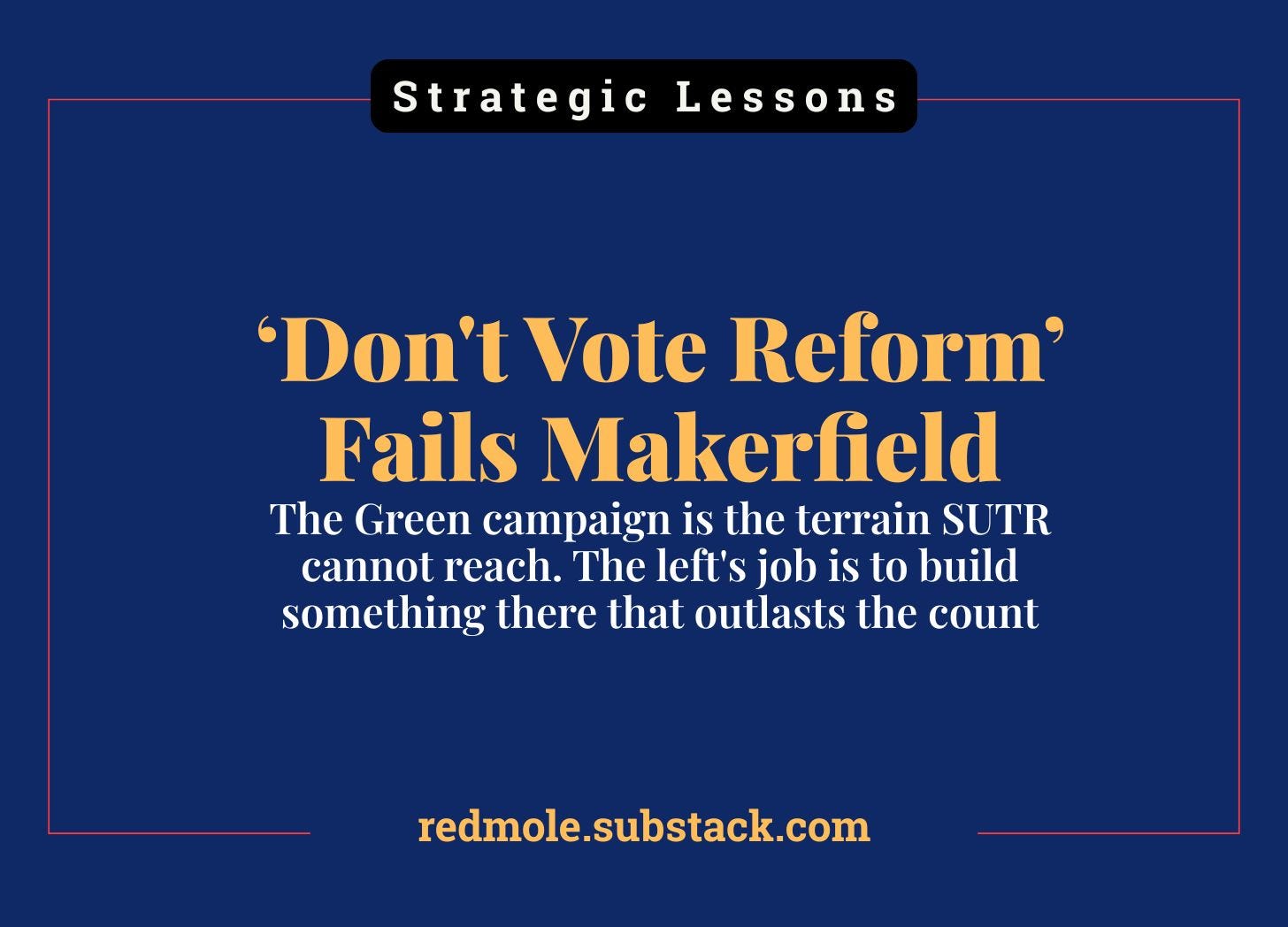
TL;DR. The question 'Labour or Greens?' is a tactical assessment, not a matter of principle. Labour was always a bourgeois party in Lenin's sense: what has changed is not its programme but the structural conditions for reformism itself. Over the past fifty years the material basis for social democratic reform has contracted to the point where reformist parties can no longer deliver the reforms that justified engagement with them. The Greens are not programmatically superior to Labour, either in Scotland or in England and Wales. But they are where the broad vanguard is currently moving, and being present in that space, raising indispensable demands the Green campaign can either deliver or refuse, is the work that serves the construction of class independence. The far left present in Makerfield this month will mostly be bussed-in supporters in the SUTR 'Don't Vote Reform' campaign, which is a recruitment and brand-building operation for the SWP regionally, not a united front of activists in the constituency. It cannot link the defensive struggles on housing, austerity, and authoritarianism into a fighting force. The Green campaign can, if the left goes into it with organisational purpose and political independence. The vote on 18 June is tactical. The network built before and after it is the point.In May 1970, Pat Jordan answered Robin Blackburn’s call to let Labour bleed with a sentence that should be tattooed somewhere visible in every left campaign room in Britain. ‘If all the revolutionary Marxists in the whole country went all out to persuade people to vote Labour,’ Jordan wrote, ‘it is doubtful whether this would win the L.P. one seat.’ He was not recommending abstention. He was puncturing, permanently, the illusion that the left’s electoral interventions are decisive in their own terms. Once you have absorbed that puncture, the question ‘Labour or Greens?’ transforms. It stops being a question about which party to deliver leaflets for on a sweltering Saturday in a post-industrial Lancashire constituency and starts being a question about what the work is for.
That is the question this article addresses. The tactical argument about Makerfield specifically is in ‘Let Burnham Bleed’. What follows is the strategic framework behind it: why the choice between Labour and the Greens is a tactical assessment rather than a matter of principle, and what that assessment requires the left to ask.
Start with a clarification the British left has generally preferred to avoid. Labour is not, and never was, a workers’ party in any programmatic sense. The hyphenated ‘bourgeois-workers party’ formula invented by post-war British Trotskyism implied a structural contradiction that might be worked from inside: a party half-bourgeois and half-proletarian whose worker composition might eventually overcome its bourgeois leadership. Lenin implied nothing of the sort. In ‘Left-Wing Communism: An Infantile Disorder’, written in 1920, he described Labour as ‘a thoroughly bourgeois party, because, although made up of workers, it is led by reactionaries, and the worst kind of reactionaries at that, who act quite in the spirit of the bourgeoisie. It is an organisation of the bourgeoisie, which exists to systematically dupe the workers with the aid of the British Noskes and Scheidemanns.’ The reference to Noske and Scheidemann is not rhetorical decoration. These were the SPD leaders who suppressed the German revolution, authorised the Freikorps, and bore direct responsibility for the murders of Luxemburg and Liebknecht. Lenin is making a precise claim about what the Labour leadership will do to the British working class when the moment of decision arrives. A claim to be tested. Not assumed. But not dismissed.
That formulation captures a contradiction rather than simply delivering a verdict. Engels coined the term and Lenin described it as ‘remarkably profound’ precisely because it holds together the tension between working-class social base and bourgeois political character. The argument here is not that Labour was always equivalent to the Tories, or that the contradiction the formulation captures was never real. It was real. The organic connection between Labour and working-class political development was the living justification for engagement across most of the twentieth century. What has changed is not the theoretical formula but the empirical reality it describes.
The theoretical foundation behind this assessment is older than 1920. In ‘Imperialism and the Split in Socialism’, written in October 1916, Lenin draws on forty years of Engels’s correspondence to establish the analysis. Engels writes to Marx in 1858 that the English proletariat is ‘becoming more and more bourgeois.’ By 1882 he notes that English workers ‘gaily share the feast of England’s monopoly of the world market and the colonies.’
Engels’s analysis, developed across four decades of correspondence, identified what he called the bourgeois labour party not as a formal organisation but as a political function: the Liberal Party, in the mid-Victorian period, performed this function for the labour aristocracy, the skilled craft workers whose wages and conditions had been lifted by Britain’s monopoly position in the world market. These workers were becoming more and more bourgeois: their material interests had been partially aligned with capital through the share of imperial superprofits that trickled down to them, and their political expression was accordingly Liberal rather than revolutionary. Engels italicised the term in his original correspondence, and Lenin, quoting him in 1916, preserved that emphasis, explicitly attributing it to Engels and describing it as his ‘remarkably profound expression.’ The standard English translation renders those italics as quotation marks: the British left drops the quotation marks. What matters is that neither Engels nor Lenin was deploying a settled descriptive label. Engels was identifying a specific historical phenomenon: the Liberal-aligned trade union leadership of mid-Victorian England, whose bourgeoisification he had traced across four decades of letters. Lenin was applying that analytical category to the new conditions of the imperialist epoch, arguing that what had been exceptional to England was now ‘inevitable and typical in all imperialist countries’ because imperialist superprofits now allowed every advanced capitalist bourgeoisie to bribe a stratum of its own working class. The term describes a political function performed at a specific historical moment, not a permanent characteristic of any party with trade union connections. And the mechanism of decay is built into the analysis: when the material basis for the labour aristocracy erodes, the party that represented it loses its working-class anchoring. Deindustrialisation, the collapse of the craft union base, the replacement of stable manufacturing with precarious logistics: these are not accidental background conditions. They are the material substrate on which the Labour Party’s structural transformation has occurred.
Lenin says as early as 1913, writing in Pravda, that those conditions are already ‘becoming a thing of the past.’ The basis for Labour’s opportunism is historically contingent. The case he would make seven years later for Communist affiliation was therefore always a historically specific tactical judgement, not a permanent structural position: go where the workers are, raise demands their party cannot satisfy, help them draw the conclusions the experience will eventually force. The exit condition was built into the argument before the argument for entry was made.
What made the 1920 affiliation argument coherent was precisely Lenin’s method for testing it. He was not calling for blanket Labour support on the grounds that Labour is marginally better than the Tories. He was describing a sequence. The Communist Party proposes a bloc with Henderson and Snowden on working-class terms. If Labour refuses, ‘we shall expose the Labour Party as a bourgeois party of the worst kind.’ The characterisation is the conclusion of the tactic, not its premise. You propose the bloc. You force the choice. The response is the lesson. Revolutionary politics does not begin with correct classification. It begins with concrete proposals that reveal the actual alignment of forces.
This method is importantly different from the Third Period position, which deserves to be named directly because it will be raised. The Third Period Comintern from 1928 denied the contradiction in the bourgeois labour party analysis by equating social democracy with fascism, coined the ‘social fascism’ formula, and on that basis refused any united front with social democratic organisations. That position produced the catastrophe of 1933. The argument here does none of those things. It accepts the contradiction, acknowledges that Labour emerged from the working class and was built by the unions, and makes a historical argument about the current state of that relationship. These are not the same thing, and treating them as equivalent does not strengthen the theoretical case against this article’s conclusions.
Applied to the present: the tests have been applied. The Birmingham bin workers, in one of the most significant industrial disputes in years, found a Labour council ranged against them: not their reluctant critic, not their embarrassed ally, but the party in direct institutional conflict with its own members in dispute. The shadow cabinet ban on picket line appearances was not a blunder. The Murdoch press and the Financial Times endorsed Labour because they read it correctly. These are not anomalies. They are responses to tests. The class fronts have been clarified.
In Makerfield specifically, the test takes a particular form. As argued in ‘Let Burnham Bleed’, Andy Burnham reversed his positions on proportional representation, immigration, and trans rights in the space of a single campaign week, under the pressure of a Reform-leaning electorate. A man who built a political identity as a northern Labour counterweight to the Westminster machine is now standing on a platform indistinguishable from that machine. Labour leaflets in that borough have carried the Union Jack and declare support for business. This is the Blunkett playbook: accommodate the framing to pull the rug from under the far right, and thereby deepen the drift you were trying to reverse. The test response is visible in real time and publicly.
Most British trade unions are not affiliated to Labour. Of more than forty TUC-affiliated unions, currently only 11 hold formal Labour affiliation. The RMT was expelled from Labour in 2004 after backing Scottish Socialist Party candidates. The Fire Brigades Union disaffiliated in 2004 amid disputes with the Blair government, reaffiliated in 2015 following Corbyn's election as leader, and the Scottish FBU has maintained independence from Labour throughout. BECTU, the media and entertainment union, left Labour affiliation when it merged into Prospect in 2017. The BFAWU left in 2021. These are not cases of institutional drift. They are cases where specific unions applied something close to the logic of indispensable demands to their relationship with Labour and acted on the result. The picture of union affiliation is more complex than headline figures suggest. Eleven unions covering around four million workers in total are formally affiliated to Labour, but the official affiliated voting strength declared to the Labour Party sits closer to 2.2 to 2.5 million members, because affiliation fees are based only on members who actively direct their political levy to the Labour-affiliated fund rather than to their union's general campaign fund. In UNISON alone, fewer than a third of members choose the Labour-affiliated option. Since the Trade Union Act 2016 required new members to opt in to the political levy rather than opt out, that proportion will continue to fall. The institutional relationship between union leaderships and Labour is maintained by bureaucracies whose material interests are served by access to a Labour government. It is not straightforwardly backed by the membership beneath them.
A qualification is needed here, and honesty requires making it. The decay in Labour’s relationship with working-class political development has occurred at the national and strategic level. It has not occurred uniformly everywhere. There are CLPs where genuine left currents are in real contest with the national party’s direction. There are Labour-controlled councils operating well to the left of what Starmer’s government will contemplate nationally: Leeds City Council has declared a 2030 carbon neutrality target, requires council-funded developments to meet net-zero standards, and runs the largest zero-emission vehicle fleet of any UK local authority, none of which is consistent with the national party’s accommodation to fossil capital. Last weekend, a Labour constituency party co-sponsored the Ecosocialism 2026 conference organised by the Ecosocialist Action Network, an explicitly anticapitalist project which includes Greens Organise. The broad vanguard has not been expelled wholesale from every local Labour structure. Where those local relationships remain alive, however, they persist despite what the party has become nationally, not because of it. They are rearguard actions within a formation whose national leadership has resolved the contradiction in a particular direction. The test in each case remains the one Lenin applied in 1920: does being present in this space, raising these demands, serve the development of class independence? At the national level, the answer is clearly no. At the local level, it remains an empirical question, and the left in those spaces will draw its own conclusions from its own experience.
The current left apologetics for continuing Labour engagement as a national orientation, the argument that internal contradictions remain worth working at the strategic level, that a worse alternative justifies swallowing what cannot be defended, is Kautskyism in Lenin’s precise sense. In 1916, Lenin described the Kautskyite position as ‘masked defence of the social-chauvinists’: it reconciles the proletariat with the bourgeois labour party under the guise of realism, while the open opportunists are at least honest about what they are doing. Lenin’s injunction was the opposite. Go down lower and deeper, to the real masses. Find the layers whose ‘minds were virgin soil, entirely free from the inherited respectable bourgeois prejudices.’ Ask where those layers are now expressing their political development. Go there.
Which brings us to this island’s two Green parties: the Scottish Greens, and the Green Party of England and Wales. And here the argument requires a step that will irritate people on both sides of the debate: the Greens are not meaningfully more of a workers’ party than Labour. They are a different bourgeois party, with a different social history and a different current relationship to working-class political consciousness. The question of whether to engage with Green campaigns is therefore not a question about the Greens’ class character. It is the same question Lenin asked about Labour in 1920: are the workers we need to reach expressing their political development through this formation, and does being present in that space serve the construction of class independence?
In some places, at this conjuncture, the answer is yes. The Green vote is no longer primarily the expression of a professionalised petty-bourgeois environmentalism. It increasingly represents generalised hostility to the existing order among younger workers, precarious workers, and the layers that Corbynism briefly organised and then lost. These are precisely the layers Engels described: not yet integrated into the structures of bourgeois respectability, not yet bound by the institutional loyalties that tie the labour bureaucracy to Labour regardless of what Labour does. The tens of thousands in England and Wales who joined the Greens under Zack Polanski’s leadership are not to be dismissed. Their subjectivity matters. Their political development is the terrain.
The Scottish rent cap of 2022 is the most concrete recent example of what organised pressure through that space can produce. Living Rent campaigned publicly and persistently for rent controls; the Cost of Living (Tenant Protection) (Scotland) Act 2022 delivered a temporary cap, driven by the SNP Scottish Government under cross-party pressure in which the Scottish Greens played a supporting role. Living Rent did not achieve this by treating any party as the natural home of the left. They achieved it by being organised enough, and politically independent enough, to make a specific demand that the parliamentary arithmetic was forced to answer. The political independence of the movement from the parties was what made it possible.
Engaging with Green campaigns does not mean subordinating to them, north or south of the border. The formulation that emerged in recent left discussion around Makerfield is approximately right: with them when possible, without them when necessary. The ‘when necessary’ is not ornamental. In Makerfield it has already been triggered. The Green Party’s initially announced candidate withdrew after sharing antisemitic disinformation about the arson attack on four Hatzola ambulances in Golders Green on 23 March 2026: an attack the Metropolitan Police treated as an antisemitic hate crime, with Counter Terrorism Policing leading the investigation, though at the time of writing it had not been formally declared a terrorist incident.
The Green Party has since selected Sarah Wakefield, a newly elected Manchester City councillor for Deansgate who was drafted in at short notice while on maternity leave, after the initial candidate withdrew within twenty-four hours of selection. The local party’s decision to stand at all was itself contested: Caroline Lucas called for a scaled-back campaign unless Burnham committed to electoral reform, which he subsequently did. The Wigan and Leigh Green Party overrode her. That grassroots democratic decision, a local party refusing to manage the electoral terrain in Labour’s favour at the instruction of a former national leader, is precisely the kind of political independence from party management the left should be looking for and working with.
Wakefield’s stated priorities on Manchester City Council include rent controls and landlord accountability. In Deansgate, where around three-quarters of homes are rented, that is a direct material demand for most of her constituents. Makerfield is a different place: around three-quarters of homes there are owner-occupied, the tenure pattern of a post-industrial working class whose survival terrain is shaped more by deindustrialisation, benefits cuts, and public service collapse than by the landlord-tenant relationship. Wakefield herself makes the connection explicitly: she describes Durham, where she grew up, as sharing Makerfield’s experience of ‘decades of neglect following the closure of the pit and lack of thought about what industry and activity people can be doing after all those closures.’ That is the right diagnosis. The question is whether the campaign translates it into the right demands.
The indispensable demand is not a portable programme. It is derived from the specific survival terrain of the class in the specific place. In Makerfield that terrain points toward the bedroom tax: a sustained act of class hostility introduced under the Coalition in 2013 and maintained by every government since, which cuts housing benefit for social tenants deemed to have a spare room by fourteen percent for one spare bedroom and twenty-five percent for two or more. It hits disabled people, carers, and the long-term unemployed hardest. Labour under Reeves has made no commitment to abolish it. The contrast with the two-child benefit cap is instructive: that too was Green Party policy, and it was abolished from April 2026 under sustained political pressure from the Greens and from Labour's own internal dissent. The Scottish Greens called Labour's repeated refusal to act on the bedroom tax 'a gross act of betrayal.' They were right. That a demand can be won is not an argument against raising it. It is the argument for raising it. The bedroom tax is a transitional demand in the precise sense: it addresses immediate survival, requires a specific budgetary choice against the fiscal framework Reeves has made her religion, and cannot be satisfied within the boundaries of what the current government will deliver without being forced. Raising it inside the Green campaign in Makerfield does not require the audience to have read anything. It requires them to have received a benefits letter.
The interview Wakefield gave to the Manchester Evening News this week suggests the campaign is not yet fighting on that terrain. The questions she fielded most confidently were about flooding, biodiversity, food systems, and public transport: legitimate concerns, none of them the indispensable demand Makerfield’s survival terrain requires. The bedroom tax did not appear. When asked why the Greens are not talking about climate change, she pivoted to environmental justice as social justice, which is analytically correct but politically generic in a constituency where Reform took fifty percent. The Greens are polling at three percent in Makerfield. That is not an argument against engaging with the campaign: the article’s case is about network-building rather than vote-winning, and three percent in a constituency where Reform has fifty percent is precisely the situation that requires organisational work rather than electoral calculation. But it is an argument for the left going into that campaign knowing exactly what it is looking for, and not assuming the candidate will provide it unprompted.
Whether the network being built around Wakefield’s candidacy fights on the terrain Makerfield’s working class actually inhabits, and keeps fighting there after 19 June, is the test the article cannot answer from the outside. It will be answered on the doorstep.
If no Green candidate had stood at all, the confirmed candidate list for 18 June would have offered Burnham, Reform’s Robert Kenyon, the Liberal Democrats, Restore Britain, the Conservatives, Rejoin EU, and the Official Monster Raving Loony Party. None of those options would have satisfied the ‘when possible’ condition. The argument would then have defaulted cleanly to the closing position of ‘Let Burnham Bleed’: the question is not which candidate to support but whether the campaign period builds the organisational network that survives the count on 19 June. In a constituency where Reform took 50.4 percent of the aggregate ward vote in May 2026 against Labour’s 22.7 percent, the scale of that task should be visible to anyone who has read the numbers without flinching.
Reform's programme for the people of Makerfield includes the largest cuts to benefits expenditure ever recorded, withdrawal of support from job seekers after four months, and pushing over a million disabled claimants back into work. The anger that produced that fifty percent is legitimate. The vehicle it has found is not.
The Norwegian Socialist Left Party understood none of this between 2005 and 2013. The logic was recognisable: a right government is always worse, so never let things come to a head, accept the constraints of coalition arithmetic, trust that proximity to power produces incremental gains. SV’s vote fell from 8.8 percent in 2005 to 6.2 percent in 2013, a drop of roughly thirty percent of its original share across eight years in government. The gains were real but modest. The credibility as a radical social opposition was gone. When the Stoltenberg government implemented policies SV had campaigned against, SV accepted them. The base drew its own conclusions, as bases always do.
The alternative is the strategy of indispensable demands: specific, non-negotiable programme points raised within or against any formation to force a choice between a genuine leftward shift and open alliance with the right. The function of such demands is not only to win them, though winning them matters. It is to clarify the class fronts, to make visible what the balance of forces actually is, rather than allowing it to be obscured by the language of progressive unity. This is what Lenin was describing in the 1920 bloc proposal sequence. Propose the terms. Force the choice. The response is the lesson. The strategy of indispensable demands is not separable from the transitional method: both begin from what the class needs, not from what the party will accept.
The Brazilian left has a precise formulation for the resulting tactical position: ‘voto crítico’ without ‘adesão acrítica’. A critical vote without uncritical adherence. The vote is tactical. The programme is not. PSOL was founded in 2004 by PT dissidents, among them Heloísa Helena, Luciana Genro, and Babá, who were expelled from the PT after opposing Lula’s pension reform: the moment when the indispensable demand met the limit of what the formation would deliver, and the organised current within it was clear enough, and independent enough, to name what was happening and draw the necessary conclusions.
Most of the actually-existing far left near Makerfield will be in the Stand Up to Racism campaign. That is not a neutral fact about the distribution of activist energy. SUTR is a recruitment and brand-building operation for the SWP: if ‘Don’t Vote Reform’ is a staging post toward anything, it is toward joining the SWP and building more SUTR and Together Against Racism infrastructure. The popular front logic is not a ceiling the SWP cannot break through. It is the product they are selling. The result is an organisation that can oppose Reform winning votes but cannot link the defensive struggles: housing, austerity, authoritarianism, Palestine solidarity. What those struggles need is not another megaphone for opposition but connective tissue that turns dispersed resistance into something with organisational memory and political direction.
In the absence of an anticapitalist pole with actual roots in the constituency, that connective tissue is most likely to come from within the Green campaign. Not because the Greens will deliver it automatically: they will not. But because a Green campaign conducted with organisational purpose, by leftists who go into it knowing what they are looking for, can find the people asking the right questions across those separate struggles, put them in the same room, and give them a reason to keep meeting when the count is over. Sixty-five people turned out to the SUTR Makerfield launch on a Sunday and went leafleting. Some of those people are asking the questions that SUTR’s popular front logic forbids them from answering inside that campaign. The Green campaign is where those questions can be pursued. The Living Rent model again: the campaign is the terrain, the network is the point, and the political independence of the activists within it from the party above them is what determines whether anything lasting gets built.
The infrastructure for a broader anticapitalist pole is not being assembled from nothing. The RMT’s independence from Labour since 2004 and its subsequent support for socialist electoral formations is the most concrete existing example of what union independence from the Labour machine can produce organisationally. Parts of the pole already exist. The task in Makerfield, and in every constituency where this argument applies, is to find them, connect them, and build the relationships of trust that make the next fight possible.
Jordan was right in 1970. The revolutionary left will not determine who holds Makerfield on the night of 18 June. What it can determine is whether there exists, in the week of 19 June, an organised network of people in that constituency who have refused the Blunkett accommodation and who are capable of fighting the right on the ground: in workplaces, in community organisations, in the specific wards where Reform built its fifty percent in the May locals. That is not a satisfying answer to the person asking which door to knock on this weekend. It is the only answer that addresses what the work is actually for.
The electoral question is downstream of the organisational question.
Lenin citations: ‘In Britain’, Collected Works Vol. 19, pp. 55-56, Pravda No. 85, 12 April 1913; ‘Imperialism and the Split in Socialism’, Collected Works Vol. 23, pp. 105-120, October 1916 (Russian original: Полное собрание сочинений, 5-е издание, том 30, стр. 163-179); ‘Left-Wing Communism: An Infantile Disorder’, Collected Works Vol. 31, section on Britain. All confirmed against Marxists Internet Archive editions and the Russian fifth edition. The “bourgeois labour party” term appears in the Russian original as буржуазная рабочая партия, italicised by Engels in the source letter Lenin quotes, rendered as quotation marks in the standard English translation.
Related Reading:
What Makerfield Tells the Socialist Federation: The amendment that Makerfield makes necessary
The Ladder Built in Midair: Part One of ‘The Vanguard in Retreat’: What the Connections convention revealed about the dispersed layer, the Greens question, and the...
Why Jeremy Corbyn is endorsing landlords: Postscript: On unity, Weimar, and who the SPD actually unified with
In Every Ward, a Line in the Sand: The anti-austerity pledge campaign could give the left a tool in every ward and a mass conference to...
From ‘British Jobs’ to BSW: How the Fortress Left Surrendered to Hyperpolitics: The Controlled Experiment the Fortress Left Lost
The two child benefit cap was abolished from April of this year.
This is a great example of why the left needs to be politically independent of the machine politicans: https://novaramedia.com/2026/06/09/andy-burnham-pledges-to-expand-immigration-detention-centre-use/