

TLDR: This piece was drafted before this weekend's crisis. It publishes as the CEC prepares to vote on a governance paper designed to expel organised left tendencies from Your Party. The coincidence is exact, and it is not really a coincidence. The same leadership that is endorsing solicitor-landlords in Newham and ex-Conservative councillors in Walsall is simultaneously building the bureaucratic architecture to remove the people most likely to name what those endorsements mean. The governance paper's catch-all clause, targeting any organisation that "requires political discipline and accountability to an external leadership or programme," is not a response to entryism. It is a response to the argument this article makes.
Jeremy Corbyn’s Your Party presents itself as the socialist alternative to a Labour leadership that has abandoned the working class. The pitch is familiar and, on its own terms, not wrong: Starmer’s government has means-tested the winter fuel payment, kept the two-child benefit cap, and armed Israel while calling it foreign policy. The case for a socialist alternative is real. The problem is what Your Party has actually built.
Among the candidates and affiliated groups Your Party have endorsed are: a solicitor-landlord in Newham who wants to dismantle emissions-based parking charges and freeze council tax; three Walsall councillors who sat in Conservative Party before the door was closed on them; and local independent movements in Oldham whose primary domestic campaign has been to brand landlord licensing fees a “stealth tax.” On every question except Palestine, these are Reform UK politics with a different flag.
Something happened in April that deserves more attention than it received. Adnan Hussain MP, a founding figure of Your Party, stated publicly that trans women are “not biologically women” and proposed “safe third spaces” as a substitute for inclusion. Zarah Sultana responded online: “I’ve always stood with the trans community, and I always will... That’s the new party we’re building. Bigotry has no place in it.” The episode was reported as a policy rift, a teething problem, the inevitable friction of a broad coalition finding its edges. That framing is wrong. This wasn’t a rift. It was a structural disclosure.
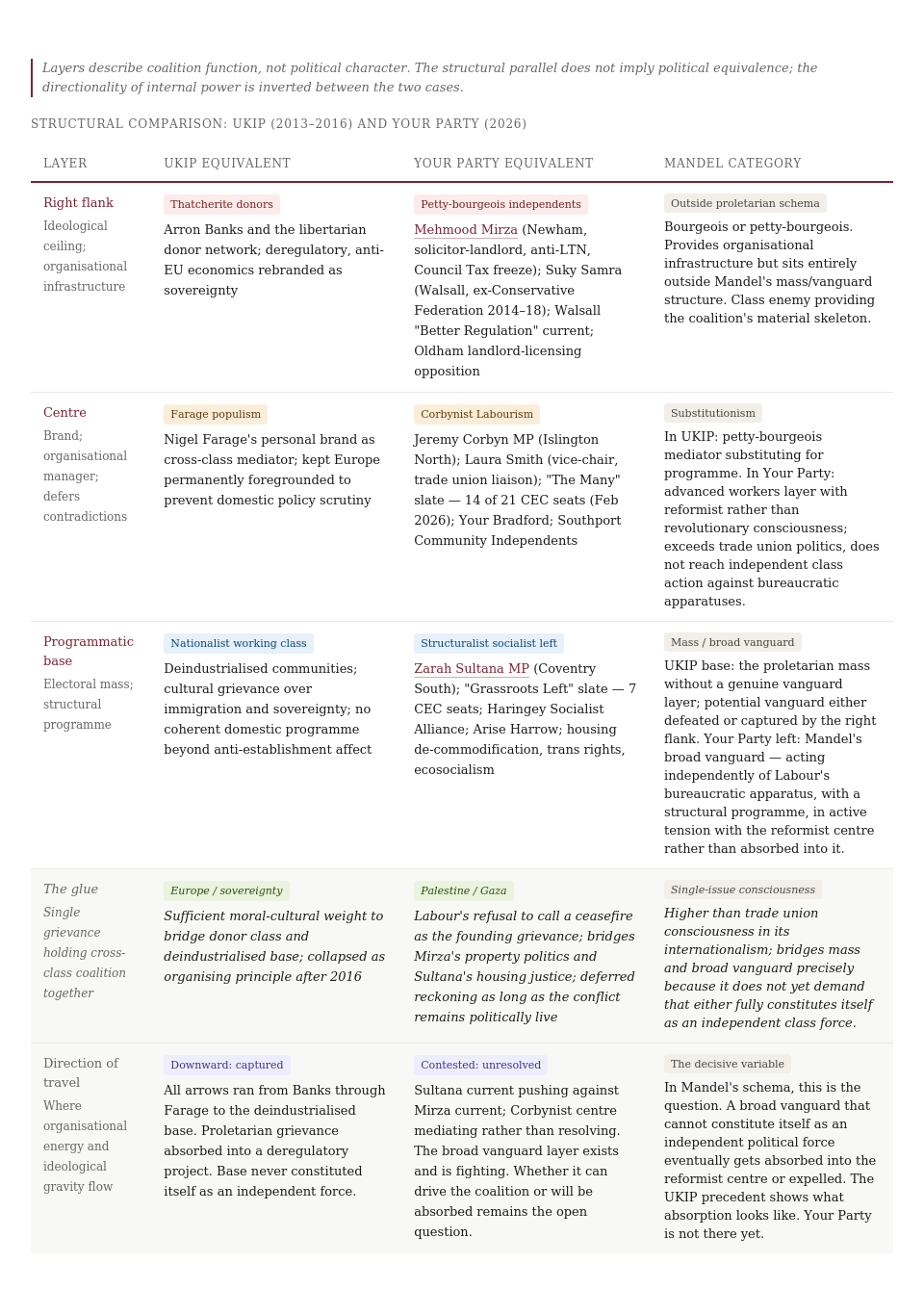
The British left has periodically fantasised about building a UKIP of the left: a cross-class populist formation assembled around a single moral grievance, capable of breaking Labour’s monopoly on working-class votes. Your Party, in 2026, has done something very close to this. The comparison is not an insult. It is an analytical category, and it should be taken seriously, because UKIP’s internal architecture is instructive. UKIP had three layers. A libertarian-Thatcherite donor class provided the funding and the ideological ceiling. A culturally nationalist working-class base provided the electoral mass. A Farage-brand populist centre held the formation together by keeping the single grievance, Europe, sovereignty, always in the foreground, deferring the moment when the class contradictions would become impossible to manage. Your Party’s three-layer structure maps almost exactly. Palestine has replaced Europe as the unifying affect. The institutional arrangements are doing the same work that Farage’s rhetorical genius did for UKIP: keeping the contradictions permanently deferred.
Three layers, two coalitions
The table below maps each formation's internal architecture against Ernest Mandel's categories of mass, vanguard, and substitutionism. The structural parallel does not imply political equivalence: in UKIP the arrows of organisational gravity ran downward and rightward; in Your Party, that question remains open and contested.
Who is actually in this party
The Sultana current, organised through the Grassroots Left slate, represents a genuinely structuralist socialist programme. Housing as a human right, de-commodification of land, rent controls, a socialist Green New Deal, democratic control of the energy transition, trans rights framed as class struggle. This is a coherent political project, and it speaks to a real constituency: marginalised working-class communities in highly deprived wards who understand that the same political establishment that arms Israel also manages their housing crisis. The Grassroots Left won seven seats in the February CEC elections. That is the organisational measure of where the genuine anticapitalist current currently stands within the formation it helped build.
The Corbynist centre, organised through The Many and its fourteen CEC seats, is a different political animal. Corbynism’s historic character is this: a redistributionist social democracy with a broad-church instinct, committed to the parliamentary road, allergic to programmatic clarity on questions of class. In 2017 and 2019 that instinct was a political strength. It assembled the largest Labour membership in British history and came within a newspaper proprietors’ campaign of government. In Your Party 2026, the same instinct functions as the ideological solvent that makes the coalition chemically stable. Corbynism will nationalise the utilities; it will not challenge property relations. It will defend the NHS; it will not name the class character of a solicitor-landlord opposing tenant licensing. This is not a failure of nerve. It is a structural feature of the Labourist tradition, the reason why every formation in that lineage, from the ILP to Militant to the Corbyn surge, eventually faces the question it cannot answer: what do you do when your coalition contains people with directly opposing material interests? The Many’s answer, so far, is to call it pluralism, manage it organisationally, and keep Gaza in the foreground.
Which brings us to layer three. In Newham, Mehmood Mirza, SRA-regulated solicitor and landlord of ten properties in the borough, remains on Your Party's list of endorsed candidates. In Walsall, on 14 February, Corbyn spoke at the Walsall Community Independents' campaign launch with three ex-Conservative councillors in the front row; the WCI posted publicly that "Jeremy Corbyn MP endorsed Walsall Community Independents and asked everyone to support Walsall Community Independents in the May 2026 Local Council Elections." Six days before the event, those same three ex-Tories had met with Your Party MP Ayoub Khan. When a leaflet emerged in April claiming Corbyn's personal endorsement, Your Party denied it; their spokesperson stated those candidates "weren't even in the group when Jeremy was there." Corbyn’s surrogates went into overdrive, even though the video and photographs from the February event show Corbyn endorsing the group and in a posed photo with the three former Conservatives. Incredibly, Your Party then endorsed the Walsall group. Separately, Obaydul Kabir, a confirmed ex-Conservative, remains formally listed as a "Your Party Candidate." The Oldham Group, which included ex-Tory Graham Sheldon, appeared on the endorsed groups list until public pressure forced its removal. So did the Pendle Community Independents. In Oldham, independent-aligned figures have campaigned against landlord licensing schemes, branding the one-off fee of up to £500 a "stealth tax" that "ramps up rents." The pattern is not a vetting failure. It is a vetting policy.
This is the language of the Federation of Small Businesses, not the labour movement. That it now appears on a Your Party-endorsed platform, delivered at an event where three ex-Conservative councillors sat in the front row, is not a coincidence. It is the coalition’s logic made visible.
The Palestine bridge and its limits
The Palestine question bridges all three layers. Shared moral outrage at Labour’s complicity in Gaza creates space for a solicitor-landlord and a housing justice activist to occupy the same electoral formation without the contradiction becoming immediately visible. For the petty-bourgeois flank, Palestine provides the moral credential that makes the Reform-style domestic programme legible as something other than what it is. For the marginalised working-class base, Palestine is the genuine central grievance, and the landlord politics are simply not yet the question being asked. For the Corbynist centre, Palestine is the unifying symbol that makes broad-church pluralism feel like political coherence rather than deferred contradiction.
But Palestine will not remain the organisational solvent indefinitely. When a ceasefire forces a pivot to domestic policy, when local elections require candidates to take simultaneous positions on housing regulation, transport infrastructure, and council taxation, the fault line between Mirza’s politics and Sultana’s will become the party’s defining crisis. The Oldham landlord opposing licensing fees and the Southport tenant organiser demanding rent controls are not two emphases within a shared socialist project. They represent opposing class interests. The moment that becomes the question, the Corbynist centre’s broad-church instinct becomes a liability rather than an asset, because Labourism has no theoretical resources for naming the class character of its own right flank. It never did.
Hussain’s “safe third spaces” are not a rift to be managed. They are a preview of what the transaction costs. The Corbynist leadership has bought organisational unity at the price of political clarity. UKIP held together until it won. Then it fell apart, because there was nothing underneath the single grievance to sustain a common political project. Your Party is not UKIP. But it has built, with considerable organisational skill and genuine moral energy, something with the same structural flaw. The question is not whether the contradictions will surface. It is whether the socialist left within the formation will have the organisational capacity to name them when they do.
The removals from the endorsed list, forced by organised pressure over the past week, show that the socialist left inside Your Party retains leverage the UKIP base never had. That matters. But leverage is not programme. The question is whether the Grassroots Left can convert the pressure that works on individual endorsements into the structural argument this weekend's CEC vote requires.
Postscript: On unity, Weimar, and who the SPD actually unified with
Since publication, a reader has argued that this article is “divisive” and that the left must unite against fascism, citing the Weimar Republic as the cautionary example.
The Weimar analogy is worth taking seriously. It is also, on inspection, an argument for this article rather than against it, as Ernest Mandel explained.
The SPD did not fail to stop Hitler because socialist critics refused to hold their tongues. It failed because of two specific decisions. First: in 1919, SPD Defence Minister Gustav Noske deployed the Freikorps to murder Rosa Luxemburg and Karl Liebknecht, destroying any basis for trust between the socialist parties for the decade that followed. Second: when the crisis came, the SPD’s instinct was not to build grassroots neighbourhood power but to seek accommodation with Hindenburg and the conservative establishment, the people it considered respectable, the people it thought could manage the situation. It unified with the right, not the left. The result was Hitler’s appointment as Chancellor by a conservative president who believed he could be controlled.
The parallel that should concern us is not the KPD’s sectarianism. It is the SPD’s preference for coalition with property owners over coalition with organised workers. A party that makes room for ex-Conservative councillors opposing tenant licensing while expelling the organised socialist tendencies most capable of building grassroots power in working-class neighbourhoods is not learning the lessons of Weimar. It is repeating the SPD’s specific error: choosing respectable allies over accountable ones, managing contradictions from above rather than resolving them from below.
Unity against fascism is not achieved by refusing to name the class character of your own coalition. It is achieved by building the kind of grassroots organisation in workplaces and neighbourhoods that can actually resist when the moment comes. The Walsall landlord in the front row at Corbyn’s February event will not build that organisation. The socialists expelled from Your Party this weekend might have.
Related Reading:
Listen to Grace, Not Zack: The Green Party’s left has a strategic choice to make. It probably does not know it is making it
Find Them, Link Them, Arm Them: Transitional demands, community terrain, and what Cymru can teach the left: Part 3 of “The Terrain of Survival”
The Invisible Hand: Socialist Action, Machine Politics, and the Battle for Your Party’s Soul: The most secretive organisation on the British left is running the campaign for ‘openness’. That...
Is everything a demand on the bourgeoisie until you’ve won power? : How the Socialist Federation and Greens can avoid Your Party’s mistake
Sinn Féin Shared a Platform With the Far Right and Said Nothing. People Before Profit Named Them as Frauds.: Fuel protests & the ghost of the gilets jaunes
And if all this wasn't bad enough Jeremy Corbyn and Your Party have so far refused to endorse the nine candidates of Islington Community Independents standing for election to Islington Council, even though most of them are also YP members. One of the nine candidates is Amu Gib, a prisoner for Palestine who was on hunger strike for 49 days and is still on remand awaiting trial. To her credit, Zara Sultana has publicly endorsed Amu Gib and now will be canvassing on their behalf in Islington. It's likely the Corbynistas will denounce Zara for parking her tank on Jeremy's lawn!
A defence of Corbyn in the Spotlight Socialist Network suggests that the Nazis could have been defeated through unity with people like these ex-Tory councillors. Our postscript replies: https://redmole.substack.com/i/193916332/postscript-on-unity-weimar-and-who-the-spd-actually-unified-with